
- LOGIN
- MemberShip
- 2026-05-18 18:57:17
- Policy
- Leclaza was listed at ₩68,964 per tablet
- by Kim, Jung-Ju Jun 29, 2021 05:46am
- Leclaza 80mg (Lazertinib) made with domestic technology passed the final step to insurance benefits. Leclaza finally chose this track, considering its similar clinical utility to the alternative drug Tagrisso, but cheaper with the Risk Sharing Agreement (RSA) Refund and Expenditure Cap. The date will be started on July 1, which means that the company succeeded six months after the approval in January. The MOHW announced on the 25th that the revised "Pharmaceuticla benefit list and upper price limit table" was proposed as a sub-issue of the 15th Health Insurance Policy Committee. Leclaza is a third-generation epithelial cell growth factor receptor (EGFR) tyrosynkina inhibitor (TKI) and received "conditional approval" from the MFDS on January 18 this year as a treatment for local progressive or metastatic non-small cell lung cancer. At that time, the company applied for insurance registration at the HIRA on December 30 last year, just before being licensed using the drug approval-patent linkage system. On 24 February, the HIRA held the Cancer Drugs Benefit Appraisal Committee to discuss the drug, and was judged on 8 April after deliberation by the Pharmaceutical Benefits Advisory Committee. The Pharmaceutical Benefits Advisory Committee determined that the clinical usefulness was similar to that of Tagrisso, an alternative drug, and that it was therapeutically equivalent to Tagrisso, which is currently being applied to RSA. Leclaza also concluded that following the RSA track would be cost effective at a lower cost than Tagrisso. Korean Cancer Study Group, Korean Society of Medical Oncology, and Korean Association for Lung Cancer suggested these opinions that similar effects have been shown compared to Tagrisso, and it is an additional treatment alternative that demonstrates safety results such as decreased cardiac toxicity and is more effective than treatment. It chose refund and expendature cap among RSA. The RSA Refund type is that a pharmaceutical company reimburses the NHIS for the full amount of pre-determined drug claims, and the Expenditure Cap reimburses the NHIS for a certain percentage of the excess if the actual claims exceed the pre-set annual expected cap. Since then, the MOHW has ordered negotiations on drug prices between the NHIS and the company and agreed on the estimated amount of claims for Refund and Expenditure Cap from April 23 to the 8th of this month. It has agreed that it will make $18.5 million (₩14.1 billion). The NHIS predicts no additional financial needs because there is an alternative drug, Tagrisso. Leclaza was insured from authorization in just half a year. The price is ₩68,964 per tablet, and the benefit will begin in earnest on the 1st of next month.
- Company
- Attention focused on children’s NIP flu vaccine supply
- by Whang, byung-woo Jun 29, 2021 05:46am
- With the bid for the 8 million doses of influenza vaccine for seniors under the National Immunization Program nearly compete, the pharmaceutical industry is intently focused on the supply amount and bid that will be set for the children’s NIP flu vaccines that will follow. According to the Korea Disease Control and Prevention Agency and the industry, the expected NIP quantity of influenza vaccines for those aged 6 months to 12 years will be around 4.6 million doses and will be supplied under a third-party Unit Price Contract. The reason why the pharmaceutical companies are paying attention to the NIP influenza vaccine (hereinafter referred to as flu vaccines) supply for children and adolescents is because the bid amount could affect the number of vaccines that will be released to the private sector in the future. Last year, due to concerns over a ‘Twindemic,’ where COVID-19 and influenza spread simultaneously, the subjects for NIP flu vaccines were temporarily expanded to include those in the 13 to 18-year range, increasing the supply by 1.54 million people’s worth. From this year's perspective, this means that if the flu vaccines for adolescents are removed from the NIP supply this year, that amount will now return to the private sector. Generally, the third-party unit price contract for children’s flu vaccines under the NIP are made without a procurement contract. When the pharmaceutical company supplies flu vaccines to vaccinating medical institutions, the institutions vaccinate eligible children and receive expenses for the vaccination and execution from their local public health centers. The pharmaceutical companies also receive the price for the vaccine from public health centers. When the pharmaceutical company supplies flu vaccines to vaccinating medical institutions, the institutions vaccinate eligible children and then receive expenses for the vaccine and its administration from their local public health centers. The pharmaceutical companies also receive the price for the vaccine from the public health centers. Currently, around 5.2 million children and adolescents are eligible to receive the NIP flu vaccine based on the resident registration statistics in May. The NIP inoculation rate is expected to be around 80% of the eligible population, which means that NIP will roughly require 4.2 million doses. Adding the 500,000 that need to be inoculated twice to the supply, the total amount required will be around 4.7 million doses. Most domestic companies will take part in the bid as NIP suppliers for the pediatric flu vaccines, and Sanofi, which is known to have ramped up its flu vaccine volume by nearly 30% in the absence of SK Bioscience, is also expected to participate in the bid. The pharmaceutical industry expects the total vaccine supply, including the NIP amount, will be around 26 million doses this year. Taking into account the various factors, some believe that the competition among pharmaceutical companies will intensify as the number of flu vaccines released into the private market will be much greater than expected compared to the previous year. However, there also lies the possibility that these expectations will be reversed, as the eligibility age for NIP may continue to be expanded this year in line with the probable approval of the supplementary budget. Analysts predict that supplementary budget requests this year will not be rejected as the Ministry of Economy and Finance had underestimated last year's tax revenue by around 32 trillion won and will be reflecting this amount in the budget. At least, the NIP vaccine age expansion plan will unlikely be rejected due to the lack of a budget. In addition, NA member Jong Sung Lee of the People Power Party had pointed out that NIP for adolescents was virtually nonexistent except for the supplementary budget bill approved in 2020 to inoculate adolescents aged 14 – 18 years old. This pressure from the NA may also be positively reflected in the supplementary budget request. An official from a domestic pharmaceutical company said, “The total NIP amount will be determined according to whether the NIP age range will be expanded or not. The rest will be distributed in the private market. It’s not about whether we agree or disagree to the age expansion plan – the nay or yay needs to be sorted out as soon as possible so we can plan measures accordingly.” Also, the pharmaceutical industry believes that COVID-19 vaccination will be an important variable in establishing a competitive strategy for the flu vaccine market. “This year’s flu vaccine market size may be determined by the COVID-19 vaccination rate this year," a Sanofi official said. "The government will need to provide guidelines for inoculations as the COVID-19 vaccination completion period coincides with the flu vaccination period that was announced by the government."
- Policy
- Following Gilead's hepatitis C tx Epclusa, Vosevi was filed
- by Lee, Tak-Sun Jun 28, 2021 05:50am
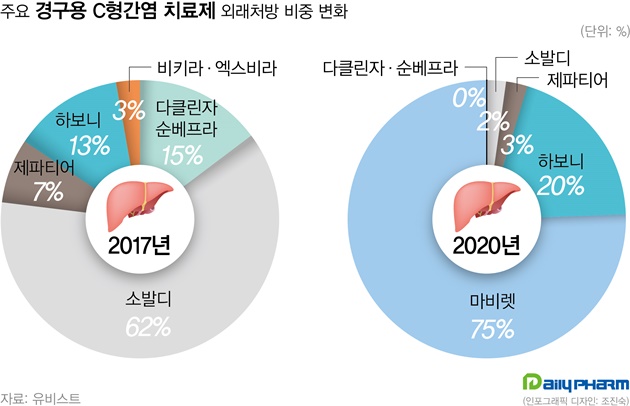
- This year, hepatitis C drugs Epclusa and Vosevi have been filed by the MFDS in Korea. These items are expected to replace Sovaldi. According to the industry on the 27th, Gilead's Vosevi (Sofosbuvir/Velpatasvir/Voxilaprevir) has recently been filed and will begin screening in earnest. Vosevi is expected to be a Pangenotypic DAA preparation that can be used in patients who fail to treat existing Direct-Acting Antiviral (DAA) drugs. AbbVie's Mavyret, a phangenotypic inhibitor, is now the market leading item. And, Mavyret is applicable to both chronic hepatitis C virus genotypes 1, 2, 3, 4, 5 and 6. For Gilead's Sovaldi, it is only valid for type 1, 2, 3 and 4 and must be administered simultaneously with Ribavirin. For this reason, Mavyret currently occupies 75% of the domestic hepatitis C treatment market based on UBIST last year. Sovaldi, by contrast, stood at 2%. Sovaldi had a 62% market share in 2017. Gilead's other hepatitis C drug, Harvoni, came in second with a 20% share after Mavyret last year. Epclusa (Velpatasvir + Sofosbuvir) was also received. Epclusa is also a pangenotypic treatment that can be administered regardless of genotype, a competitive drug for Mavyret. If the two drugs are registered in Korea, it is predicted that they will replace performance of Sovaldi and Harvoni. Although the market for hepatitis C drugs is decreasing in size due to the decrease in the number of patients due to effective drugs, it is attractive for pharmaceutical companies as Mavyret achieved ₩32.6 billion in outpatient prescription last year. As Gilead prepares a new drug, the domestic hepatitis C treatment market is expected to enter fierce competition again.
- Policy
- 16 drugs including Venclexta receive reimbursement in 1H
- by Kim, Jung-Ju Jun 28, 2021 05:50am
- A total of 14 products were newly listed on the insurance benefit list to improve patient access in the first half of this year. Also, two drugs benefited from the reimbursement criteria expansion that was applied to already-listed new drugs. This expanded coverage is interpreted as a result of the government’s decision to flexibly apply coverage for drugs according to the patients’ needs and social importance. The government estimates that around 760,000 patients in Korea will be benefiting from the change. The coverage will financially cost around 115.6 billion won per year, which indicates that the coverage expansion for drugs is being carried out faster than the previous year. During the first half of this year, from January to June, a total of 16 drugs (based on each drug’s representative strengths) were listed on the drug benefit list. These include new drugs that were newly listed and those whose criteria (indication, administration criteria, etc) were expanded to enhance coverage. New drugs that were newly listed this month include the hemophilia A treatment Afstlya inj.; bacteremia treatment Daptocin inj., Boryung Daptomycin inj., and Dapto Inj.; nocturnal hemoglobinuria treatment Ultomiris inj.; and hyperlipidemia treatment Praluent Pen inj.. Also, the reimbursement criteria for the already-listed choric lymphocytic leukemia treatment Venclexta tab. was expanded to enhance coverage. The number of domestic patients expected to use the drugs that were newly listed or received expanded reimbursement varies greatly by product. For the Venclexta tab., the number of patients that will benefit from the expanded reimbursement is expected to be around 75. Also, the number of patients to benefit from the newly listed Ultomiris is 92. Contrary to such drugs that are expected to benefit less than 100 patients, the glaucoma treatment Eybelis Eye Drops is expected to benefit around 45,000 patients. Also, the blood sugar regulator Xultophy Flex Touch inj. that was newly listed in May is expected to benefit 12,756 patients, and Parkinson treatment Equfina Film Coated tab. that started its reimbursement process in January this year is expected to benefit 7,000 patients. The number of beneficiaries greatly varies due to policies that now allow flexible expansion of NHI coverage to high-price drugs that are used for a small number of rare diseases, that were established based on the increased social maturity that can now accept such policies. Due to the new listings and expanded benefit criteria, the government and payer are expected to spend around 115.6 billion won a year to grant access to around 76,769 patients.
- Company
- MET inhibitor ‘Tabrecta’ to overcome Tagrisso resistance?
- by Jun 28, 2021 05:50am
- A study that attempts to address the resistance issue by using the first-ever MET inhibitor ‘Tabrecta’ in combination with the EGFR-TKI ‘Tagrisso,’ will be conducted in Korea. According to the Ministry of Drug and Food Safety on the 25th, Novartis Korea’s application to conduct a Phase III trial on its non-small cell lung cancer treatment ‘Tabrecta (capmatinib)’ was approved that day. Tabrecta is the first-ever MET inhibitor to be approved by the U.S. FDA and was approved in June last year. In Korea, the drug has been designated as an orphan drug by the MFDS in the pre-approval stage. The new clinical trial that will be conducted by Novartis will be studying Tabrecta in combination with Tagrisso (Osimertinib). More specifically, the study will evaluate the treatment effect of Tabrecta+Tagrisso in comparison to platinum-based chemotherapy in patients with non-small-cell lung cancer (NSCLC) with epidermal growth factor receptor (EGFR) mutation, T790M negative, mesenchymal-to-epithelial transition factor (MET)-amplified who progressed following treatment with 1st/2nd generation EGFR tyrosine kinase inhibitors (TKIs) or Tagrisso. MET amplification is one of the known causes of EGFR TKI resistance, in which an EGFR-inhibited cancer cell activates alternative signaling pathways to escape inhibition. It is found in around 25% of all patients treated with Tagrisso and is considered the most commonly observed alteration with C797S mutations associated with resistance to Tagrisso. No treatment that targets the abovementioned mutations currently exists, therefore, patients who develop resistance have no option but to use cytotoxic agents. Thus, work to address these Tagrisso-resistant mutations has been continuing around the world. AstraZeneca is currently conducting a Phase II study on combination therapy using Tagrisso with its new MET inhibitor drug substance ‘savolitinib (product name: Orpathys).’ Savolatinib is a new lung cancer drug in development by AstraZeneca and the Chinese pharmaceutical company, Hutchison China MediTech (Chi-Med). The drug received its first approval in China on the 24th. In the first cohort study that was conducted initially on 46 patients, the combination was associated with an objective response rate (ORR) of 52% with 24 partial responses The median duration of response (DOR) was 7.1 months. In the second, the combination yielded an ORR of 28%, with 12 partial responses. The median DOR was 9.7 months However, the savolitinib+Tagrisso combination showed more side effects in the cohort study. Jassen and Yuhan Corp. is also developing a combination of Rybrevant (amivantamab) and Leclaza (Lazertinib) that targets MET amplification. According to a paper recently published at the 2021 American Society of Clinical Oncology (ASCO) Annual Meeting, the combination resulted in a 36% ORR, with one complete response and 15 partial responses. Rybrevant and Leclaza are each currently approved in the U.S and Korea.
- Policy
- Billing for α-GPC is managed
- by Lee, Jeong-Hwan Jun 28, 2021 05:50am
- The HIRA plans to consider the need to manage claims by selecting Choline alfoscerate, which is under controversy over reducing adaptation certificates, as the "selection focused item." The MFDS plans to periodically monitor pharmaceutical companies that have been clinically reassessed, block unnecessary clinical extensions, and take administrative action against pharmaceutical companies that have failed to reassess. On the 24th, the HIRA and the MFDS responded to Nam In-soon's criticism of the Democratic Party of Korea about Choline alfoscerate. She ordered the HIRA to review and implement follow-up measures to prevent Choline alfoscerate from prescribing drugs based on reduced benefit due to the lack of proven efficacy and effectiveness of other than dementia. The HIRA said it will collect opinions from the public and medical circles and decide whether to select and manage Choline alfoscerate as a selective target after deliberation and resolution process of the central screening coordinator committee. It is a proactive screening system that selects items that need to improve medical trends, such as increased medical expenses, screening problems, and social issues, and makes intensive screening after prior notice to induce improvement in autonomous medical trends of medical institutions. The HIRA will make efforts to make sure that Choline alfoscerate is not prescribed for other than dementia in front-line medical institutions. In addition, the HIRA said it is currently monitoring claims, amounts, and actual number of employees after the suspension of execution of Choline alfoscerate's benefit standard notice. "We will continue to monitor Choline alfoscerate's claims and come up with follow-up measures with related agencies," The HIRA said. "We will continue to re-evaluate the benefit adequacy of the system to streamline spending structure for health insurance fiscal sustainability of health insurance." She ordered the MFDS to block pharmaceutical companies from indiscriminately extending the clinical re-evaluation period of Choline alfoscerate and start managing pharmaceutical companies that have not submitted clinical plans. The MFDS said it will monitor the progress of clinical re-evaluation periodically and speed up the process of changing or canceling permits if it is deemed ineffective or insufficient. The MFDS said 11 items from eight companies that did not participate in the clinical re-evaluation are being subject to secondary administrative measures under the Pharmaceous Affairs law. The first disposal will be suspended for two months, the second disposal will be suspended for six months, and the third disposal will be revoked. The MFDS announced on the 10th that it had previously notified the procedure of changing permission to delete "emotional and behavioral changes, senile caustic depression," which is not included in the scope of clinical re-evaluation. The intention is that there is a need for management only for "secondary symptoms and metamorphic or degenerative cerebral substrate syndrome caused by cerebrovascular deficits" where clinical re-evaluation has been decided. The MFDS said, "To reevaluate the validity quickly, we adjusted and approved the clinical trial period after consulting experts based on the progress of clinical trials of similar adaptive items and data on insurance claims by the HIRA." The MFDS replied, "We will closely review the re-evaluation process and take administrative action against non-submitted pharmaceutical companies."
- Policy
- The number of items has plummeted due to regulatory impact
- by Lee, Tak-Sun Jun 28, 2021 05:49am
- Recently, More and more items are being removed due to the expiration date. Pharmaceutical companies have sorted out the items due to strong regulations on impurities and penalties for drug prices of consignment items. According to the MFDS on the 23rd, a total of 63 new drugs have been approved this month. On the contrary, there are 226 items which permits have been deleted, almost four times more. From January 1 to June 23 this year, 1,224 items were licensed. On the other hand, 2,229 items were deleted, nearly doubling. Most of the deleted items have expired five-year period, and they have not submitted data that proves the safety and validity of the license renewal. Since 2018, the MFDS has operated a renewal system for item evaluation and has been evaluating it every five years. Pharmaceutical companies are required to submit data such as safety management, quality, and status of foreign use to renew their permits. As a result, items withdrawing from the market are often given up their permits. Analysts say that this pattern has become worse recently. An industry official said, "We submitted an evaluation of the possibility of impurities for all medicines by June, and decided not to renew the license because some items are difficult to proceed." An official from another company said, "Most of the consignment items are given permission as penalties are given at drug prices." "There have been far more cases of deletion recently because there are no items to put on the market," he said. Items subject to regulation due to the detection of impurities are likely to be removed. Satan or Tidin drugs, which have been a problem recently, are representative. Even if these items are sold, lot release is possible only when tests prove that there are no impurities.
- Company
- Intra-articular injection Conjuran can be reimbursed
- by Moon, sung-ho Jun 28, 2021 05:49am
- As the age of aging population begins in earnest, the number of osteoarthritis patients is increasing, and the market for related treatments is also heating up. Competition among pharmaceutical companies is fierce as various products of "Intra-articular injection," which has recently been in the spotlight, are newly included in the benefit. According to the pharmaceutical industry on the 23rd, the HIRA has recently been confirmed to have changed the reimbursement standard related to "treatment materials for Intra-articular," which is called joint strength injections, since June. Collagen is added to the existing intra-pulmonary infusion treatment material. Specifically, patients with knee osteoarthritis were added not only sodium polynucleotide but also collagen, including a total of two components of joint strength injections. An official from the HIRA said, "The addition of collagen is the result of the application for the benefit registration while the related products are recognized as new medical technology." The HIRA clarified the method and number of injections with Polynucleotide administered up to five doses per six months and collagen administered up to five doses per six months (within 180 mg of total collagen dose). These categories set patient copayment rate of 80% for Selective Health Benefit targets. PharmaReaserch's Conjuran is a Polynucleotide-based joint strength injection, and CartiZol is a collagen-based joint strength injection. Among them, PharmaReaserch's Conjuran has been subject to Selective Health Benefit since the second half of last year, leading the osteoarthritis treatment market as the administration of patients has increased, led by orthopedic and rehabilitation clinics. Recently, it had an influence on general hospitals by conducting a co-promotion with SK chemicall. Conjuran began competition with Sewoncellontech's CartiZol, a collagen-based injection of joint strength. Due to the increase in arthritis patients due to the aging population, competitors such as CGBIO also predicted challenges in the joint steel injection market. Osteoarthritis treatments market is growing. According to the NHIS, the number of arthritis patients increased by about 10% in five years from 4.4 million in 2014 to 4.86 million in 2018. "As the population ages and the number of patients with knee osteoarthritis increases, joint strength injections are in the spotlight recently," an official from a pharmaceutical company said. "In particular, the treatment market will begin to compete with companies." "The current market for this treatment is worth ₩100 billion a year, and it will grow year by year," he predicted
- Company
- Will the new social distancing benefit the prescription mkt?
- by Chon, Seung-Hyun Jun 25, 2021 05:51am
- New social distancing rules will be applied from next month. The restrictions set on private gatherings will be eased, and the operating hours of multi-use facilities will also be extended. The pharmaceutical industry has its eyes on whether the outpatient prescription market, which has contracted due to a decrease in outdoor activities, will take a turn for the better under the new regulations. According to the pharmaceutical research institution UBIST on the 21st, outpatient prescription in May this year was around 1.15 trillion won, down 1.1% YoY. This is a 10.4% fall compared to the market’s performance in May 2 years ago. This downward trend has been continuing since last month, as outpatient prescription in April was also reduced by 0.3% YoY to record 1.18 trillion won. The accumulated outpatient prescription in May this year was 5.91 trillion won, down 2.4% from the same period of the previous year. The aggregate prescription sales in May were 5.91 trillion won, down 2.4% YoY. The prescription market was hit the hardest in April to May last year due to the aftermath of the COVID-19 outbreak. Monthly outpatient prescription sales trend (Unit: 100 million won, Source: UBIST) Prescription in April and May last year were each lower by 8.7% and 9.4% YoY. At that time, with the COVID-19 spreading in full pace, patients with chronic diseases such as hypertension and diabetes chose to avoid visiting medical institutions by receiving prescriptions for the long-term, creating a void in the prescription market. However, performance in April and May this year are even worse off than the prescription void period of the previous year. The prescription market, in general, has been sluggish compared to the previous year. Prescription sales in January and February this year were also down by 7.0% and 5.6% YoY, respectively. Experts pointed to the prolonged COVID-19 as the cause of sluggish sales in January and February this year. The increased interest in personal hygiene after the spread of COVID-19, including hand-washing and mask-wearing, may have greatly reduced the incidence of infectious diseases, leading to a decrease in visits to medical institutions. Although the performance had improved temporarily in March, marking a 1.9% increase, sales has again turned downward from April. Analysis predict that the increased personal hygiene management in the prolonged COVID-19 will inevitably continue to impact the prescription market for infectious diseases, etc., even though the flu season had ended. Another reason that was raised was that the social distancing level that was elevated since the end of last year due to a surge in COVID-19 cases may have led to decreased visits to medical institution. However, with eased social distancing restrictions to be applied from next month, many are expecting the prescription market to pick up. According to the Ministry of Health and Welfare’s Central Disaster and Safety Countermeasures Headquarters (CDSCH), a new, 4-level social distancing plan will be applied from next month. The key indicator used will be the weekly daily average confirmed cases per 100,000 people. Level 1 applies when the rate is less than one in 100,000, Level 2 when the rate is between 1 and 1.9, Level 3 when the rate is between 2 and 3.9, and Level 4 for 4 or greater. In the capital area, Level 1 will be applied if the weekly daily average is less than 250, Level 2 for 250 or more, Level 3 for 500 or more, and Level 4 for 1,000 or more. Regarding private gatherings, no restriction will apply in Level 1, and up to 8 people may meet at Level 2. Local governments may choose not to apply the 8-person restriction at their own discretion. In other words, the restrictions on private gatherings for 5 or more people that was enforced since December 23rd of last year may be eased down from next year. Also, the closing hours may be extended for multi-use facilities. Industry officials expect the increase in outdoor activities will increase the number of visits to medical institutions, and benefit the prescription market. Many believe that the sluggish sales in the prescription market will not continue long as drug use continues to increase with the increase in the elderly population and people with chronic conditions. Contrary to the tourism and culture industry, which is facing an extreme crisis after the COVID-19 outbreak, the pharmaceutical industry is more influenced by the patients’ demand rather than the external environment. Therefore, experts believe, the continued social distancing restrictions set in Korea will not lead to a sudden recession of the pharmaceutical market. Also, hopes that that the prescription market will rebound due to increased COVID-19 vaccination area also present. Recently, vaccination has sped up, and the cumulative total number of those vaccinated exceeded 15 million. This means that over 15 million people visited medical institutions in about four months since March, when vaccinations first begun. With more patients visiting medical institutions for COVID-19 vaccinations, some expect this will also lead to an increase in other drug use. An industry official said, “There is a high possibility that the prescription market will recover as some people who have been hesitant to visit hospitals due to COVID-19 have been requesting additional prescriptions for their usual medications during their vaccination visits.”
- Company
- Telemisartan is excluded from impurity survey
- by Kim, Jin-Gu Jun 25, 2021 05:51am
- The MFDS has expanded the scope of the impurity investigation to ARB drugs as a whole. However, Telmisartan·Azilsartan·Eprosartan were excluded from the list of additional investigations. The pharmaceutical industry understands that Telmisartan was excluded from the impurity survey because it does not have a tetrazole ring. The MFDS said on the 23rd, an official letter was sent to analyze and evaluate the possibility of impurities occurring in Olmesartan, Fimasartan, and Candesartan. The company that owns the drug in question shall analyze and submit the possibility of 'AZBT/Azido Methyl Bipheny Tetrazole' by the 22nd of next month. The scope of impurity investigation has been expanded from the existing Irbesartan·Losartan·Valsartan to the entire ARBs. A total of nine ARB-based drugs are licensed in South Korea. Losartan, Valsartan, Azilsartan, Eprosartan, Olmesartan, Fimasartan, Candesartan, Irbesartan and Telmisartan. Telmisartan, Eprosartan and Azilsartan were excluded from further investigations by the MFDS. 797 products containing Telmisartan such as Micardis, 5 Azilsartan products such as Edarbi, and 2 items of Eprosartan such as Teveten do not need to be further investigated. ◆AZBT and NDMA can occur during the synthesis of tetrazole rings Tetrazole ring molecular structure. Many ARBs contain this molecular structurThe pharmaceutical industry understands that the shape of each component's molecular structure influenced the MFDS' decision on the scope of the investigation. The MFDS ordered an investigation into impurities, limiting only ingredients with "tetrazole rings" in molecular structure. The MFDS estimated that Azido impurities are produced by reacting 'Br-OTBN (4'-Bromomethyl-2-cyano-biphenyl) and 'Sodium Azide (NaN3). Br-OTBN is the main intermediate in the synthesis of tetrazole rings. Add a reagent called Sodium Azide and the tetrazole ring is synthesized. In other words, the reagent (azide) used to synthesize tetrazole rings may have been produced as a "suspicious substance (AZBT)" in response to certain conditions. It is estimated that NDMA (N-Nitrosodimethylamine), which was detected during the Valsartan crisis in 2018, also occurred after a similar process. At that time, the MFDS (DMF), which was used as a solvent to make the tetrazole ring, was decomposed into dimethylamine during the high temperature process, and was produced by reacting to NaNO2. The same is true of NDEA (Nitrosodiethylamine). It is believed to have been produced by reacting to the impurities dimethylamine and nitrite contained in the triethanolamine (TEA) itself used as reagents. The MFDS judges that ARB drugs, including tetrazole rings, are likely to develop AZBT or NDMA and NDA at any time. ◆Of 9 ARB drugs, six contain tetrazole rings Looking at the molecular structure of ARB drugs, tetrazole rings are found only in Eprosartan, Olmesartan,Fimasartan,Candesartan,Irbesartan, Losartan. This is not the case with Telmisartan, Azilsartan, and Eprosartan. The tetrazole ring determines whether the Ministry of Food and Drug Safety will order an investigation into the possibility of impurities. An official from a pharmaceutical company said, "Even if it is the same ingredient, the possibility of detecting impurities is divided depending on which reagent or solvent is used." "In addition, the possibility of occurrence varies depending on whether or not there is a tetrazole ring in the molecular structure. "In Telmisartan's case, there is little chance of impurities occurring because there is no tetrazole ring."
