
- LOGIN
- MemberShip
- 2026-05-21 02:27:34

- Company
- Is MFDS going to suspend sales on nizatidine with no NDMA?
- by Chon, Seung-Hyun Nov 06, 2019 08:59am
- Pharmaceutical industry is walking on thin ice as the government initiated impurity investigation on stomach ulcer medicine. Now that the U.S. detected impurity in nizatidine, following a case in Japan, probability of finding impurity in nizatidine has gotten higher in Korea. The industry is on high alert against the government’s possible order to suspend sales of nizatidine drug without detecting any impurity, which was the case with ranitidine. According to an industry insider, Ministry of Food and Drug Safety (MFDS) ordered pharmaceutical companies to submit complete nizatidine product manufacturing record and to test active pharmaceutical ingredient (API) chemically similar to the ingredient. MFDS ordered companies to submit API usage record and other archived evidences to confirm manufacturing record until Nov. 4. The ministry seems to be investigating uses of all complete product with both Korean-made and imported nizatidine Nizatidine is an H2-receptor antagonist similar to ranitidine suspended of sales from last September. After deciding to suspend sales of all ranitidine drugs, MFDS also set a plan to investigate similar APIs, starting with nizatidine first. Ministry’s nizatidine usage record investigation resembles that of ranitidine’s. On last Sept. 20, MFDS directed pharmaceutical companies to investigate ranitidine API usage record, and six days after on Sept. 26, the ministry announced sales suspension on all ranitidine items. The industry presumes MFDS is about to announce nizatidine investigation result based on the precedent case. And now, the industry is nervously waiting for the ministry’s decision on nizatidine items. .Possibility of finding N-Nitrosodimethylamine (NDMA) has been raised at home and aboard, already .A private U.S.-based research institute, Valisure unveiled their testing report on nizatidine last September and stated they have detected NDMA .Previously, Valisure proposed regulators to recall ranitidine as it detected excessive level of NDMA in the API .Their latest report state researchers found one-seventieth of NDMA in ranitidine was detected in nizatidine .Japanese Ministry of Health, Labour and Welfare announced Japan-based Ohara Pharmaceutical tested their nizatidine product and detected NDMA exceeding the accepted level .The ministry reported the company decided to voluntarily recall their products due to the issue .On Nov .4, the U.S .Food and Drug Administration (FDA) released a statement about their investigation on NDMA found in ranitidine, and stated four nizatidine items from two companies had NDMA .However, the said nizatidine drugs had NDMA within the accepted level and were not included in the voluntary recall subject group .Some of pharmaceutical companies in Korea are promoting that their nizatidine drugs are NDMA free .However, some have raised concern about possibility of detecting NDMA in nizatidine ingredient used in Korea .At the moment, total nine API manufacturing plants have been registered to produce nizatidine .Korean Medical Association (KMA) has already advised doctors to refrain from prescribing nizatidine .In last month, KMA official said “The recent ranitidine incident has created a social turmoil, so the organization advised members to refrain from prescribing nizatidine containing drugs until MFSD announces final investigation result and its further action” .Pharmaceutical companies are keeping a close eye on MFDS’ further action for when finding minuscule amount of NDMA in nizatidine .The companies are afraid of the ministry ordering sales suspension on all nizatidine drugs for questionable cases of NDMA not detected from most of the complete product, and a single manufacturing unit containing minuscule amount of NDMA exceeding acceptable level .As for ranitidine drugs, all seven manufacturing plants had NDMA surpassing acceptable level in the API, but each item manufactured in a same plant had different levels of NDMA .For instance, some ranitidine drugs manufactured from one plant were found with unacceptable level of impurity and others were not .Result of NDMA investigation on collected ranitidine API (Source: MFDS)At the time, MFDS official stated “After collecting issue API and investigating them, each registered items from one manufacturing plant had different levels of NDMA and similar cases have also been found in other countries” .After making the statement, the ministry ordered sales suspension on all ranitidine drugs, judging that ranitidine itself is too unstable to be consumed .A pharmaceutical research institute, UBIST reported last year’s volume of nizatidine drug prescription for outpatient reached 25.9 billion won .Although it would be about one tenth of the ranitidine market, some pharmaceutical companies are faced with serious damage from sales suspension on popular nizatidine products .Pharmaceutical companies continue to urge the Korean regulators to suspend sales limited to items exceeding acceptable NDMA level like the case in the U.S .Some of the industry is also questioning credibility of the NDMA testing methodology as same API has been detected with different levels of NDMA .A pharmaceutical industry insider stressed, “MFDS has decided to suspend sales on valsartan and ranitidine drugs, regardless of each sample showing different level of the carcinogen .The regulators should use more precise investigative methodology and limit penalty to items with exceeding level of NDMA only” .
- Dreaming of making a brighter world together with patient
- by Kim, Jin-Gu Nov 04, 2019 03:12pm
- About 40 patients with retinal degeneration and medical professions were taking a group walk on Namsan hiking trail. No one could tell who was the patient or doctor. Each seemed to be enjoying pleasant fall breeze brushing over their face. President Yu Hyeong-gon of Korean Association of Retinal Degeneration (KARD) hosted an event, ‘Making a Brighter World’, for his organization. A president of KARD and an ophthalmology professor at Seoul National University Hospital, Yu said, “As you can see, distinguishing a patient or non-patient is meaningless. We both can be considered non-patient as for retinal degeneration, but we could be a patient with other health issue”. KARD, the organization he leads differentiates itself from other patient group or academic society. Member consists of mix between patients and doctors, but at the same time doctors are not the face of the organization. While studying inherited retinal degenerations (IRDs), KARD also advocates for patient support and social awareness. During the interview, President Yu Hyeong-gon constantly emphasized the value his organization strives on; ‘making a society embracing both patients and non-patients’. ▶How about a short introduction of your organization? “Korean Association of Retinal Degeneration, or KARD, is a research organization that also supports severe retinal degeneration treatment. First it started as a small-scale study group for medical professions. The members contemplated much about providing practical support to patients. So the original members all agreed to make it a public interest group. And without any other outside donation, each professor put down some money and made an incorporated association. “Usually an academic society is formed centering doctors. But KARD wanted to take a step further and make a group for actual patients to participate in. In fact in the U.S., there are plenty of groups where patients and healthcare providers come together. The organization got bigger as time passed, and now we have 50 university hospital medical professions and bioengineering researchers, along with 30 patients as members. And there are some outside sponsors, KARD has numerous ongoing projects varying from treatment research to retinal degeneration awareness training and public relations for general public, and even to policy making.” ▶What inspired the ‘Making a Brighter World’ event? “The name of the event, ‘Making a Brighter World’ has two meanings; one is to bring a ray of light to patients with visual impairment by providing effective treatment, and another is to make a warmer society by bringing disabled, sick and healthy people together. That is how the name came about. “This marks a sixth event. In last five events, patients and non-patients took a walk together and tried rowing and tap dancing together. All events had different activities, but what meant the most is spending the time together”. ▶Apparently there is no clearly proven treatment for IRDs. But recent news reported now there are new treatments available like retina implant and gene therapy. “Gene therapy was developed first than the other. It has been about a year and a half. We predict it would be introduced to Korea at earliest next year. Apparently, about 260 out of 300,000 genes cause IRDs. And one of them is identified as ‘RP65’. “Currently approved treatment targets defect in gene RP65. It treats to prevent death of photoreceptor cell and recovers its function to a certain level. Eye sight may get better a bit, but the treatment cannot completely revive dead cells. But, it is still quite meaningful. Because most of retinal mutation is found after 20s, even a bit of improvement in sight helps the patient’s later life. “Prosthetic retina implant has been experimented many times, before gene therapy was as developed as now. A chip is inserted to replace dead photoreceptors. It literally stimulates cells to see artificially. And because the chip would replace photoreceptor cells, the principle is to conduct the procedure after the cell is completely lost. However, the procedure is quite burdensome without healthcare coverage”. ▶Going back to the medical condition, are symptoms mainly found in adulthood as you mentioned? “Most of patients recognize the condition after their early 20s. Some rare cases have detected symptom when they were younger than one. It is a condition called ‘Leber Congenital Amaurosis (LCA).’ Symptoms and progression are similar to normal retinal degeneration, but it starts at a very young age. And if it is the RP65 causing the condition, then the said gene therapy can be tried”. ▶You mentioned 260 out of 300,000 genes are responsible for IRDs and one of them is RP65. Then, out of a hundred IRDs patient, how many could use the gene therapy? “It would be about one out of hundred. Or maybe even less. It may seem significantly low, but having one effective treatment out makes a difference. After a success of this treatment, many pharmaceutical companies have initiated a pipeline on IRDs. At the moment, 26 ongoing clinical trials are conducted around the world. And the trials not only focus on RP65, but also on a gene called ‘MYO7A’”. ▶Is there any research done by the organization independently? “To be honest, independently researching a treatment is not that easy. It requires advanced facilities and tools, and the cost is exponential. So whenever there is a chance, we conduct a joint research with overseas research institute. “Also we are actively participating in clinical trials. Specifically, the organization has its own medical image analysis center for clinical trials. In Korea, Chong Kun Dang Pharmaceutical is conducting a clinical trial on biosimilars. 27 university-affiliated hospitals are part of the study. And there are other Korean companies running clinical trial on three or four other medicine. And of course, multinational pharmaceutical companies are developing many more medicine”. ▶Heard there is an ongoing cohort study. Have you found any new findings specifically for Korean patients? “General prevalence rate is not far off from cases in other countries. Studies have found about one out of 2,000 has a severe IRDs, and one out of a thousand has not-so-severe IRDs. And I published a book summarizing key findings of the condition. “Many cases of IRDs have different causes. Most of the cases were caused by uveitis, an eye infection, and sometimes it is found as symptoms of malnutrition, syphilis, tuberculosis, and other infectious diseases”. ▶Any notable plan in the future? “A patient has to take 200 genetic testing to get diagnosed with IRDs. They cost about a little less than one million won per patient. The cost is quite steep. The organization is trying to sponsor the diagnostic tests for some patients. We wish we can cover all patients, but the organization is not that well off. But still our goal is to support as many patients as possible. We are currently raising fund for 200 patients’ testing. “KARD is now six years old. When we turned a research group to a full-blown organization, we did not know what to expect. But for sure, what we wanted out of it was for the sake of the public. The organization’s schedule is getting full with events like ‘Making a Brighter World’, symposium and group counseling. And we are now ready take the organization into another level. So we could finally conduct creative research we have wanted to do”. ▶And lastly, few words to patients? “It must be difficult without a clear treatment, yet. But more treatments are getting coming soon. Please do not let go of your hope. KARD is here to provide various information and support for treatment. “What matters the most is the ‘togetherness’. Segregating patients and non-patients does not mean much. Retina degeneration could make one a patient, but other diseases could make anyone a patient. We hope we can bridge patients and non-patients for more help to be shared. “I would also like to express my gratitude for all active patient members of KARD. Many patients first join the organization for their individual agenda. But as time passes, more of them try to help other patients based on their experience. I know it is not that easy. It is a right thing to do, but not everyone can do it. We are just trying to be together and help each other. We believe the day would come when we get good results for all endeavors”.

- Company
- Biosimilar Ultomiris to follow Soliris next year at earliest
- by Kim, Jin-Gu Nov 04, 2019 03:12pm
- Sources predict Ultomiris would enter the Korean market and a competition against a blockbuster antibody, Soliris, next year. According to pharmaceutical industry on Oct. 30, the drug manufacturer of Ultomiris, Alexion is preparing for a launch in Korea at the end of next year. The follow-on antibody drug already has been approved by FDA in the U.S. and by EMA in Europe last December and July, respectively. Like the case with Soliris, Handok is highly likely to manage Ultomiris’ approval and healthcare reimbursement application in Korea, but sales and marketing company has not been decided, yet. Currently, Handok is in charge of Soliris’ sales and marketing in Korea. Both Alexion and Handok are hesitant to give a clear plan, as they are still working on Ultomiris’ approval in Korea first. An official from Handok said, “Handok would be handling Ultomiris’ application for approval and healthcare reimbursement listing. At this point, it is still too early in the process for both companies to discuss about approval application schedule in Korea” and “sales and marketing contract would be dealt with after they are handled”. Alexion insider hinted, “Specific schedule has not been set, yet, but we are aiming to get approval from Korea at the end of next year”. Now the title has been taken away, but Soliris used be called the ‘most expensive drug in the world’. In 2010, it costed 500 million won for a year-long treatment of Soliris. Worldwide sales marked USD 3.14 billion (about 3.59 trillion won). The patient size may be small but because of its extremely expensive price, the sales volume is still massive. However, Soliris is soon to face biosimilar competitors as its patent expiration date is approaching. In the U.S., Amgen has reportedly filed a suit invalidating patent for Soliris as a preparation for an early release of its biosimilars product. If Amgen wins the case, the original patent expiration in 2027 would be moved up as early as 2021. In Korea, Samsung Bioepis and Abxis are currently developing biosimilars. Prospective competitors expect their products to excel in the market considering the original cost 500 million won a year. Alexion’s Ultomiris launch prep is also closely related to the original patent case. The blockbuster original and the biosimilars have overlapping indication of ▲paroxymal nocturnal hemoglobinuria (PNH) and ▲atypical hemolytic uremic syndrome (aHUS). Also the market could favor Ultomiris over Soliris as number of annual injection is about a quarter of Soliris’. The original is supposed to be shot once every other week, whereas Ultomiris is shot once every eight weeks. Summing up a year worth of injections, Soliris and Ultomiris are shot 26 times and six to seven time a year (52 weeks), respectively. Accordingly, the drug expense for Ultomiris would be significantly lower. A global pharmaceutical industry analytic firm, EvaluatePharma has once evaluated Ultomiris’ market value at 10.9 billion dollars (about 12.26 trillion won). The figure is over a triple of Soliris’ global sales volume of 3.14 billion dollars.

- Policy
- “MOHW neglected 10000 practices by 56 suspended doctors”
- by Kim, Jung-Ju Nov 04, 2019 03:11pm
- Sources report tens of doctors, Korean medicine doctors and dentists with suspended licenses have practiced over 11,000 medical services and claimed over 800 million won of insurance reimbursement. The Board of Audit and Inspection of Korea (BAI) notified the details the health authority and ordered to take a corrective action on its negligence on obligated monitoring of suspended healthcare providers. On Oct. 31, BAI officially disclosed a Ministry of Health and Welfare (MOHW) management audit report on containing the details. The audit was conducted on the ministry’s inappropriate internal and external practices. The audit report on the ministry’s management negligence over healthcare providers with license suspended from illegal practice found 56 doctors, dentists and Korean medicine doctors have practiced 11,102 cases of medical service. Moreover, the doctors received 808,358,420 won of National Health Insurance (NHI) reimbursement claimed from HIRA, during their suspended license period. Field inspection on two doctors and a Korean medicine doctor randomly selected by MOHW from the 56 suspended doctors, confirmed their medical practices. The Korean medicine doctor, for example, practiced total 1,469 cases of medical service from last Jan. 1 to Mar. 6, such as acupuncture on outpatient with spinal pain. The doctor claimed and received 38,510,110 won of NHI reimbursement. BAI estimates two other doctors have practiced medical service on outpatient and inpatient during their suspension period and received back 176,649,200 won and 3,816,360 won, respectively, for NHI reimbursement. And BAI pointed out MOHW was completely unaware of the situation and did not revoke their licenses. Regarding the issue, MOHW accepted BAI’s audit result and suggested it would establish a system to inspect medical service practiced by suspended healthcare providers by cooperating with related government agencies, and also impose appropriate penalty to 56 doctors, who have been paid with NHI reimbursement, after a thorough inspection on any medical service practiced during their suspension period. BAI ordered Minister of Health and Welfare to take appropriate action on the 56 healthcare providers, such as field inspection, and establish a system to monitor and inspect healthcare providers’ practice during their license suspension period.

- Policy
- First year of Rare Disease Support Scheme
- by Eo, Yun-Ho Nov 04, 2019 08:13am
- The biggest issue of the policy is ‘lack of interest’. ‘Rare disease’ is not a specific categorization, but rather it is designated based on frequency of diagnosis. Korea defines ‘rare disease’ as a disease diagnosed to less than 20,000 people. With small patient size and lack of drug, these diseases are in dire need of new drug. But the voices of small handful of patients are easily lost in the air. At the moment in Korea, 951 diseases are designated as subject for Rare Disease Medical Aid Program, in which 927 of them are eligible for special case benefit. The total of 927 consists of 827 rare diseases as defined by the National Health Insurance special case copayment benefit system, and about 100 more added, as of August 2017, by a rare disease survey reflecting opinions of patients and their families, patient advocacy group, and medical experts. Previously, the government did not have a government-managed rare disease list without sufficient legal basis to back it up. So the size of rare disease patients was estimated according to the special case benefit subject list. Rare and chronic diseases were confused and defined as one keeping rare disease related policy making and researches limited. But growing voices criticized government for neglecting rare disease, and finally the Rare Disease Management Act was enacted in 2016. Since then, the first Rare Disease Management Plan was established, and in September 2018, the Rare Disease Patient Support Scheme was first implemented as more demanded for state-level rare disease patient support like disease management, treatment and prevention. ◆Rare disease patients supported by government:The objective of the Rare Disease Patient Support Scheme was to lessen patient’s financial burden of medical expense. The health authority applied special case benefit on the new rare diseases and expanded eligible disease for low-income patient medical aid. Including the newly designated 100 rare disease, now about 1,800 patients receive special case benefit, annually. Special case benefit system for rare disease patient started from applying 20 percent of copayment rate on artificial kidney dialysis or continuous ambulatory peritoneal dialysis for chronic kidney failure patients, and the benefit continued to expand on hemophilia, Gaucher’s disease, leukemia and cancer patients. But some undiagnosed rare disease patients had been excluded from the special case benefit due to unidentifiable diagnosis and disease code with limited patient size. And from last January, the roster for special case benefit and rare disease medical aid program subject diseases were unified. The revised regulation also stipulated special case benefit for undiagnosed rare disease patients without a disease code. Medical aid subject disease roster expanded significantly from 652 to 927 cases, granting financial support to about 2,600 more patients. Compared to last year, the Rare Disease Medical Aid Program bumped up this year’s budget and allocated about 32 billion won. The Rare Disease Patient Support Scheme includes Rare Disease Diagnosis Support Program to prevent patients from missing adequate treatment timing with difficulty in diagnosis. The diagnosis support program covers patients with Genetic Testing Support subject disease and undiagnosed condition. Also from this year, Rare Disease Regional Care Center Network has been expanded to ten centers, consisting of one Central Support Center and other Regional Support Centers. To sum it up, the Rare Disease Support Scheme mainly focuses on ▲establishing rare disease list and registration system, ▲increasing medical aid to reduce financial burden, and ▲expanding rare disease diagnosis support and Regional Support Centers. ◆Only 5% of diseases have treatment and NHI coverage rate is still low: Despite the government’s effort, some rare disease patients are still struggling to get access to treatment. Only about five percent of rare diseases have treatment developed. Diagnosis and treatment developments are far slower than other general medical conditions, because of small limited number of patients and prospective profit estimated low. And even if better treatments are developed, many of them are unapproved or non-reimbursed, leaving patients hopeless. Without guaranteed National Health Insurance (NHI) coverage on treatment, patients and their families would suffer not only from physical pain, but also with financial strain. More than 80 percent of rare diseases are inherited and patient’s family member show similar conditions. This vicious cycle leads medical expense in one single household to surge exponentially. However, the current Rare Disease Management Act does not specifically stipulate expansion of NHI coverage on rare disease treatments. Related industry claims Korea lacks a legal basis to back policy and regulation to boost pharmaceutical accessibility for rare disease patients catering unique qualities of the disease. Korea may have established a meaningful legislation of Rare Disease Management Act, but in fact, the law does not help many of struggling patients to get better access to drug to this date. Even at the National Assembly Annual Audit session, lawmakers urged the government to enhance NHI coverage on rare disease. Lawmaker Yoon Jong-pil of Liberty Korea Party spoke at Ministry of Health and Welfare audit session and pointed out, “Considering exceptionally limited number of patients and difficulty in developing effective treatment, rare disease treatment should be reviewed with more flexible criteria or they would not be accessible to patients in need”. .Drug pricing department of a multinational pharmaceutical company claimed, “An independent set of reimbursement review criteria should be designed for rare disease treatment as it is impossible to evaluate with common economic sense .And this is why special clause or supplementary article as a part of Rare Disease Management Act should stipulate expansion of coverage on rare disease treatment” .
- Policy
- Industry burdened but accepting of mandatory DSUR
- by Byun Kyung A Oct 31, 2019 09:59am
- Pharmaceutical industry initially complained of administrative strain when the government issued a notice on enforcing mandatory drug safety update report (DSUR)’, as advised by the National Assembly. But the industry also agrees with Korean government’s intention to enforce the pre-marketing regulation, which now has become a global trend. The pharmaceutical industry sees why the government would rather tighten the pre-marketing regulation than to cause actual corporate loss and public confusion over post-marketing recall and reimbursement and approval revocation. According to the lawmakers and pharmaceutical industry on October 27, Ministry of Food and Drug Safety (MFDS) plans to enforce mandatory submission of DSUR to strengthen clinical trial safety control. Currently, the Pharmaceutical Affairs Act does not stipulate mandatory DSUR submission. Along with post-marketing periodic safety update report (PSUR), DSUR has been an issue as a whistleblower from MFDS reported how “the ministry neglects its most basic job and does not even review submitted drug safety materials”. Criticism on MFDS neglecting drug review expertise grew intensely as drug quality and safety issues, such as ranitidine impurity incident and Invossa-K approval revocation, surfaced all at once. Accordingly, the lawmakers tackled the ministry on DSUR and PSUR management at the recent National Assembly Annual Audit. MFDS accepted the criticism and vowed to reinforce related regulation. MFDS official stated, “The ministry reviewed a total of 2,823 PSUR materials in last five years, and drug safety information reported from around the world were evaluated and reflected during the reexamination period”, and “mandatory DSUR would be enforced from 2020 based on the five-year National Health Insurance Comprehensive Plan announced last August”. Starting with new drug, MFDS is to phase in mandatory DSUR submission from next year considering pharmaceutical industry’s human resource, cost and other preparation procedure. Pharmaceutical industry showed mixed feelings of burden and need of the tightened regulation. Many also saw DSUR as unavoidable task the industry should take in as it is a pre-marketing regulation in clinical trial phase. “It is difficult to happily accept the new regulation as a company. DSUR submission, despite the phase-in introduction, would inevitably burden the industry with development cost and time,” but “we do agree the regulation is needed. Already many pharmaceutically advanced countries have enforced mandatory DSUR and it is now a global trend Korea cannot avoid,” a pharmaceutical administrative personnel from Korean pharmaceutical company commented. The Korean company associate also added, “Time would not be much of an issue, as it would be applied to new drug first, and give plenty of preparation time. The regulation aims to reinforce drug safety measures before commercialization, and not to be an excessive over-regulation. MFDS officials would probably convene a regulatory seminar for companies”. A multinational pharmaceutical company insider predicted DSUR would be less of a problem, as it regulates pre-marketing phase and not post-marketing. The multinational company associate said, “The authority has been trying to swiftly solve recent drug safety and approval revocation issues with strict regulation, retrospectively. Meanwhile, DSUR is a pre-marketing regulation that minimizes post-marketing measures but raises the bar for drug safety management. The actual strain on the industry would be relatively insignificant”.
- Product
- Lixiana joins NOAC market race late but takes the lead
- by Byun Kyung A Oct 31, 2019 09:59am
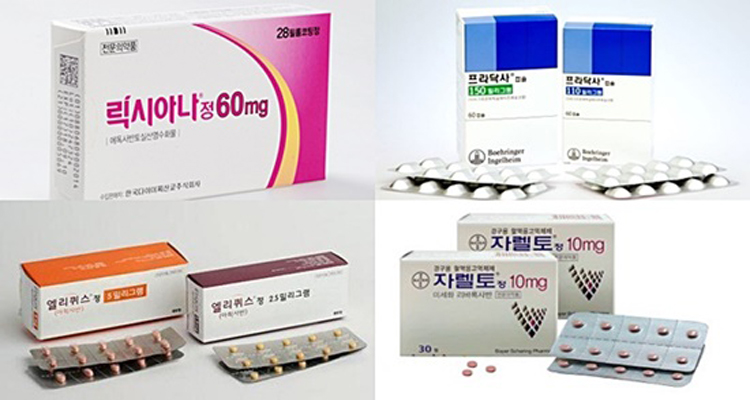
- (Clockwise from upper left) Images of Lixiana, Pradaxa, Xarelto, and Eliquis A follow-on drug in the non-vitamin K antagonist oral anticoagulant (NOAC) market, Lixiana, continues to lead the market. The treatment took the lead from Xarelto in last January for the first time, and it has been the most prescribed drug in the market for nine consecutive months. Pfizer and Bristol-Myers Squibb’s Eliquis had to face a Korean-made generic as a competitor, but its sales performance was unaffected with its original price maintained. On Oct. 28, UBIST, a pharmaceutical market data research firm, reproted Lixiana (edoxaban) marked an accumulated prescription of KRW 40.1 billion in the third quarter. The figure skyrocketed by 68.5 percent from last year same period. Lixiana recorded prescription sale of 14.9 billion won in the third quarter only and marked its record-breaking quarterly performance. The treatment reached outpatient prescription sale of 4 billion won in last January and beat Xarelto’s (rivaroxaban) prescription sale of 3.8 billion won, for the first time. The top spot in the NOAC prescription market has been solidified for nine months straight. The total sale gap between Lixiana and Xarelto’s prescription marked 6.6 billion won and was widened in the third quarter, due Xarelto’s sale dropping 0.2 percent in the third quarter than the year before. The treatment was ranked on second place in the market with 33.5 billion won accumulated prescription sale. Outpatient prescription sales trend of four NOAC items by month (Unit: KRW1 million) Source: UBIST Both internal and external factors played a part in shuffling the NOAC market rank. Bayer’s German production plant issue prolonged the unstable supply management in Korean market, and also the revised pharmaceutical product labeling regulation required all dosage containers to be reprocessed and slowed down Xarelto’s come back. In the meantime, Daiichi Sankyo and Daewoong’s co-promotion revved up the prescription sales of a follow-on drug, Lixiana. Insider from Daiichi Sankyo evaluated, “The healthcare providers and patients were positive about Lixiana’s better drug compliance with once-daily regimen, and improved safety for patients backed by Phase 3. The long-lasting co-promotion partnership with Daewoong, started from Sevika HCT deal, also created a great synergy effect boosting the sales performance”. Monthly prescription sales trend for Eliquis and apixaban generics (Unit: KRW) Source: UBIST Eliquis cumulated 31.3 billion won prescription sales this year, showing 32.1 percent surge than the year before. As of the third quarter, difference in accumulated prescription sales between Xarelto and Eliquis is only about 2.1 billion won. Eliquis was the first NOAC original to compete against generics, but its sales were not influenced as it maintained its original price. After the Korean Supreme Court in last June invalidated drug patent protecting Eliquis, the drug now has Korean-made generics competitors from Chong Kun Dang, Yoo Young, Yuhan, Huons, and Hanmi. But as Ministry of Health and Welfare has decided to defer Eliquis’ price reduction until the final decision on the treatment’s substance patent case is to be made on coming Dec. 31. Currently, the drug still maintains its initial price of 1,185 won per tablet. On the other hand, Chong Kun Dang’s competing generic with the highest content apixaban is about half the price of Eliquis. Boehringer Ingel Heim’s Pradaxa (dabigatran) marked accumulated prescription sales of 12.4 billion won in the quarter. The company sought for a significant increase in market share with a co-promotion deal with Boryung, but the sales performance did not show much increase than last year with 12.3 billion won.
- Policy
- Weighted pricing benefit abused as permanent price booster
- by Byun Kyung A Oct 31, 2019 09:58am
- The government evaluated the current weighted drug pricing system has been digressed as a permanent pricing benefit. Apparently, 96 percent of items have maintained the benefitted pricing for more than three years, and the authority sees that such practice has distanced itself from the initial objective to secure stable supply. Ministry of Health and Welfare (MOHW) submitted a statement answering the National Assembly Health and Welfare Committee Audit addressing the issue. Previously, Liberty Korea Party Lawmaker Kim Soon-Rye questioned the ministry about revising drug pricing system and strengthening competitiveness of Korean companies. In summer, MOHW presented revised 'Decision-making and Modification Standard for Drug Item' and unveiled weighted pricing system revision plan as a part of generic pricing system revision. The system was revised to set one year period of weighted pricing for synthetics and biopharmaceuticals, but provides maximum two years in case number of companies supplying the equivalent generics is less than three. The revision also established generic drug pricing standard and pricing for multi and single-use eye drops. On the revised weighted pricing system, MOHW explained “The initial objective of the system was to stabilize drug supply (weighted pricing for generics with less than three suppliers) and to induce soft landing for a generic entering the market where the original is lowering its price, from 100 percent to 70, and then to 50 percent.” “The revision was planned to keep the regulation faithful to its original objective maintaining stable drug distribution”, the ministry added. And the government emphasized its justification of drug pricing system revision as “244 out of 254 items, or 95 percent of the benefited items have been maintaining its increased price for more than three years, abusing the system as a permanent price boosting tool”. The ministry also ensured it would thoroughly review individual cases that need special support to stabilize drug supply. The statement added MOHW’s commitment to contribute strengthening Korean pharmaceutical company’s global competitiveness by executing the Biohealth Industry Innovation Strategy and Pharmaceutical Industry Fostering and Support Master Plan.
- Product
- Maviret takes up 83% of HCV treatment market share
- by Byun Kyung A Oct 31, 2019 09:41am
- Maviret product image Abbvie broke through the hepatitis C virus (HCV) treatment market and dominated 83 percent of oral outpatient prescription market only with its pan-genotype HCV treatment, Maviret, launched last year. Gilead once dominated the market with two items, but their prescription ratio shriveled down to 12 percent. On Oct. 30, a pharmaceutical market research agency, UBIST reported this year’s third quarter outpatient prescription sales of eight direct-acting antiviral (DAA) regimen HCV treatments recorded 13.2 billion won, soaring 41.4 percent from last year’s third quarter at 9.3 billion won. Abbvie’s Maviret prescription skyrocketed from the launch in last year September, and brought back up then descending total volume of HCV outpatient prescription market. The market had plummeted to 9.3 billion won in September last year, but turned around with Maviret’s launch. Outpatient prescription sales trend of major hepatitis C virus treatments (Unit: KRW 1 million) Source: UBIST This year’s third quarter outpatient prescription sales of Maviret reached 10.9 billion won. The sales easily doubled since last year’s fourth quarter with 4.2 billion won. As its accumulated prescription sales this year marked 31.1 billion won, Maviret is projected to make over 40 billion won by the end of the year. Taking up 82.9 percent of the eight DAA regimen treatments’ outpatient prescription sales, Maviret affirmed its unmatched position in the market. Maviret is the first treatment approved in Korea for chronic HCV infection in adults across all major genotypes. It is a pan-genotype ribavirin-free treatment that combines glecaprevir (100mg), an NS3/4A protease inhibitor, and pibrentasvir (40mg), an NS5A inhibitor, dosed once-daily as three oral tablets. Industry insiders view Maviret rapidly took over the market as it shortened drug treatment period by a month, compared to other DAA regimen. The treatment also mainly targets for patients without cirrhosis and who are new to treatment, the condition most of hepatitis C patients have. Recently, Maviret was able to improve consumption convenience as FDA approved of the drug shortening treatment period of chronic hepatitis C patients with cirrhosis and who are new to treatment, from 12 weeks to eight weeks. Sources also report Ministry of Food and Drug Safety’s approval on the expanded indication is imminent as related application has been submitted. However, due to the fact number of HCV patients is limited and the virus has fairly high full recovery rate, it is unclear if Maviret’s golden days would last long. In fact, Maviret’s prescription sales growth has turned from the third quarter. The total prescription soared every quarter since its launch and peaked in the second quarter, but it’s the figure dropped 9.1 percent in just about three months. Meanwhile, a former HCV treatment market leader, Gilead Sciences seems to have lost a big cut from its own market share. Sovaldi marked 18.1 billion won in last year’s first quarter, but its third quarter prescription sales in this year plunged to 4.68 billion won. Two top selling products of Gilead, Sovaldi and Harvoni, made total prescription of 1.5 billion won. The two drugs combined accumulated prescription sales of 5 billion won, merely taking up 11.7 percent of the whole hepatitis C treatment market. BMS’ Daklinza and Sunvepra combined marked outpatient prescription sales of 4.5 billion won in the third quarter, which is about one-tenth of what they had made last year same quarter. Launched around same season in the second quarter of 2017, MSD’s Zepatier and Abbvie’s Viekira and Exviera watched their sales continue dropping after the launch of Maviret and had short period of sales peak. In the third quarter, Zepatier marked prescription sales of 700 million won, whereas prescription sales for Viekira and Exviera were not even counted from last July. Abbvie insider commented, “Demand for Viekira and Exviera has decreased after Maviret was launched. There isn’t any issue with supply from the company”.
- Product
- Government likely to list Zejula in December
- by Byun Kyung A Oct 31, 2019 09:36am
- Sources predict Zejula, an ovarian cancer treatment, would get listed for healthcare reimbursement in coming December. According to an industry insider on Oct. 16, Takeda Pharmaceuticals Korea is waiting for Health Insurance Policy Deliberation Committee’s (HIPDC) deliberation, after recently reaching an agreement with National Health Insurance Service (NHIS) on drug pricing of Zejula (niraparib), a poly (ADP-ribose) polymerase (PARP) inhibitor. The niraparib treatment has been passed by Drug Reimbursement Evaluation Committee of Health Insurance Review and Assessment Service (HIRA) only after four months it was approved in last July. Zejula can be prescribed as a maintenance treatment for adult patients with recurrent epithelial ovarian cancer, including fallopian tube or primary peritoneal cancer, who are in a complete or partial response to platinum-based chemotherapy. However, the National Health Insurance (NHI) reimbursement would be first available for BRCA mutation patients only. Zejula was approved based on results of Phase 3 trials (ENGOT-OV16/NOVA). Progression-free survival (PFS) of patients taking Zejula, with or without BRCA mutation, showed a meaningful extension than the the control group. Moreover, the treatment proved its efficacy through PRIMA trial testing as a first-line treatment for ovarian cancer, regardless of BRCA mutation. In Korea, AstraZeneca’s Lynparza was listed for NHI reimbursement as a first PARP inhibitor. Lynparza was exempted from pharmacoeconomic analysis and was listed as reimbursed drug with expenditure cap risk sharing agreement (RSA) in October, 2017. However, the reimbursement benefit was suspended for some patients from last January as it was initially listed as post-chemotherapy maintenance therapy up to 15 months. From then on, AstraZeneca underwent reimbursement expansion talks with Korean government and lifted limitation on the fixed period of 15-month since last May.
