
- LOGIN
- MemberShip
- 2026-05-20 06:18:25
- Policy
- 13 drugs were sold before patent termination
- by Lee, Tak-Sun Jul 08, 2020 05:37am
- Domestic pharmaceutical companies were caught largely on charges of sales before patent termination. These pharmaceutical companies reported to the MFDS that they would sell after the end of the patent at the time of the application, but the sale was made even before the end of the patent through reporting on supply. The industry believes that they have committed illegal acts due to a lack of understanding of patent-linkage system introduced in 2012. However, there are criticisms that pharmaceutical companies have responded too easily because the allegations of selling before the end of the patent are just the reason for canceling the license. The MFDS has recently disclosed the results of disposing of products suspected of being sold prior to the termination of the patent. A total of 13 items were revoked by the 5th. These items are generic (Varenicline) for Pfizer's anti-smoking treatment 'Champix', and generic (Bazedoxifene Acetate) for Pfizer's osteoporosis treatment 'Viviant'. It was discovered that the items for cancellation of license were sold before the patent expired. According to the Pharmaceutical Affairs Act, the drug is withdrawn before the period expires if a person who applied for approval or revised approval of a drug is filed to market the drug after the period of a registered patent expires. This was reflected in the Pharmaceutical Affairs Act at the time of the introduction of the licensed patent linkage system in 2012. In the case of generic drugs with original patent rights, the application for permission is accompanied by a confirmation of the relationship of the patent, which is to be sold before patent termination through patent challenge or after patent termination. This is notified to the patent holder so that the patent holder can prepare in advance. A patent owner may make a request for prohibition of sales for nine months with a lawsuit against an item deemed to be infringement of a patent to the MFDS. Although the item that was caught this time has been applied for permission to be sold after the patent is over, it is suspected of being sold even before the patent expires. It is known that the MFDS caught the items sold before the end of the patent through report on supply history and field investigation. Administrative measures are underway because more items are caught than the 13 items that have been released so far. According to the industry, hepatitis B treatment and erectile dysfunction treatment are also included. It is known that some companies have additionally approved salt-altering items in preparation for cancellation of the license or have obtained the same active ingredients through affiliates.
- InterView
- Post-corona KSC academic conference finds answer in hybrid
- by An, Kyung-Jin Jul 08, 2020 05:37am
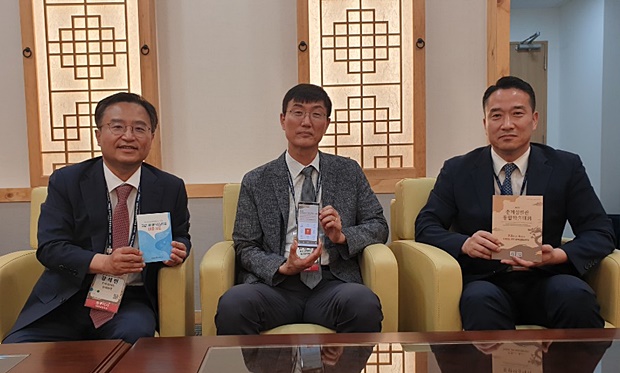
- (From left) KSC Secretary General Kang Seokmin, Academic Director Gwon Hyeon Cheol and Head of Convention Service team at Gyeongju Hwabaek International Convention Center, Park Seo-Joon. The Korean medical academy scene also took a hit from the novel coronavirus (COVID-19). Still not contained COVID-19 pandemic had affected the spring academic conference and other events, which left the academic event coordinators in a tight spot. So what is it like to have an academic conference in the day and age of ‘Post-coronavirus?’ The executives of Korean Society of Cardiology (KSC) say they found the answer in ‘hybrid.’ They concluded both online and offline events have to be simultaneously conducted to continue exchange academic findings and network while joining the movement to stop the spread of COVID-19. KSC Secretary General Kang Seokmin (Cardiovascular Department at Severance Hospital) and Academic Director Gwon Hyeon Cheol (Cardiology Division at Samsung Medical Center) at ‘2020 Annual Spring Scientific Conference of KSC with Affiliated Cardiac Societies’ claimed, “Simultaneously convening offline and online events would become the standard style of academic conferences post-coronavirus.” The academic society intends to share the tips they have learned from organizing the spring conference with other societies and to overcome the tough time together. ◆From special guideline to simulation, a month in making Only a month ago, KSC had decided to convene the annual spring conference in the first week of July at Gyeongju Hwabaek International Convention Center. Considering a large number of frontline healthcare providers of COVID-19 response had to participate, the society had internal dispute over having a complete virtual event. But some argued back it would diminish the level of networking and academic exchange and result in long-term loss. The executives pondered on the subject and finally found the solution; a hybrid event with an offline event strictly following the disease control guideline combined with the real-time presentation streaming online. Professor Kang Seokmin elaborated, “The annual spring conference is a massive scale of an event, where seven academic societies, including KSC, Korean Heart Rhythm Society, Korean Pediatric Heart Society, Korean Society of Heart Failure, Korean Society of Interventional Cardiology, Korean Society of Cardiometabolic Syndrome, Korean Society of Echocardiography and Korean Society of Lipid and Atherosclerosis, come together. As the participation of world renowned scholars was canceled, the invited professors were disappointed in losing a chance to expand their network.” Event staffs usher in conference participants to a lecture hall after checking their body temperature The executive committees of KSC had to struggle for a month to make an exemplary event amid COVID-19 pandemic. Professor Kang personally drafted the COVID-19 Response Guideline and edited eight times. The final version of the guideline reviewed by Korean Society of Infectious Diseases (KSID) defined the infection of COVID-19 and specified the floor plan and entrance management of the conference venue, management of the venue surroundings, management of relevant staffs, enforcement of disease prevention rules in participating members and operating the conference, and management of the event planning agency staffs. A day before the conference, the professor convened the convention center service team to conduct a simulation on contacting the public health center in case of spotting a suspected case of COVID-19 and transferring the patient. Professor Kang said, “The number of pre-registered members exceeded 1,700, and 900 of them participated in the morning of the first day. Keeping the safe distances in the seating arrangement, many had to listen to the live-streamed lecture from the lounge area,” and “We are grateful for the event staffs and participants complying with the guideline and safely and successfully closing the event.” ◆Hybrid academic conference with advantages of online and offline events to become a norm While the executive directors were busy organizing a safe event, academic committees were also hectic as well. They collected presentation material and voice or video recording of the foreign speakers unable to participate, and set up an online streaming system for the academic society members to conveniently use. By analyzing the pros and cons of international and domestic conferences convened online recently, the committees were able put up the basic framework of the event. As the spring conference was postponed over two months, the committees also simultaneously worked on the fall conference to come in three months time. As a result, they developed a system to watch lectures streaming from seven conference halls by simply clicking on a Smartphone app. The voice and video recordings from the foreign speakers were played from respective conference halls in a set order. Professor Kang demonstrates the real-time streaming lecture video on a Smartphone appProfessor Gwon Hyeon Cheol explained, “According to respective hospital guideline, many of the members are not allowed to participate in the conference unless they are speaker, mediator, or a panel,” and “Insisting on convening a virtual event would bring a serious impact on academic activity and networking.” The professor says the hybrid style of academic conference that fully embraces the advantages of both online and offline events would get more prevalent in the future. Professor Gwon also stated ultimately the executives of those academic societies hosting an academic event and the government should contemplate together on further improving the hybrid academic conference on more intricate level. The professor plans to create a system that enables real-time two-way feedback for question and answer session with the foreign speakers for the next conference. Professor Gwon advised, “The government also seems to have a lot to think about on setting the sponsorship standard as the conferences are changing their forms. Hopefully, they would also talk of setting detailed standard for the hybrid style with both online and offline events,” and “They should seek the most idealistic platform together with the relevant stakeholders to reflect their opinions”.
- Company
- Pfizer seeks for coverage on EGFR TKI to launch this year
- by Eo, Yun-Ho Jul 07, 2020 06:13am
- Pfizer Pharmaceutical Korea is quickly taking steps to join the competition in epidermal growth factor receptor (EGFR) tyrosine kinase inhibitor (TKI) market. According to the pharmaceutical industry sources, Pfizer is in process of listing EGFR TKI Vizimpro (dacomitinib) for healthcare reimbursement. Vizimpro took the pricing negotiation exemption track by accepting the weighted average pricing as an alternative option, taking into account that first generation Iressa (gefitinib), Tarceva (Erlotinib) and directly competing second generation Giotrif (afatinib) have already settled in the market. The drug would be able to launch with reimbursement in the second half of the year. The dacomitinib drug seeking for the reimbursement is a targeted therapy treating patients with non-small cell lung cancer (NSCLC), who have confirmed EGFR gene deletion in exon 19 or 21 L858R substitution mutations. The efficacy of Vizimpro was confirmed in Phase III trial ‘ARCHER 1050.’ The clinical trial compared dacomitinib’s efficacy head-to-head against AstraZeneca’s first generation EGFR TKI Iressa. Total 452 NSCLC patients have registered for the trial. The study reported Vizimpro lowered the risk of progression or death by 41 percent against Iressa, and the median progression-free survival (PFS) was 14.7 months in the Vizimpro group and 9.2 months in the Iressa group. However, Vizimpro demonstrated more adverse reactions. Frequently reported grade 3 events in Vizimpro group were dermatitis acneiform (14 percent) and diarrhea (8 percent), whereas over 8 percent of the Iressa group was reported with abnormal level of liver enzyme. As a result, 60 percent of the dacomitinib group had to adjust the dosage due to the adverse events. Meanwhile, Vizimpro has received marketing approval on three doses (15 mg, 30 mg and 45 mg) from Ministry of Food and Drug Safety (MFDS) in last February.
- Policy
- Ticagrelor Napadisylate by Chong Kun Dang was applied
- by Lee, Tak-Sun Jul 07, 2020 06:13am
- It has been shown that Chong Kun Dang developed a salted product of Ticagreler (Brilinta, AstraZeneca) and applied for permission to the MFDS. It is the first product to be approved as a Ticagrelor salt product. Anti-thrombotic agent, Ticagrelor, is a poorly soluble drug and is known to have poor solubility, so it has been noted whether salted drugs can overcome disadvantages. According to the industry on the 6th, Chong Kun Dang developed Ticagrelor napadicylate and applied to the MFDS on the 26th of last month. AstraZeneca Korea’s Brilinta (Ticagreler) was approved in July 2011. This product has indications that reduce the incidence of thrombotic cardiovascular events (death due to cardiovascular events, myocardial infarction, stroke) in combination with Aspirin in adult patients. Domestic pharmaceutical companies have made generics for Brilinta and have been sequentially approved since November 2017. However, due to the remaining material patents, it cannot be launched immediately, and will be sold from November next year. 25 items have obtained the right to monopolize the market from November 21, 2021 to August 20, 2022 by obtaining generic exclusivity by overcoming the remaining patents excluding material patents. Chong Kun Dang also obtained generic exclusivity. It is Ticarex 90mg which is unsalted form of Ticagreler. Accordingly, it is expected that Chong Kun Dang will release salt added products and salt free products simultaneously. In particular, it is expected that the salt additive product has improved solubility of Ticagrelor and will be able to secure competitiveness in the market. Brilinta is a blockbuster drug with a record of ₩10.3 billion in outpatient prescriptions (based on UBIST) last year.
- Policy
- Daewoong's Camostat was approved for clinical trial phase II
- by Lee, Tak-Sun Jul 07, 2020 06:12am
- Daewoong’s FoistarDaewoong has been approved for clinical trials in patients with mild and moderate COVID-19 as a drug with Camostat Mesilate used as a treatment for pancreatitis. The MFDS approved a plan for phase II clinical trial for 'DWJ1248', which Daewoong applied for on the 6th. DWJ1248 is known as Camostat Mesilate. Daewoong holds Foistar (Camostat Mesilate). This clinical trial is a double-blind, randomized, placebo-controlled, multicenter phase II clinical trial to evaluate the efficacy and safety of DWJ1248 in 90 patients with mild and moderate COVID-19. A team of researchers from Georg-August-Universität Göttingen is raising hopes as a candidate for COVID-19 treatment by announcing the results of an experimental study in which the Camostat prevents lung cell infection of COVID-19 in the global journal “Cell”. The research team at Aarhus University Hospital in Denmark started a phase II clinical trial to check the effectiveness of COVID-19 of Camostat Mesilate after receiving research funding from the Lundbeck Foundation. In Korea, Crystal Genomics was approved for the first time in a phase II clinical trial to evaluate the effectiveness and safety of Camostat for COVID-19.

- Policy
- Stepped drug pricing applied on maximum price as of Aug 1
- by Kim, Jung-Ju Jul 07, 2020 06:12am
- The Korean government unveiled the specified schedule and plan to apply stepped drug pricing system, also known as the upper limit price reevaluation on listed drug. Although the Regulatory Reform Committee ordered Ministry of Food and Drug Safety (MFDS) to drop the ‘1+3 joint bioequivalence test system’ from the revised ‘Regulation on Pharmaceutical Approval, Notification and Review,’ the health authority’s intention to limit joint bioequivalence test and to promote drug master file (DMF) registration are still apparent in the newly revised policy. Ministry of Health and Welfare (MOHW) officially disclosed the ‘Plan on Reevaluating Pharmaceutical Maximum Reimbursed Price,’ and spoke of the key dates such as a base date for reevaluated pricing and evidence submission period for the responsible pharmaceutical and bio companies. ◆Reevaluation subject and exemption conditions: Drugs listed for reimbursement before the government finalized the ‘Pharmaceutical Decision and Adjustment Criteria (MOHW notice No. 2020-51)’ as of Feb. 28 are subject to the reevaluation. But some are exempted from the reevaluation; drug requested for decision by the President of Korea Orphan and Essential Drug Center (KOEDC), or oxygen, nitro oxide, basic parenteral nutrition, artificial perfusates and radiopharmaceuticals are ruled out from the reevaluation. Other exempted drugs include low-cost drug, shortage prevention drug, orphan drug and other drugs specifically designated by the Minister of Health and Welfare, according to the Example 가 (Ga) to 라 (Ra) of the Item 2 of the Notice Appendix 4, that require stable supply and management essential for medical service. Moreover, a first drug in the class to be listed is also excluded from the list of subject drugs. If the first-in-class drug is not on the list of reimbursed drugs, the drug that MFDS notified as a reference drug for bioequivalence test among the same substance drugs would be considered as the first-in-class drug. ◆Adjusted drug pricing and criteria: The base price for the upper limit pricing adjustment (reduction) is the maximum price among the same substance drug. However, drugs with premium pricing benefit would base their reevaluation on the original pricing without the premium. As announced previously, the maximum price of a listed drug would be reduced by passing two, one or none of the criteria—submitting individual bioequivalence test data or clinical trial confirmation data, and submitting evidence of using active pharmaceutical ingredient registered with DMF. A drug meeting two of the criteria would receive the maximum price lowered to the adjusted base price, and meeting one criterion would lower the price down to 85 percent of the base price. And the maximum price of a drug clearing none of the criteria would be reduced to 72.25 percent of the adjusted base price. MOHW does not plan to lower the maximum price of a drug with the price already lower than the adjusted base price. And if the adjusted price is lower than the base price of a low-cost drug, the maximum price would be reduced down to the low-cost drug’s base price. But the pricing would be adjusted as the original policy, if an item is listed with minimum unit (1 mL, 1 g, 1mCi etc.) or its maximum price is labeled with minimum unit. The bioequivalence test reference drug, not a first-in-class drug, would be only considered to have met the first criterion of submitting the individual bioequivalence test evidence or submitting the evidence of clinical trial. ◆Evidence submission: For the pharmaceutical companies to get the most of the maximum pricing, the reevaluation criteria should be met. The government has set the deadline on Feb. 28, 2023 for the evidential materials to be submitted to Health Insurance Review and Assessment Service (HIRA). Other details would be fine-tuned further by discussing with Drug Reimbursement Evaluation Committee (DREC).

- Opinion
- [Reporter’sView] A good administrative move by government
- by Eo, Yun-Ho Jul 06, 2020 10:44am
- Korea’s Ministry of Health and Welfare (MOHW) withdrew the plan to apply the stepped drug pricing reduction on drugs transferred by business restructuring in just four months to reflect the pharmaceutical industry’s opinion. It was first announced in February, and the revision was updated in June. The industry has been in a chaos for a while as the government mentioned of a possibility of applying stepped pricing on the transferred drugs. Initially, the stepped drug pricing, in effective from August, sets the upper limit pricing a drug, regardless of qualifying two criteria for top-level pricing, at 85 percent of either the lowest pricing or 38.69 percent of the first-in-class drug, if the number of listed same-substance drugs exceeds 20. However, the Pharmaceutical Decision and Adjustment Criteria amended in last February opened room for the stepped pricing to be used on a product that succeeds business status due to corporate restructuring—for example in case of M&A, corporate split or license sell-off. Accordingly, companies like Pfizer Pharmaceutical Korea (Upjohn) and MSD Korea (Organon) preparing for multiple transfer of original products to the respective split off companies, feared of the possible pricing reduction. Takeda Pharmaceuticals Korea that recently sold off an antidiabetic treatment pipeline to Celltrion could not be completely free from the same fear. Relevant industry organizations like Korean Research-based Pharmaceutical Industry Association (KRPIA) and Korea Pharmaceutical and Bio-pharma Manufacturers Association (KPBMA) submitted statements to urge MOHW to exempt transferred products from stepped pricing reduction, and requested for flexible interpretation of the regulation. Surprisingly, MOHW’s action was even more straightforward. The Pharmaceutical Decision and Adjustment Criteria were revisited again and announced the newest amendment last month. Fortunately, it subsided the industry’ complain fast. In this day and age of high-cost drugs, the Korean government puts forth ‘trade-off’ as the key regulatory approach to lessen the expenditure on off-patent drug for compensation on new drug coverage. As for the government, the initial plan was a great chance. Besides generics, lowering the pricing of the transferred original would put generics pricing higher than the original, and most likely the same substance drug pricing would fall, automatically. But the government accepted the industry’s logic behind its argument. A good communication can also lead to another opportunity. Hopefully, the government could result in good trade-off while listing new drugs or expanding coverage in the future.

- Policy
- Samsung Bioepis' Adalloce prefilled pen was approved
- by Lee, Tak-Sun Jul 06, 2020 06:15am
- Samsung BioepisSamsung Bioepis’ pen type product of Humira (Adalimumab) biosimilar named Adalloce has additionally approved in Korea It is evaluated as a product with improved convenience of administration than Adalloce PFS that was approved in September 2017. The MFDS approved Samsung Bioepis' Adalloce prefilled pen 40mg on the 3rd. This product is an injection type in a pen equipped with a colorless and transparent pre-filled syringe. It is a self-injectable form that can be administered by the patient himself, such as the previously approved Adalloce PFS. However, the pen formulation has the advantage of not only reducing the fear of the injection needle due to the lack of exposure to the injection needle, thereby reducing the possibility of contamination. Adaloche prefilled pen is simple to use because the injection drug is automatically injected by pressing the button on the injection site. Humira, which is the original drug of this product, has both pre-filled syringe and pre-filled pen formulations, and the preference of pen formulations is high. It has been reported that most patients with pen formulation experience pain reduction following injection. Adalimumab is mainly used in patients with rheumatoid arthritis. However, Adalloce has not yet been released in Korea. This is because Humira's fastest patent expires in June 2022. However, Samsung Bioepis succeeded in invalidating the Humira patent, which was scheduled to expire on July 18, 2023, through a trial request, and laid the foundation to release it sooner. Currently, Samsung Bioepis' Adalloce is the only product that has the same ingredient (Adalimumab) as Humira in Korea. Last year, Humira's domestic sales (based on IQVIA) amounted to ₩96.2 billion, and it is a very large-scale drug that is close to ₩100 billion. Samsung Bioepis has been selling Humira's biosimilar in Europe since October 2018 under the name Imraldi. Biogen, which sells Imraldi in the European market, said last year that its sales were $184 million, more than 10 times higher than ₩16.7 million in 2018. It is the No. 1 market share in Humira biosimilar products. It is an analysis that Imraldi is leading among the four biosimilars due to the advantages of price competitiveness and convenient pen formulation in the European market. It is highly anticipated that it will become a competitive with Humira if it is released in Korea.
- Policy
- Pariet holder was changed from Janssen to Kolmar in 20 years
- by Lee, Tak-Sun Jul 06, 2020 06:15am
- The domestic license holder for 'Pariet', a PPI used for GERD, has been changed in 20 years. As Janssen Korea operates the Hyangnam factory until next year, the manufacturer has finally changed. Eisai Korea is in charge of sales. According to related industries on the 3rd, the permit holders of Pariet licensed in 2000 were changed from Janssen Korea to Kolmar Korea, and an insurance code was newly established reflecting this from July. Accordingly, items whose license holder is Janssen Korea can only be claimed by this December. Since last year, Janssen Korea has been in the process of transferring manufacturing. This is because the operation of the Hyangnam Plant until next year will no longer produce Pariet, which was commissioned and manufactured in Korea. It is developed by Eisai, and Eisai Korea is in charge of sales. Janssen Korea has established a relationship since Pariet launched in Korea in 2000. In addition to permitting, manufacturing and production, the company also conducted joint sales with Eisai Korea. It closed sales in 2015, and was transferred to Kolmar Korea at this time. Pariet has recently released a low dose product, and is strengthening its marketing by conducting joint sales with Yuhan Corporation. Pariet is also receiving reflex benefits according to anti-ulcer drug Ranitidine has been banned due to the detection of NDMA, a carcinogen, It is noteworthy whether Pariet, whose license has changed from Janssen Korea to Kolmar Korea in 20 years, will making its way up once again in Korea with a new partnership.
- Company
- GC Pharma has signed a contract to supply Pfizer's Rapamune
- by Jul 06, 2020 06:15am
- GC Pharma is launching a sale of Rapamune (Sirolimus), an immunosuppressive agent of Pfizer Korea. PfizerAccording to the distribution industry on the 3rd, GC Pharma signed a supply contract with Pfizer Korea for supply of Rapamune 0.5·1·2mg on the 19th of last month and began selling on the 1st of this month. Rapamune is an immunosuppressive drug released by Pfizer Korea with a domestic license in March 2006. It is used to prevent long-term rejection of patients with kidney disease and to treat patients with lymphangioleiomyomatosis (LAM). Rapamune's annual prescription amount is low at ₩2 billion. According to IQVIA, the annual sales from 2015 to 2019 were ₩2.4 billion. In the case of Rapamune 1 & 2mg, the drug price is expected to drop slightly from this year, and sales are expected to fall further. As a result, Rapamune has not released generics for 5 years after the patent expires in 2013. Only in August 2018, Chong Kun Dang was the first Korean pharmaceutical company to receive a generic named Raparobell. The generic got listed this year. With the drug price cut and generics, the impact of GC Pharma's sales of Rapamune is expected to be minimal. Nevertheless, the reason for choosing Rapamune is considered to reflect the company's willingness to empower the rare disease field. GC Pharma has a rare disease team and provides treatment for many rare diseases such as Hunter syndrome, hemophilia, and Fabry disease. An official in the pharmaceutical industry said, "As GC Pharma is focusing on the rare disease field, it seems to be a choice to increase the market influence by expanding the related pharmaceutical items rather than sales."
