- LOGIN
- MemberShip
- 2026-09-15 11:13:43
- Jideytro posts 94% response rate in NSCLC
- by Son, Hyung Min | translator Alice Kang | 2026-09-15 08:50:31
Jideytro, a ROS1-positive non-small cell lung cancer (NSCLC) therapy recently acquired by GSK, has shown high response rates in an earlier-line treatment setting.
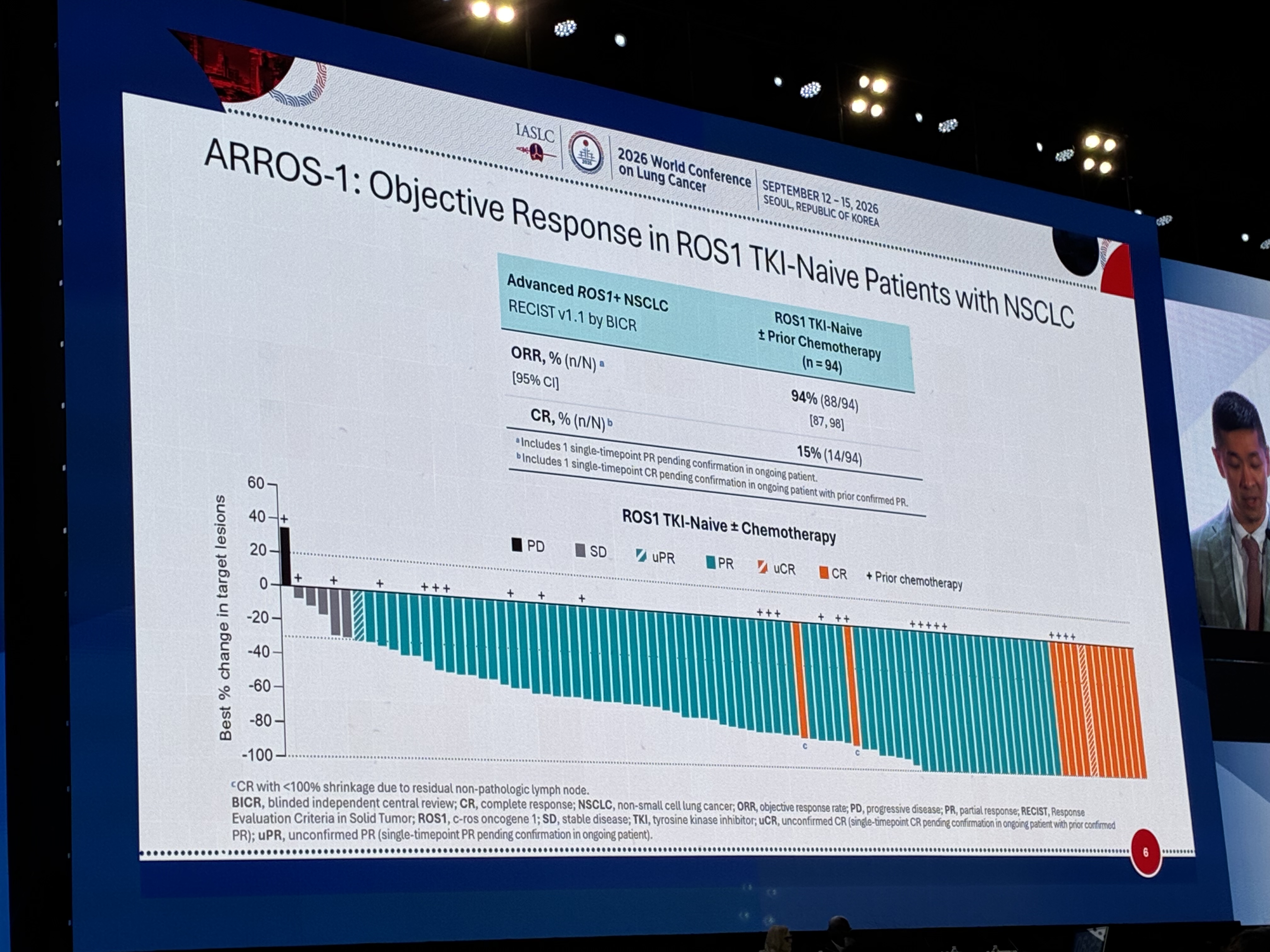
Among patients with no prior ROS1 TKI treatment, the objective response rate (ORR) reached 94%, while the 12-month progression-free survival (PFS) rate was 90%. All 10 patients with baseline brain metastases who were evaluable for intracranial response responded to treatment.
Jideytro (zidesamtinib) was approved in the US in July as a later-line treatment for patients previously treated with a ROS1 TKI. The latest findings have raised interest in whether its use could be expanded to treatment-naive patients.
At the World Conference on Lung Cancer (WCLC 2026), held at COEX in Seoul on the 14th, Alexander E. Drilon, professor at Memorial Sloan Kettering Cancer Center in the US, presented results from the Phase I/II ARROS-1 trial in patients with advanced or metastatic ROS1-positive NSCLC.

Jideytro is a next-generation oral TKI designed to retain activity against ROS1 and key resistance mutations while enhancing brain penetration and minimizing TRK inhibition.
The US Food and Drug Administration (FDA) approved Jideytro in July for adults with locally advanced or metastatic ROS1-positive NSCLC who had previously received at least one ROS1 TKI.
GSK acquired Jideytro through its acquisition of Nuvalent this year. The WCLC data are notable because they explore the drug’s potential in the first-line setting, beyond its current approval for previously treated patients.
ORR reaches 94%…12-month PFS rate at 90%
ARROS-1 is a global Phase I/II trial evaluating the efficacy and safety of Jideytro in patients with advanced ROS1-positive NSCLC and other solid tumors.
Phase I trial evaluated doses ranging from 25 mg to 150 mg in patients previously treated with a ROS1 TKI. In the Phase II trial, the recommended Phase II dose (RP2D) of 100 mg was administered once daily.
The efficacy analysis included 94 patients with no prior ROS1 TKI treatment who had measurable disease by blinded independent central review (BICR). The data cutoff was April 16, with a median follow-up of 15.2 months.
The median patient age was 59 years. Women and non-smokers each accounted for 59% of patients. By region, 40% were from North America, 31% from Asia-Pacific, and 29% from Europe. At baseline, 17% had CNS metastases and 27% had previously received platinum-based chemotherapy.
By BICR, Jideytro achieved an ORR of 94% (88 patients), including a complete response (CR) in 15% (14 patients).
Responses were also durable. Among responders, the estimated proportions maintaining a response for at least 6, 9, and 12 months were 96%, 94%, and 86%, respectively. Median PFS had not yet been reached, while the 12-month PFS rate was 90%.
Drilon said, “Jideytro demonstrated clinically meaningful activity in ROS1-positive lung cancer patients with no prior TKI treatment,” highlighting not only the high initial response rate but also the durability of responses.
Strong activity was also seen in patients with brain metastases
CNS activity was another key finding.
Brain metastases can emerge during the course of ROS1-positive NSCLC, making brain penetration and intracranial disease control important considerations in treatment selection.
At the time of treatment initiation, 10 patients had brain metastases at baseline and were evaluable for intracranial response.
The intracranial objective response rate (IC-ORR) was 100% (10 patients), with 70% (7 patients) achieving an intracranial complete response (IC-CR).
The estimated proportions maintaining an intracranial response for at least 6 and 9 months were both 100%, while 78% were estimated to maintain a response for at least 12 months. Median intracranial duration of response had not yet been reached.
Among 78 TKI-naive patients without brain metastases at baseline, no CNS progression was observed by BICR.
Drilon said Jideytro was designed to maintain activity against ROS1 and resistance mutations while achieving brain penetration and minimizing TRK inhibition.
Treatment discontinuation at 4%…TRK inhibition minimized
The safety analysis included 532 patients with advanced ROS1-positive NSCLC who received Jideytro 100 mg, regardless of whether they had received prior TKI therapy.
The most common treatment-related adverse events (TRAEs) were peripheral oedema, which was reported in 42% of patients. Increased blood creatine phosphokinase (CPK) and constipation each occurred in 23%, followed by weight gain in 22%, increased AST in 19%, and increased ALT and dysgeusia in 18% each.
Dyspnea, arthralgia, and peripheral sensory neuropathy were each reported in 17% of patients.
Grade 3 or higher adverse events included weight gain in 7%, increased CPK in 5%, dyspnea in 4%, and hypertriglyceridemia in 3%.
Treatment-related adverse events occurring in at least 15% of patients included peripheral edema in 34%, weight gain and increased CPK in 18% each, dysgeusia in 17%, and increased AST in 15%.
Dose reductions due to TEAEs occurred in 12% of patients, while 11% required dose reductions because of treatment-related adverse events. Treatment discontinuation rate due to TEAEs was 4%, and due to treatment-related adverse events was 1%.
Because ROS1-positive lung cancer often requires prolonged treatment, tolerability is an important factor in treatment selection alongside efficacy. Jideytro was designed to reduce the TRK-related neurologic toxicities that can occur during long-term therapy.
Next-generation ROS1 TKI competition intensifies… efficacy, tolerability and CNS activity
A review session following the presentation examined where Jideytro could fit among existing ROS1 TKIs.
James Chih-Hsin Yang, professor at National Taiwan University, identified efficacy, tolerability and CNS activity as the three key factors in assessing Jideytro.
Treatment options for ROS1-positive disease have expanded from Xalkori (crizotinib) and Rozlytrek (entrectinib) to newer-generation TKIs including Augtyro (repotrectinib) and taletrectinib.
In an indirect cross-trial comparison presented by Yang, median first-line PFS was 19.3 months with crizotinib, 15.7 months with entrectinib, 31.1 months with repotrectinib and 46.1 months with taletrectinib.
However, differences in patient characteristics, follow-up periods and assessment methods across trials preclude direct comparisons of efficacy between the drugs. Yang likewise cautioned against simply comparing or pooling median values across studies.
OS data also remain immature. In previous studies, median OS was 51.4 months with Xalkori, 47.8 months with Rozlytrek, and 74.6 months with Augtyro. Median OS had not been reached with taletrectinib, with a 3-year OS rate of 65.3%.
For Jideytro, the median follow-up in the current analysis was only 15.2 months, and OS results have not yet been reported.
Yang described the 94% ORR as among the highest initial efficacy results reported in the first-line lung cancer setting. He also pointed to the 90% 12-month PFS rate and the fact that median PFS had not yet been reached as evidence of durable activity.
In terms of tolerability, Yang highlighted Jideytro’s relatively limited TRK-related neurologic toxicity, an important consideration given the need for long-term TKI treatment.
CNS activity was also cited as a major strength. The high intracranial response rate and absence of CNS progression among patients without baseline brain metastases were considered encouraging signs of intracranial disease control.
Yang concluded that Jideytro is a treatment candidate combining all three key attributes: efficacy, tolerability, and CNS activity.
He noted, however, that the feasibility of conducting randomized head-to-head trials among next-generation ROS1 TKIs is unlikely. Given the rarity of this molecular subtype, direct comparative studies between newer agents would be difficult to conduct, and no separate Phase III trial of Jideytro is currently planned.
More follow-up is therefore needed to determine Jideytro’s place in first-line treatment. While the data to date show encouraging early results in response rate, one-year PFS and intracranial activity, there is no direct comparative evidence against existing next-generation ROS1 TKIs.
Drilon said the findings support further development of Jideytro in TKI-naive patients. The key question going forward is whether its high initial response rate and CNS control translate into durable PFS and OS benefits.
-

- 0
댓글 운영방식은
댓글은 실명게재와 익명게재 방식이 있으며, 실명은 이름과 아이디가 노출됩니다. 익명은 필명으로 등록 가능하며, 대댓글은 익명으로 등록 가능합니다.
댓글 노출방식은
댓글 명예자문위원(팜-코니언-필기모양 아이콘)으로 위촉된 데일리팜 회원의 댓글은 ‘게시판형 보기’와 ’펼쳐보기형’ 리스트에서 항상 최상단에 노출됩니다. 새로운 댓글을 올리는 일반회원은 ‘게시판형’과 ‘펼쳐보기형’ 모두 팜코니언 회원이 쓴 댓글의 하단에 실시간 노출됩니다.
댓글의 삭제 기준은
다음의 경우 사전 통보없이 삭제하고 아이디 이용정지 또는 영구 가입제한이 될 수도 있습니다.
-
저작권·인격권 등 타인의 권리를 침해하는 경우
상용 프로그램의 등록과 게재, 배포를 안내하는 게시물
타인 또는 제3자의 저작권 및 기타 권리를 침해한 내용을 담은 게시물
-
근거 없는 비방·명예를 훼손하는 게시물
특정 이용자 및 개인에 대한 인신 공격적인 내용의 글 및 직접적인 욕설이 사용된 경우
특정 지역 및 종교간의 감정대립을 조장하는 내용
사실 확인이 안된 소문을 유포 시키는 경우
욕설과 비어, 속어를 담은 내용
정당법 및 공직선거법, 관계 법령에 저촉되는 경우(선관위 요청 시 즉시 삭제)
특정 지역이나 단체를 비하하는 경우
특정인의 명예를 훼손하여 해당인이 삭제를 요청하는 경우
특정인의 개인정보(주민등록번호, 전화, 상세주소 등)를 무단으로 게시하는 경우
타인의 ID 혹은 닉네임을 도용하는 경우
-
게시판 특성상 제한되는 내용
서비스 주제와 맞지 않는 내용의 글을 게재한 경우
동일 내용의 연속 게재 및 여러 기사에 중복 게재한 경우
부분적으로 변경하여 반복 게재하는 경우도 포함
제목과 관련 없는 내용의 게시물, 제목과 본문이 무관한 경우
돈벌기 및 직·간접 상업적 목적의 내용이 포함된 게시물
게시물 읽기 유도 등을 위해 내용과 무관한 제목을 사용한 경우
-
수사기관 등의 공식적인 요청이 있는 경우
-
기타사항
각 서비스의 필요성에 따라 미리 공지한 경우
기타 법률에 저촉되는 정보 게재를 목적으로 할 경우
기타 원만한 운영을 위해 운영자가 필요하다고 판단되는 내용
-
사실 관계 확인 후 삭제
저작권자로부터 허락받지 않은 내용을 무단 게재, 복제, 배포하는 경우
타인의 초상권을 침해하거나 개인정보를 유출하는 경우
당사에 제공한 이용자의 정보가 허위인 경우 (타인의 ID, 비밀번호 도용 등)
※이상의 내용중 일부 사항에 적용될 경우 이용약관 및 관련 법률에 의해 제재를 받으실 수도 있으며, 민·형사상 처벌을 받을 수도 있습니다.
※위에 명시되지 않은 내용이더라도 불법적인 내용으로 판단되거나 데일리팜 서비스에 바람직하지 않다고 판단되는 경우는 선 조치 이후 본 관리 기준을 수정 공시하겠습니다.
※기타 문의 사항은 데일리팜 운영자에게 연락주십시오. 메일 주소는 dailypharm@dailypharm.com입니다.