- LOGIN
- MemberShip
- 2026-09-15 07:18:31
- 'Trodelvy'+'Keytruda' fails Phase 3 for lung cancer with high PD-L1
- by Son, Hyung Min | translator Hong, Ji Yeon | 2026-09-14 15:58:37
The strategy of adding the immune checkpoint inhibitor Keytruda to the TROP2-directed antibody-drug conjugate (ADC) Trodelvy for first-line treatment of metastatic non-small cell lung cancer (NSCLC) with high PD-L1 expression did not pass the Phase 3 clinical hurdle.
Although the Keytruda + Trodelvy combination therapy extended progression-free survival (PFS) by about four months and improved the objective response rate (ORR) compared with Keytruda monotherapy, it did not meet the prespecified threshold for statistical significance. Additionally, the combination therapy did not show an overall survival (OS) benefit.
At the 2026 World Conference on Lung Cancer (WCLC 2026), held at COEX in Seoul on the 13th, key results from the Phase 3 'EVOKE-03/KEYNOTE-D46' trial evaluating the efficacy and safety of the combination of Trodelvy (sacituzumab govitecan) and Keytruda (pembrolizumab) were presented.
EVOKE-03 trial was a comparative study involving 620 patients with metastatic NSCLC harboring a PD-L1 tumor proportion score (TPS) of ≥50%, randomized to receive either Trodelvy plus Keytruda (n=311) or Keytruda monotherapy (n=309).
Eligible patients were systemic therapy-naïve for metastatic disease and lacked actionable EGFR, ALK, or ROS1 genomic alterations. The primary endpoints were progression-free survival (PFS) and overall survival (OS) assessed by blinded independent central review (BICR).
The data cutoff date was April 3 of this year, with a median follow-up of 14.7 months.

PFS was improved...Failed to prove statistical significance
In the trial results, the combination group demonstrated improved PFS. Median PFS was 11.8 months in the Trodelvy plus Keytruda group compared to 7.7 months in the Keytruda monotherapy group, resulting in a 19% reduction in the risk of disease progression or death.
However, with a p-value of 0.0252, the study did not meet the prespecified statistical significance threshold for PFS (p-value 0.007). Consequently, despite an approximately four-month difference in PFS, the combination therapy did not demonstrate statistical superiority for these dual primary endpoints.
Outcomes also differed across patient subgroups. In non-squamous NSCLC, the PFS hazard ratio (HR) for combination therapy was 0.70, whereas in squamous NSCLC it was 1.11. By geographic region, the HR was 0.68 among East Asian patients, compared with 1.20 across patients enrolled in Western Europe, North America, and Australia.
While Trodelvy combination therapy demonstrated greater PFS improvement than Keytruda monotherapy in non-squamous histology and East Asian cohorts, it showed no significant benefit in squamous histology or among patients from Western Europe, North America, and Australia.
Antitumor response demonstrated a more pronounced benefit from the addition of Trodelvy. The objective response rate (ORR) was 55.6% in the combination group versus 43.7% in the Keytruda monotherapy group. Complete response (CR) rates were 7.7% and 3.9%, while partial response (PR) rates were 47.9% and 39.8%, respectively.
However, response durability did not meaningfully differ. Median duration of response (DOR) was virtually identical between groups, recorded at 21.4 months for the combination versus 21.3 months for monotherapy.
This initial tumor cytoreduction did not translate into an OS advantage. At the interim analysis, median OS was 21.5 months in the Trodelvy plus Keytruda group and 22.8 months in the Keytruda monotherapy group.
Dr. Giannis Mountzios, MD, MSc, PhD, a Medical Oncologist at Henry Dunant Hospital Center in Greece, stated, "While the Trodelvy combination therapy numerically extended PFS and increased response rates compared to Keytruda monotherapy, it did not cross the prespecified boundary for statistical significance," adding, "No significant difference was also demonstrated in overall survival."
Dr. Giannis Mountzios explained that "The safety profile of the combination therapy was consistent with the known toxicities of each agent, with no new or unexpected safety signals observed."
Prof. Ji-Youn Han: "Chemotherapy-like initial effect fails to translate into long-term survival"
Professor Ji-Youn Han of the National Cancer Center, who reviewed the EVOKE-03 results, noted that the early disease control achieved with the Trodelvy combination did not translate into long-term survival.
Professor Han observed that the PFS Kaplan-Meier curves began separating around three months post-initiation and reached their widest divergence at approximately 9 to 12 months, before progressively converging over time.
Indeed, the delta in PFS rates between the combination and monotherapy groups narrowed from 11.4 percentage points at 12 months to 6.1 percentage points at 18 months.
Regarding this pattern, Professor Han explained that while adding the TROP2 ADC produced a chemotherapy-like early cytoreductive effect, which is similar to delaying rapid progression in patients who would otherwise not respond to Keytruda monotherapy, it did not generate new long-term survivors.
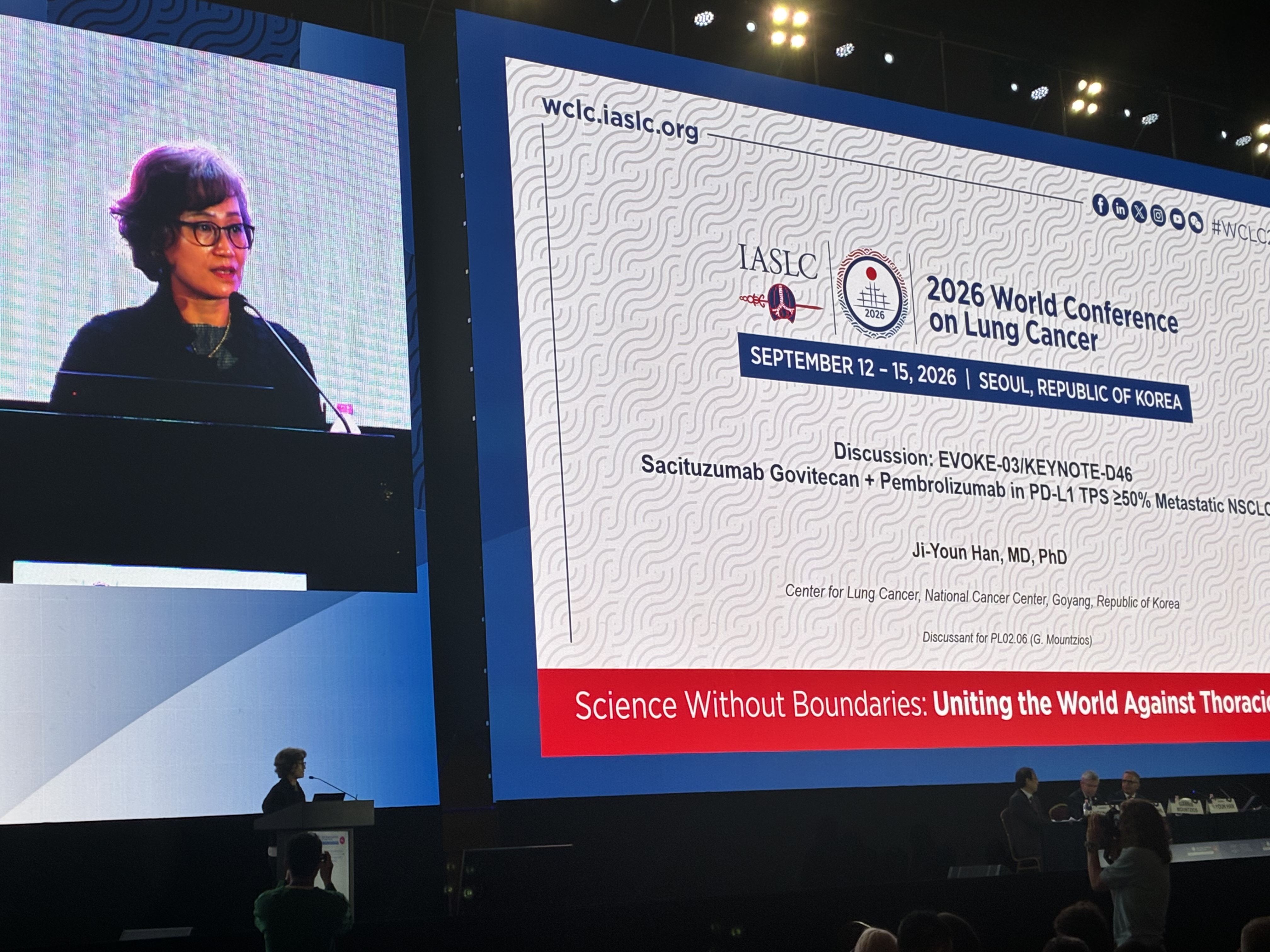
Professor Han noted that this hypothesis is substantiated by the fact that despite a roughly 12-percentage-point higher ORR (55.6% vs. 43.7%), median DOR remained nearly identical at around 21 months across both groups, and the OS curves largely overlapped.
Professor Han also cited increased treatment-emergent toxicity as a factor that may have compromised survival gains.
In the safety analysis, Grade 3 or higher treatment-emergent adverse events (TEAEs) were documented in 73.6% of the combination group compared to 45.0% of the Keytruda monotherapy group. Serious TEAEs were also elevated at 53.4% versus 39.5%, and treatment discontinuations attributable to adverse events occurred in 30.9% versus 20.1% of patients, respectively.
Professor Han pointed out that the increased toxicity burden may have offset early PFS gains, alongside the confounding impact of subsequent lines of systemic therapy, such as platinum-doublet chemotherapy post-Keytruda, which may have diluted survival differences between the groups.
"However, because follow-up progression therapy data were not disclosed in this presentation and OS data remained at only 47%, it remains difficult to draw a definitive conclusion regarding the precise etiology," she noted.
"Keytruda monotherapy remains standard of care...TROP2 patient selection remains a challenge"
Clinically, the trial data do not provide sufficient evidence to modify the current frontline standard of care.
Professor Han concluded that Keytruda monotherapy must remain the established frontline standard of care for patients with metastatic NSCLC harboring a PD-L1 TPS of ≥50% without actionable driver mutations.
Professor Han added that clinical evidence is insufficient to justify further clinical development or commercial use of the Trodelvy plus Keytruda combination outside the investigational trial setting in this patient population.
Patient selection strategies for TROP2-directed ADCs remain a challenge.
Professor Han explained that relying solely on TROP2 expression levels offers limited utility in stratifying patients who will derive clinical benefit, highlighting the need for predictive biomarkers that reflect the ADC’s mechanistic cascade, including target binding, cellular internalization, and efficient intracellular payload release.
Professor Han also suggested that favorable results observed in non-squamous histology and East Asian cohorts may require validation in future trials. She cautioned, however, that because these subgroup analyses were exploratory and not statistically powered to establish therapeutic divergence, they cannot serve as evidence to alter current clinical practice.
Currently, several Phase 3 trials are ongoing in the PD-L1 high NSCLC frontline setting, including TROPION-Lung08 evaluating the TROP2 ADC Dato-DXd (datopotamab deruxtecan), TroFuse-007 evaluating sacituzumab tirumotecan, and HARMONi-7 evaluating the PD-1/VEGF bispecific antibody ivonescimab.
Professor Han emphasized, "For future trials, OS must be weighted as a more definitive primary endpoint when designing TROP2-based patient selection, as well as specification by tumor histology and geographic region."
-

- 0
댓글 운영방식은
댓글은 실명게재와 익명게재 방식이 있으며, 실명은 이름과 아이디가 노출됩니다. 익명은 필명으로 등록 가능하며, 대댓글은 익명으로 등록 가능합니다.
댓글 노출방식은
댓글 명예자문위원(팜-코니언-필기모양 아이콘)으로 위촉된 데일리팜 회원의 댓글은 ‘게시판형 보기’와 ’펼쳐보기형’ 리스트에서 항상 최상단에 노출됩니다. 새로운 댓글을 올리는 일반회원은 ‘게시판형’과 ‘펼쳐보기형’ 모두 팜코니언 회원이 쓴 댓글의 하단에 실시간 노출됩니다.
댓글의 삭제 기준은
다음의 경우 사전 통보없이 삭제하고 아이디 이용정지 또는 영구 가입제한이 될 수도 있습니다.
-
저작권·인격권 등 타인의 권리를 침해하는 경우
상용 프로그램의 등록과 게재, 배포를 안내하는 게시물
타인 또는 제3자의 저작권 및 기타 권리를 침해한 내용을 담은 게시물
-
근거 없는 비방·명예를 훼손하는 게시물
특정 이용자 및 개인에 대한 인신 공격적인 내용의 글 및 직접적인 욕설이 사용된 경우
특정 지역 및 종교간의 감정대립을 조장하는 내용
사실 확인이 안된 소문을 유포 시키는 경우
욕설과 비어, 속어를 담은 내용
정당법 및 공직선거법, 관계 법령에 저촉되는 경우(선관위 요청 시 즉시 삭제)
특정 지역이나 단체를 비하하는 경우
특정인의 명예를 훼손하여 해당인이 삭제를 요청하는 경우
특정인의 개인정보(주민등록번호, 전화, 상세주소 등)를 무단으로 게시하는 경우
타인의 ID 혹은 닉네임을 도용하는 경우
-
게시판 특성상 제한되는 내용
서비스 주제와 맞지 않는 내용의 글을 게재한 경우
동일 내용의 연속 게재 및 여러 기사에 중복 게재한 경우
부분적으로 변경하여 반복 게재하는 경우도 포함
제목과 관련 없는 내용의 게시물, 제목과 본문이 무관한 경우
돈벌기 및 직·간접 상업적 목적의 내용이 포함된 게시물
게시물 읽기 유도 등을 위해 내용과 무관한 제목을 사용한 경우
-
수사기관 등의 공식적인 요청이 있는 경우
-
기타사항
각 서비스의 필요성에 따라 미리 공지한 경우
기타 법률에 저촉되는 정보 게재를 목적으로 할 경우
기타 원만한 운영을 위해 운영자가 필요하다고 판단되는 내용
-
사실 관계 확인 후 삭제
저작권자로부터 허락받지 않은 내용을 무단 게재, 복제, 배포하는 경우
타인의 초상권을 침해하거나 개인정보를 유출하는 경우
당사에 제공한 이용자의 정보가 허위인 경우 (타인의 ID, 비밀번호 도용 등)
※이상의 내용중 일부 사항에 적용될 경우 이용약관 및 관련 법률에 의해 제재를 받으실 수도 있으며, 민·형사상 처벌을 받을 수도 있습니다.
※위에 명시되지 않은 내용이더라도 불법적인 내용으로 판단되거나 데일리팜 서비스에 바람직하지 않다고 판단되는 경우는 선 조치 이후 본 관리 기준을 수정 공시하겠습니다.
※기타 문의 사항은 데일리팜 운영자에게 연락주십시오. 메일 주소는 dailypharm@dailypharm.com입니다.