- LOGIN
- MemberShip
- 2026-09-14 10:25:29
- ‘Yescarta demonstrates potential for long-term survival’
- by Son, Hyung Min | translator Alice Kang | 2026-06-25 09:04:25
The role of CAR-T therapy is expanding in the treatment of relapsed or refractory diffuse large B-cell lymphoma (DLBCL).
With long-term survival data for Yescarta being secured in patients who relapse or become refractory within 12 months of first-line treatment, treatment strategies in the second-line setting are also beginning to evolve.
On June 24, Gilead Sciences Korea held a press conference in Seoul to mark the domestic launch of its CAR-T therapy ‘Yescarta (axicabtagene ciloleucel),’ highlighting the current treatment landscape and the therapy's clinical value in relapsed/refractory DLBCL.
Professor Dok Hyun Yoon of the Division of Oncology at Asan Medical Center emphasized that substantial unmet needs remain for patients with relapsed or refractory DLBCL.
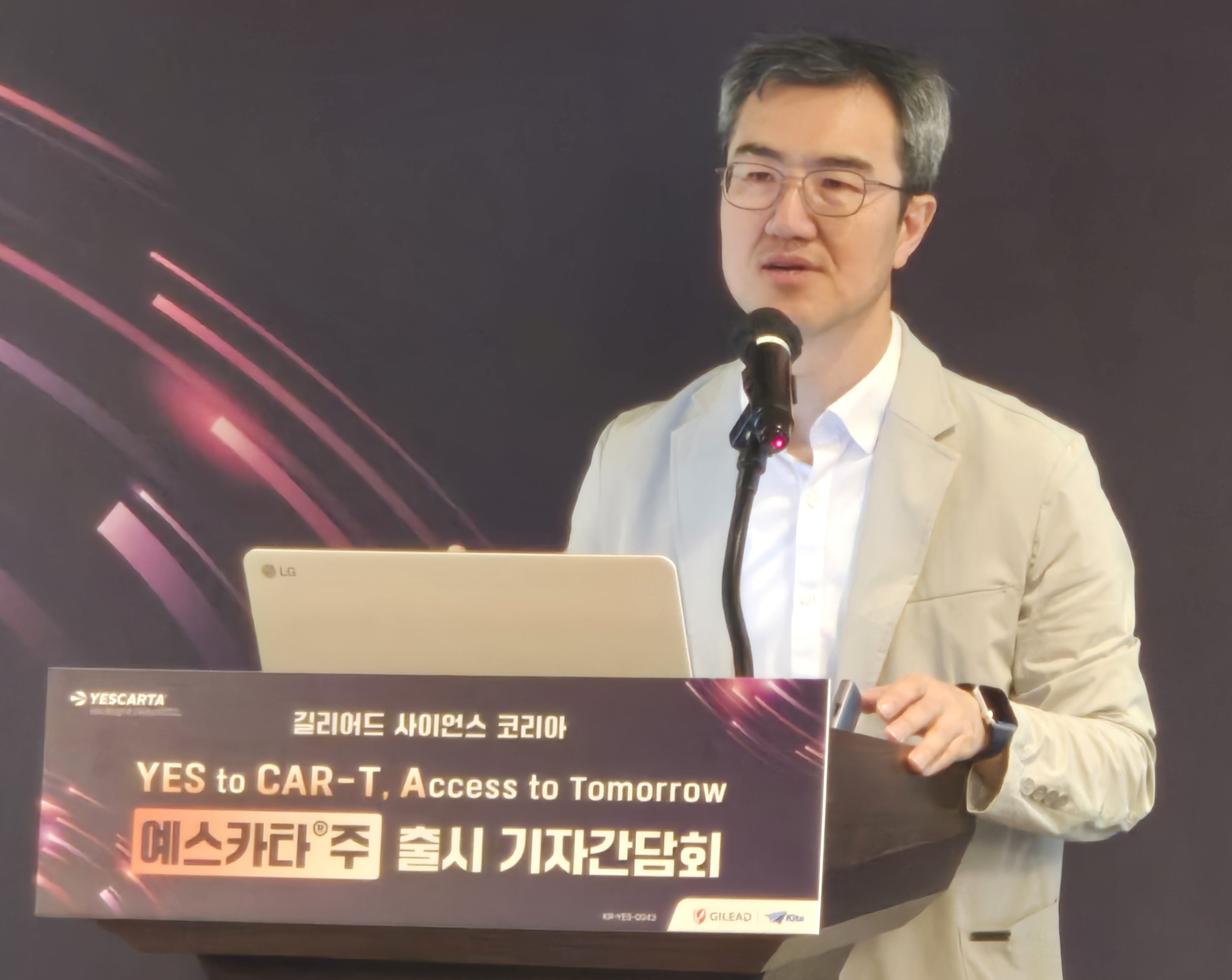
Professor Yoon said, “DLBCL is the most common subtype of non-Hodgkin lymphoma, and some patients experience relapse or become refractory even after first-line treatment. In particular, patients who relapse within one year have a very poor prognosis, making the choice of treatment in the second-line setting significantly important for long-term outcomes.”
DLBCL is one of the most aggressive forms of lymphoma. First-line treatment typically consists of R-CHOP-based chemoimmunotherapy (rituximab, cyclophosphamide, vincristine, and prednisone). While many patients can achieve complete remission with this regimen, approximately 30–40% eventually experience relapse or refractory disease.
The challenge arises after relapse. In Korea, salvage chemotherapy followed by autologous stem cell transplantation remains the primary treatment strategy. However, treatment outcomes remain limited in real-world practice.
“Response rates to salvage chemotherapy are generally low in relapsed or refractory patients, and only a limited number of patients proceed to autologous stem cell transplantation. Given the limitations of conventional therapies, it is important to implement advanced treatment options at the appropriate time to improve long-term survival.”
Value of second-line CAR-T therapy confirmed in clinical trials
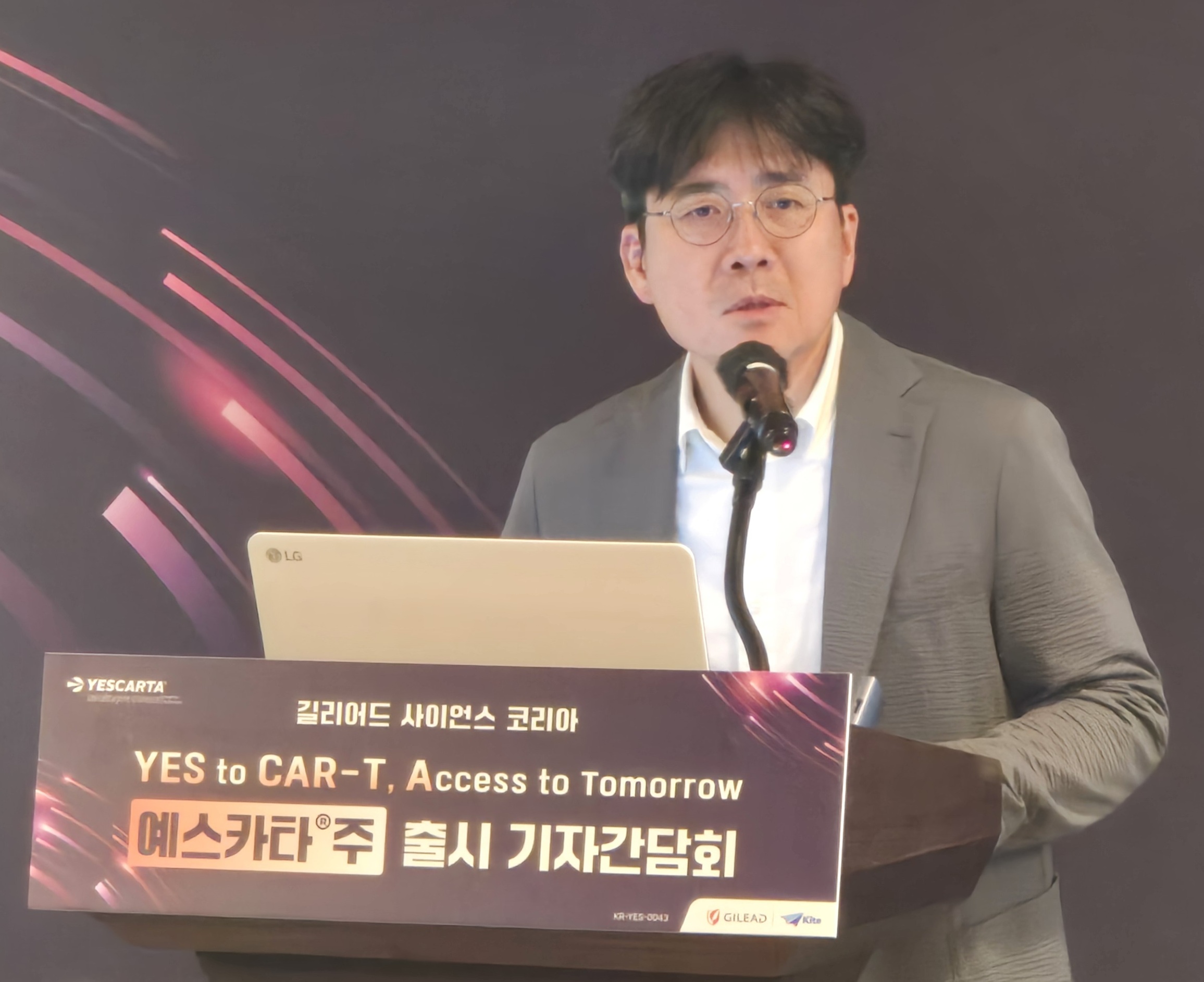
Professor Seok Jin Kim, Division of Hematology-Oncology at Samsung Medical Center, reviewed results from the pivotal ZUMA-7 study and emphasized the importance of the timing of CAR-T therapy.
Yescarta is a CAR-T therapy manufactured using a patient’s own T cells, which are genetically engineered to recognize CD19 expressed on the surface of cancer cells.
In Korea, Yescarta is approved for second-line treatment of adult patients with DLBCL that relapses within 12 months after first-line chemoimmunotherapy or is refractory to treatment, and for the treatment of relapsed or refractory DLBCL and primary mediastinal B-cell lymphoma (PMBCL) after at least two prior lines of systemic therapy.
Notably, it is currently the only CAR-T therapy approved in Korea as a second-line treatment.
The Phase III ZUMA-7 study compared Yescarta with standard-of-care treatment, including salvage chemotherapy and stem cell transplantation, in patients with large B-cell lymphoma who relapsed within 12 months of first-line therapy or were refractory to treatment.
Results showed that Yescarta significantly improved event-free survival (EFS) compared with standard treatment and reduced the risk of relapse or death by 60%. In a four-year follow-up analysis, Yescarta reduced the risk of death by 27%, while the median overall survival (OS) had not yet been reached.
“Even though a substantial number of patients in the standard-care arm later received CAR-T therapy or bispecific antibody treatments, the survival benefit of Yescarta was maintained. This demonstrates the importance of using CAR-T therapy at the appropriate stage rather than repeatedly administering multiple lines of therapy after relapse.”
He added, “Patients who relapse within one year or are refractory from the outset face an extremely high risk of death from the disease. That is why CAR-T should be considered from the second-line setting.”
Kim further noted, “More than half of these patients survived beyond four years, even though long-term survival would have been difficult to expect in the past in this population. The treatment goal in relapsed/refractory DLBCL is evolving from simple disease control to achieving long-term survival.”
Gap remains between global standards and Korean clinical practice
Experts also highlighted the shift toward earlier use of CAR-T therapy.
The current National Comprehensive Cancer Network (NCCN) guidelines recommend CAR-T therapy as a major second-line treatment option for patients with DLBCL who relapse within 12 months of first-line therapy or are refractory to treatment.
In the past, patients with relapsed disease were first treated with salvage chemotherapy and autologous stem cell transplantation, with CAR-T therapy considered only later in the treatment sequence. However, treatment paradigms are increasingly shifting toward earlier use of CAR-T therapy in high-risk patients.
Professor Kim said, “CAR-T therapy has already become a standard second-line treatment option in many countries. Korea also needs to establish an environment that allows patients to receive this therapy at the appropriate time.”
Yescarta is currently reimbursed in 30 countries worldwide, and the cumulative number of treated patients has surpassed 28,700. Gilead Sciences Korea stated that it plans to continue discussions to broaden treatment access for patients in Korea.
-

- 0
댓글 운영방식은
댓글은 실명게재와 익명게재 방식이 있으며, 실명은 이름과 아이디가 노출됩니다. 익명은 필명으로 등록 가능하며, 대댓글은 익명으로 등록 가능합니다.
댓글 노출방식은
댓글 명예자문위원(팜-코니언-필기모양 아이콘)으로 위촉된 데일리팜 회원의 댓글은 ‘게시판형 보기’와 ’펼쳐보기형’ 리스트에서 항상 최상단에 노출됩니다. 새로운 댓글을 올리는 일반회원은 ‘게시판형’과 ‘펼쳐보기형’ 모두 팜코니언 회원이 쓴 댓글의 하단에 실시간 노출됩니다.
댓글의 삭제 기준은
다음의 경우 사전 통보없이 삭제하고 아이디 이용정지 또는 영구 가입제한이 될 수도 있습니다.
-
저작권·인격권 등 타인의 권리를 침해하는 경우
상용 프로그램의 등록과 게재, 배포를 안내하는 게시물
타인 또는 제3자의 저작권 및 기타 권리를 침해한 내용을 담은 게시물
-
근거 없는 비방·명예를 훼손하는 게시물
특정 이용자 및 개인에 대한 인신 공격적인 내용의 글 및 직접적인 욕설이 사용된 경우
특정 지역 및 종교간의 감정대립을 조장하는 내용
사실 확인이 안된 소문을 유포 시키는 경우
욕설과 비어, 속어를 담은 내용
정당법 및 공직선거법, 관계 법령에 저촉되는 경우(선관위 요청 시 즉시 삭제)
특정 지역이나 단체를 비하하는 경우
특정인의 명예를 훼손하여 해당인이 삭제를 요청하는 경우
특정인의 개인정보(주민등록번호, 전화, 상세주소 등)를 무단으로 게시하는 경우
타인의 ID 혹은 닉네임을 도용하는 경우
-
게시판 특성상 제한되는 내용
서비스 주제와 맞지 않는 내용의 글을 게재한 경우
동일 내용의 연속 게재 및 여러 기사에 중복 게재한 경우
부분적으로 변경하여 반복 게재하는 경우도 포함
제목과 관련 없는 내용의 게시물, 제목과 본문이 무관한 경우
돈벌기 및 직·간접 상업적 목적의 내용이 포함된 게시물
게시물 읽기 유도 등을 위해 내용과 무관한 제목을 사용한 경우
-
수사기관 등의 공식적인 요청이 있는 경우
-
기타사항
각 서비스의 필요성에 따라 미리 공지한 경우
기타 법률에 저촉되는 정보 게재를 목적으로 할 경우
기타 원만한 운영을 위해 운영자가 필요하다고 판단되는 내용
-
사실 관계 확인 후 삭제
저작권자로부터 허락받지 않은 내용을 무단 게재, 복제, 배포하는 경우
타인의 초상권을 침해하거나 개인정보를 유출하는 경우
당사에 제공한 이용자의 정보가 허위인 경우 (타인의 ID, 비밀번호 도용 등)
※이상의 내용중 일부 사항에 적용될 경우 이용약관 및 관련 법률에 의해 제재를 받으실 수도 있으며, 민·형사상 처벌을 받을 수도 있습니다.
※위에 명시되지 않은 내용이더라도 불법적인 내용으로 판단되거나 데일리팜 서비스에 바람직하지 않다고 판단되는 경우는 선 조치 이후 본 관리 기준을 수정 공시하겠습니다.
※기타 문의 사항은 데일리팜 운영자에게 연락주십시오. 메일 주소는 dailypharm@dailypharm.com입니다.