- LOGIN
- MemberShip
- 2026-09-13 11:56:28
- 'Vadanem' prescription strategies specified
- by Son, Hyung Min | translator Hong, Ji Yeon | 2026-05-12 11:30:42
The scope of Vadanem (vadadustat), a treatment for renal anemia, is expanding in clinical practice beyond being a simple alternative to Erythropoiesis-Stimulating Agents (ESAs). This follows the growing need for a patient-centered approach that considers application criteria based on dialysis status, the timing of treatment switching, and the specific characteristics of iron metabolism and the hemoglobin (Hb) response.
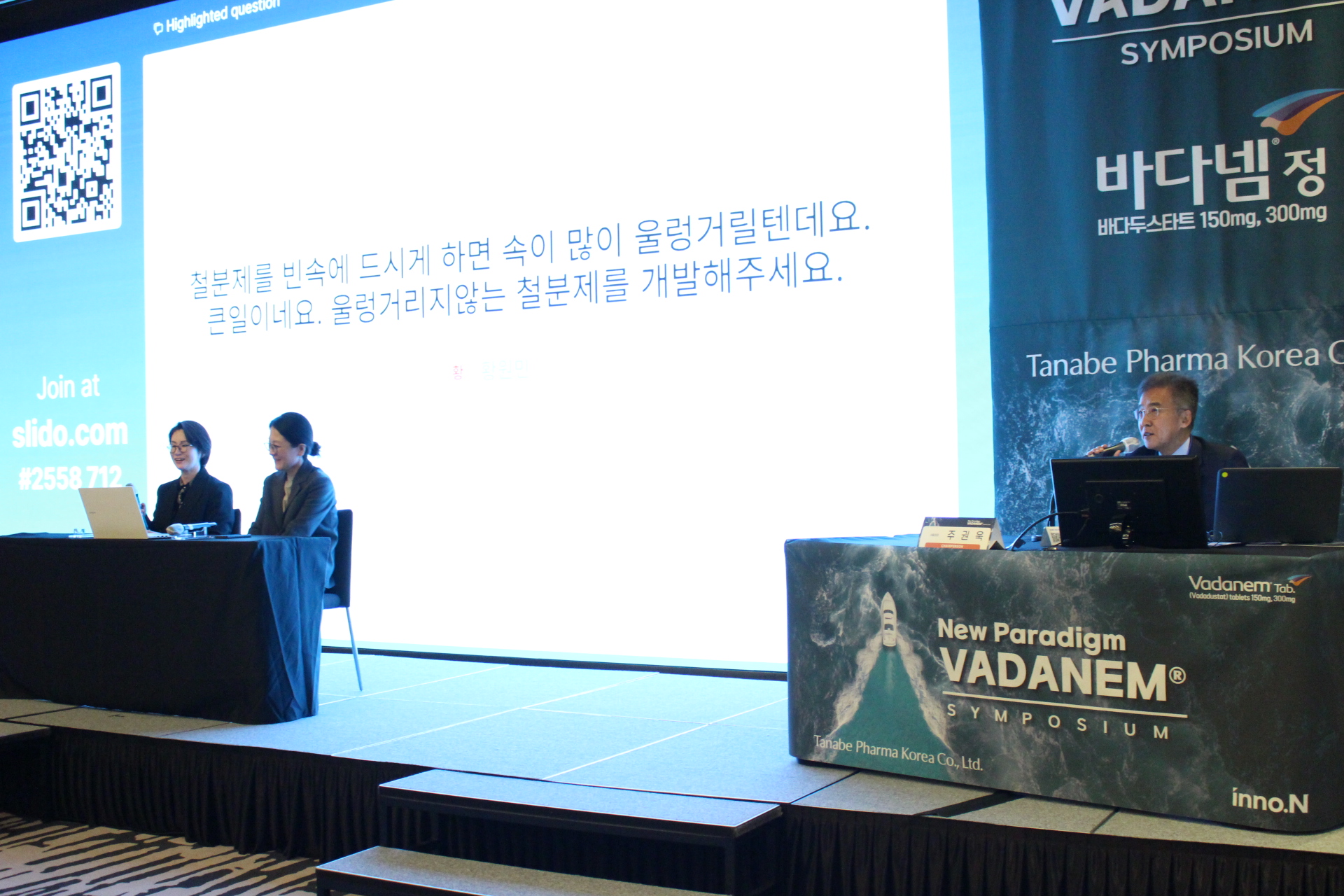
Tanabe Pharma Korea and HK inno.N recently held the ‘New Paradigm VADANEM Symposium’ in Seoul to share clinical application strategies, focusing on application criteria by dialysis status, treatment switching timing, and the characteristics of iron metabolism and Hb response.
On the first day, chaired by Professor Bum Soon Choi (Catholic Univ. College of Medicine), presentations were given by Professor Dong Ki Kim (Seoul National Univ. College of Medicine) and Professor Sungjin Jung (Catholic Univ. College of Medicine). On the second day, chaired by Professor Kwon-Wook Ju (Seoul National Univ. College of Medicine), the session featured presentations by Professor Gang Jee Ko (Korea Univ. College of Medicine) and Professor Eun Sil Koh (Catholic Univ. College of Medicine).

Application strategies vary by dialysis status and ESA response
Vadanem is an oral Hypoxia-Inducible Factor Prolyl Hydroxylase Inhibitor (HIF-PHI) that signals a shift away from the existing injection-centered treatment structure, dominated by ESAs. It has recently improved patient access following its inclusion in the domestic health insurance reimbursement list.
However, experts reached consensus that a granular application strategy based on patient status is required in clinical practice, rather than solely on the convenience of an oral medication.
Renal anemia is characterized by decreased erythropoietin (EPO) production as Chronic Kidney Disease (CKD) progresses, often accompanied by 'functional iron deficiency.' As hepcidin increases due to inflammation, a state arises in which iron cannot be utilized even when there is sufficient iron in the body.
Given such an environment, 'ESA hyporesponsiveness,' where response to ESA treatment is poor, becomes an issue. Experts explained that for many patients, maintaining Hb levels is difficult despite high doses of ESA.
Professor Dong Ki Kim said, "Since sufficient clinical experience with ESA treatment has been accumulated for dialysis patients, we should consider Hb variability and stability rather than simply switching drugs. New options can be reviewed for patients who have difficulty maintaining target Hb or experience high variability in existing treatments."
He added, "For non-dialysis patients, the fact that it is an oral medication can serve as a significant variable in treatment selection. An approach that considers oral options from the initial treatment stage is entirely feasible."
Additionally, it was noted that Vadanem could be considered an alternative for patient groups in whom Hb response is insufficient or variability is high despite ESA treatment. It was emphasized that the stability of Hb maintenance and treatment sustainability should be evaluated alongside simple numerical improvements.
Experts suggested the following as potential patients for Vadanem ▲Patients with ESA hyporesponsiveness ▲Patients with concurrent inflammation ▲Non-dialysis patients with a high burden of injection therapy. A key point mentioned was that improvements in iron utilization efficiency can be expected in patients with functional iron deficiency.
Another characteristic of Vadanem is its mechanistic differentiation regarding iron metabolism regulation. As it increases the efficiency of iron utilization in the body through the HIF pathway, analysis suggests that its coordination with iron supplementation strategies may differ from that of existing ESAs.
Vadanem does not simply supplement EPO.It possesses a mechanism that induces "complete erythropoiesis" by simultaneously regulating iron absorption, transport, and utilization.
Professor Sungjin Jung said, "HIF-PHI class treatments have the characteristic of regulating Hb more physiologically through mechanisms linked to iron metabolism. The fact that Hb increase patterns may appear differently compared to ESAs must be considered clinically."
He emphasized, "Since treatment response can vary depending on iron status, an approach that evaluates iron metabolism indicators along with Hb levels is necessary."
Hb response and iron metabolism variables…"Patient-specific approaches needed"
Presenters explained that setting treatment goals based on patient characteristics is important, especially since the focus can be on maintaining Hb stably within a more physiological range rather than a rapid surge.
For prescriptions, a strategy was suggested to start with 300 mg of Vadanem once daily, maintain it for a period, and then increase the dose based on response. It was emphasized that closely monitoring the rate of Hb increase in the early stages is crucial, and that dose adjustments are necessary if Hb rises too sharply.
Furthermore, discussions on the timing of treatment switching continued. Switching to Vadanem can be a strategy for patient groups with declining response or side effect concerns during ESA treatment, and the possibility of considering oral agents from the initial treatment stage is expected to expand.
Professor Gang Jee Ko said, "For patients whose ESA doses must be continuously raised or who have difficulty maintaining target Hb, treatment strategies need to be reviewed. For these patient groups, switching to Vadanem can be a realistic option."
She added, "If a burden or compliance issue regarding injections arises during long-term treatment, switching to an oral agent is meaningful for patient management."
Professor Koh Eun-sil also emphasized, "In the future, a trend may emerge where oral agents are considered as initial treatment options rather than just alternatives after ESA. It is important to flexibly design treatment strategies considering patient characteristics."
Additionally, Professor Ko mentioned the need for managing drug interactions due to the nature of oral medications.
Professor Ko concluded by explaining that "When co-administered with iron supplements or phosphate binders, drug absorption may decrease, so it is recommended to stagger administration times. Dose adjustments may also be necessary when co-administered with certain other drugs."
-

- 0
댓글 운영방식은
댓글은 실명게재와 익명게재 방식이 있으며, 실명은 이름과 아이디가 노출됩니다. 익명은 필명으로 등록 가능하며, 대댓글은 익명으로 등록 가능합니다.
댓글 노출방식은
댓글 명예자문위원(팜-코니언-필기모양 아이콘)으로 위촉된 데일리팜 회원의 댓글은 ‘게시판형 보기’와 ’펼쳐보기형’ 리스트에서 항상 최상단에 노출됩니다. 새로운 댓글을 올리는 일반회원은 ‘게시판형’과 ‘펼쳐보기형’ 모두 팜코니언 회원이 쓴 댓글의 하단에 실시간 노출됩니다.
댓글의 삭제 기준은
다음의 경우 사전 통보없이 삭제하고 아이디 이용정지 또는 영구 가입제한이 될 수도 있습니다.
-
저작권·인격권 등 타인의 권리를 침해하는 경우
상용 프로그램의 등록과 게재, 배포를 안내하는 게시물
타인 또는 제3자의 저작권 및 기타 권리를 침해한 내용을 담은 게시물
-
근거 없는 비방·명예를 훼손하는 게시물
특정 이용자 및 개인에 대한 인신 공격적인 내용의 글 및 직접적인 욕설이 사용된 경우
특정 지역 및 종교간의 감정대립을 조장하는 내용
사실 확인이 안된 소문을 유포 시키는 경우
욕설과 비어, 속어를 담은 내용
정당법 및 공직선거법, 관계 법령에 저촉되는 경우(선관위 요청 시 즉시 삭제)
특정 지역이나 단체를 비하하는 경우
특정인의 명예를 훼손하여 해당인이 삭제를 요청하는 경우
특정인의 개인정보(주민등록번호, 전화, 상세주소 등)를 무단으로 게시하는 경우
타인의 ID 혹은 닉네임을 도용하는 경우
-
게시판 특성상 제한되는 내용
서비스 주제와 맞지 않는 내용의 글을 게재한 경우
동일 내용의 연속 게재 및 여러 기사에 중복 게재한 경우
부분적으로 변경하여 반복 게재하는 경우도 포함
제목과 관련 없는 내용의 게시물, 제목과 본문이 무관한 경우
돈벌기 및 직·간접 상업적 목적의 내용이 포함된 게시물
게시물 읽기 유도 등을 위해 내용과 무관한 제목을 사용한 경우
-
수사기관 등의 공식적인 요청이 있는 경우
-
기타사항
각 서비스의 필요성에 따라 미리 공지한 경우
기타 법률에 저촉되는 정보 게재를 목적으로 할 경우
기타 원만한 운영을 위해 운영자가 필요하다고 판단되는 내용
-
사실 관계 확인 후 삭제
저작권자로부터 허락받지 않은 내용을 무단 게재, 복제, 배포하는 경우
타인의 초상권을 침해하거나 개인정보를 유출하는 경우
당사에 제공한 이용자의 정보가 허위인 경우 (타인의 ID, 비밀번호 도용 등)
※이상의 내용중 일부 사항에 적용될 경우 이용약관 및 관련 법률에 의해 제재를 받으실 수도 있으며, 민·형사상 처벌을 받을 수도 있습니다.
※위에 명시되지 않은 내용이더라도 불법적인 내용으로 판단되거나 데일리팜 서비스에 바람직하지 않다고 판단되는 경우는 선 조치 이후 본 관리 기준을 수정 공시하겠습니다.
※기타 문의 사항은 데일리팜 운영자에게 연락주십시오. 메일 주소는 dailypharm@dailypharm.com입니다.