- LOGIN
- MemberShip
- 2026-05-15 10:40:17
- Prescription drop amid COVID-19 finally emerges in April
- by Chon, Seung-Hyun | translator Byun Kyung A | 2020-06-02 06:09:08
The outpatient prescription volume in April has dropped by 10 percent against the same month last year.
The outcome contrasts to this year’s first quarter prescription volume showing an increase against last year.
Although the COVID-19 confirmed case curve in Korea seems to have gone down from April, the prescription volume shrunk even worse.
As chronic disease patients have received long-term prescription in the first quarter to avoid visiting healthcare institutes amid COVID-19, a long break in prescription has seemingly occurred in the month of April.
According to pharmaceutical market research firm UBIST on May 25, the total outpatient prescription volume in April was at 1.19 trillion won, which was brought down by 8.7 percent than in last year.
In 2018 and 2019, the April prescription volumes have surged by 8.3 percent and 13.1 percent, respectively, compared to the previous year, but it bounced back down in last April.
The April prescription volume this year has hit the lowest point in ten months since June last year.

Since the first confirmed case of COVID-19 in Korea, the industry was deeply concerned that the prescription drug market would be shaken as pharmaceutical companies’ sales activities have been diminished and increasing number of outpatient refrained from visiting healthcare providers.
But, the prescription volume up to March did not seem affected.
Apparently, the prescription volume in the first quarter reached 3.70 trillion won, which was 2.7 percent higher than last year first quarter at 3.60 trillion won.
The monthly prescription volume in January this year was dropped by 4.4 percent than last year by generating 1.22 trillion won.
On the contrary, the February prescription volume this year was surged by 13.0 percent, generating 1.22 trillion.
The industry experts analyze the number of business days in January and February have been affected by the early Lunar New Year holidays in Korea.
This year’s January with less number of business days than last year had less prescription volume and February with more business days this year had increased volume.
The total prescription volume in March was at 1.23 trillion won with 1.4 percent growth from last year.
But the volume in April had the steepest fall so far in the year.
In last year’s April, the prescription volume soared by 7.4 percent than the previous month, but this year’s April had a 3.2 percent dip from March.
Many of chronic disease patients receiving long-term prescription to avoid visiting healthcare providers could have created a significant prescription drop in April.
Apparently, the cases of patients receiving three to six months worth of prescription have skyrocketed when the confirmed case of COVID-19 peaked in Korea.
The experts also suspect the postponed school semester, social distancing and better-managed personal hygiene could have reduced the disease prevalence in infants and children, which also affected the drop in the number of visit to healthcare institute.
A majority of pharmaceutical companies in April had sluggish outcome in prescription volume.
Among the top ten companies—Hanmi Pharmaceutical, Chong Kun Dang, Pifzer, Daewong Pharmaceutical, MSD, Novartis, Yuhan, Boehringer Ingelheim, HK inno.N and AstraZeneca—nine companies except for AstraZeneca had stagnating prescription volume in April than the year before.
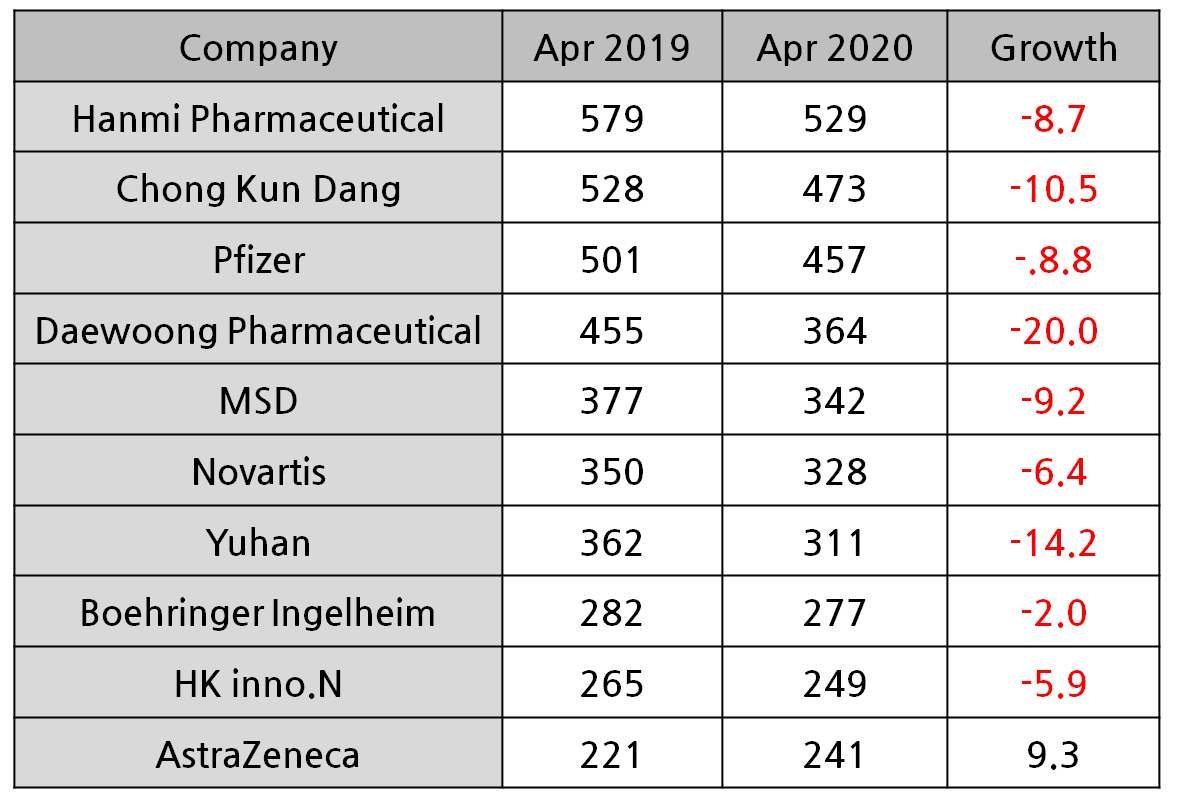
The Korean company’s first quarter volume was increased by 6.2 percent than in last year, but the volume was pulled back down in April.
Chong Kun Dang and Pfizer’s April prescription volumes also had significant drop of 10.5 percent and 8.8 percent, respectively.
Chong Kun Dang had a 1.7 percent growth in the first quarter, but the company took a steep fall in April.
Pfizer’s first quarter prescription volume was dropped by 4.1 percent, and the figure got worse in April.
The companies with the highest prescription volume, such as Daewoong Pharmaceutical, MSD, Novartis, Yuhan, Boehringer Ingelheim and HK inno.N, all performed worse than last year.
Meanwhile, AstraZeneca made 9.3 percent more in this year’s April than last year.
The multinational company’s first quarter prescription volume also grew by 9.7 percent from the year before.
The pharmaceutical industry expects the prescription drug market would take a sharp upturn soon, as the number of confirmed COVID-19 cases has been dropping and the social distancing has been shifted to distancing in daily life.
-

- 0
댓글 운영방식은
댓글은 실명게재와 익명게재 방식이 있으며, 실명은 이름과 아이디가 노출됩니다. 익명은 필명으로 등록 가능하며, 대댓글은 익명으로 등록 가능합니다.
댓글 노출방식은
댓글 명예자문위원(팜-코니언-필기모양 아이콘)으로 위촉된 데일리팜 회원의 댓글은 ‘게시판형 보기’와 ’펼쳐보기형’ 리스트에서 항상 최상단에 노출됩니다. 새로운 댓글을 올리는 일반회원은 ‘게시판형’과 ‘펼쳐보기형’ 모두 팜코니언 회원이 쓴 댓글의 하단에 실시간 노출됩니다.
댓글의 삭제 기준은
다음의 경우 사전 통보없이 삭제하고 아이디 이용정지 또는 영구 가입제한이 될 수도 있습니다.
-
저작권·인격권 등 타인의 권리를 침해하는 경우
상용 프로그램의 등록과 게재, 배포를 안내하는 게시물
타인 또는 제3자의 저작권 및 기타 권리를 침해한 내용을 담은 게시물
-
근거 없는 비방·명예를 훼손하는 게시물
특정 이용자 및 개인에 대한 인신 공격적인 내용의 글 및 직접적인 욕설이 사용된 경우
특정 지역 및 종교간의 감정대립을 조장하는 내용
사실 확인이 안된 소문을 유포 시키는 경우
욕설과 비어, 속어를 담은 내용
정당법 및 공직선거법, 관계 법령에 저촉되는 경우(선관위 요청 시 즉시 삭제)
특정 지역이나 단체를 비하하는 경우
특정인의 명예를 훼손하여 해당인이 삭제를 요청하는 경우
특정인의 개인정보(주민등록번호, 전화, 상세주소 등)를 무단으로 게시하는 경우
타인의 ID 혹은 닉네임을 도용하는 경우
-
게시판 특성상 제한되는 내용
서비스 주제와 맞지 않는 내용의 글을 게재한 경우
동일 내용의 연속 게재 및 여러 기사에 중복 게재한 경우
부분적으로 변경하여 반복 게재하는 경우도 포함
제목과 관련 없는 내용의 게시물, 제목과 본문이 무관한 경우
돈벌기 및 직·간접 상업적 목적의 내용이 포함된 게시물
게시물 읽기 유도 등을 위해 내용과 무관한 제목을 사용한 경우
-
수사기관 등의 공식적인 요청이 있는 경우
-
기타사항
각 서비스의 필요성에 따라 미리 공지한 경우
기타 법률에 저촉되는 정보 게재를 목적으로 할 경우
기타 원만한 운영을 위해 운영자가 필요하다고 판단되는 내용
-
사실 관계 확인 후 삭제
저작권자로부터 허락받지 않은 내용을 무단 게재, 복제, 배포하는 경우
타인의 초상권을 침해하거나 개인정보를 유출하는 경우
당사에 제공한 이용자의 정보가 허위인 경우 (타인의 ID, 비밀번호 도용 등)
※이상의 내용중 일부 사항에 적용될 경우 이용약관 및 관련 법률에 의해 제재를 받으실 수도 있으며, 민·형사상 처벌을 받을 수도 있습니다.
※위에 명시되지 않은 내용이더라도 불법적인 내용으로 판단되거나 데일리팜 서비스에 바람직하지 않다고 판단되는 경우는 선 조치 이후 본 관리 기준을 수정 공시하겠습니다.
※기타 문의 사항은 데일리팜 운영자에게 연락주십시오. 메일 주소는 dailypharm@dailypharm.com입니다.
- [Reporter's View] The dark side of improved diabetes med convenience
- Reporter's view | Son, Hyung Min

- [Reporter's View] Contradiction of "K-passing" and a new drug powerhouse
- Reporter's view | Lee, Jeong-Hwan