- LOGIN
- MemberShip
- 2026-09-14 22:59:27
- Korean bio-pharma companies attract attention at AACR 2021
- by Whang, byung-woo | translator Alice Kang | 2021-04-21 05:49:29
The AACR 2021 Annual Meeting, the largest meeting on cancer research in the world, took place from April 10th to April 15th.
At the meeting, new combination therapies were introduced, raising expectations for the use of new mechanisms of action in the field of cancer treatment.
Through a presentation of data on the use of nivolumab (Opdivo) in early-stage non-small cell lung cancer (NSCLC), Bristol Myers Squibb (BMS) presented its next target area for its PD-1/L1 inhibitor.
Bayer appealed the efficacy of its PI3K inhibitor copanlisib (Aliqopa) in combination with rituximab.

Patients with early-stage NSCLC who received the Opdivo-chemotherapy combination before surgery were nearly 14 times more likely to show no signs of cancer cells in their resected tissue than those who received only chemotherapy.
The findings came from the Phase III CheckMate-816 trial, which enrolled patients with stage IB to IIIA NSCLC.
BMS explained that this was the first time for a presurgery use of the Opdivo-chemotherapy combination to show a significant improvement in the complete pathological response in patients with earlier stage NSCLC More specifically, 24% of patients receiving the Opdivo-chemotherapy combination had a pathological complete response (pCR) which was defined as no residual viable tumors in their resected tissues and lymph nodes, compared with 2.2% in the chemotherapy alone arm, Also, pathological response in patients in the Opdivo combination group was 36.9%, significantly higher than the 8.9% in the chemotherapy alone group.
Patrick Forde, professor at Johns Hopkins University said, “For the first time in a phase III trial, we see the potential for an anti-PD-1 immunotherapy to improve outcomes in earlier-stage NSCLC.
We are highly encouraged by the marked improvement in pCR, the overall good tolerability, and the absence of impact on surgery feasibility when nivolumab is added to neoadjuvant chemotherapy,”
The data was from the Phase III Chronos-3 trial, in which patients were randomly assigned to copanlisib-rituximab combination (307 patients) or placebo-rituximab combination (151 patients) After a median follow-up of 19.2 months, the study met its primary endpoint of progression-free survival (PFS), showing a 48% reduction in the risk of lymphoma progression or death in the copanlisib-rituximab arm.
The overall response rate (ORR) was 80% in the copanlisib-rituximab arm and 47.7% in the placebo-rituximab arm.
The complete response rate (CRR) was 33.9% in the copanlisib-rituximab arm, compared to the 14.6% in the placebo-rituximab arm.
Regarding the results, Bayer stated that Aliqopa was the first PI3K inhibitor to demonstrate superior efficacy in combination with Rituxan with a manageable safety profile in patients with relapsed iNHL.
Also, Lilly presented the potential of its Retevmo to be approved for indications other than those reived for lung cancer and thyroid cancer with RET abnormalities.
At the annual meeting, Lilly announced that Retevmo shrunk tumors in 47% of patients with RET fusion-positive cancers originating from different sites in the body other than the lung and the thyroid in a Phase 1/2 study.
In particular, Lilly emphasized that more than half of the patients still showed benefits after a median follow-up of 13 months.
The 47% tumor response rate presented at the 2021 AACR was generated from 32 patients that had 12 unique cancer types with RET fusion.
Over 60% of patients had treatment-resistant gastrointestinal cancers that typically do not respond well to targeted therapy.
Based on such data, the company said it plans to take the ‘tumor agnostic' approach with Retevmo.
Clinical research by domestic biopharmaceutical companies presented at AACR mostly ended at preclinical trial outcomes or examining the potential of combination therapies.
However, some showed promise by drawing a response rate from patients that did not respond to existing drugs.
At the poster session held on the 12th, PharmAbcine presented the nonclinical data of its immune-oncology drug candidate PMC-309.
PMC-309 is showing promise as an immunotherapeutic strategy to be used alone or in combination for patients who showed no response to existing immune-oncology drugs by inhibiting a new immune checkpoint.
PMC-309 is a monoclonal IgG (Immunoglobulin G) that targets human VISTA (V-domain Ig Suppressor of T cell Activation), an immune checkpoint regulator.
The nonclinical study results show that PMC-309 increased T cell activities in in-vitro settings with its anti-VISTA effect.
In in vivo studies using a human VISTA Knock-In mouse model, the tumor growth inhibition was significantly higher for the PMC-309 group compared to the control group.
The tumor growth inhibition rate was comparable to the PD-1 administered group and showed a possible synergistic effect when used in combination with existing immunotherapy.
The company plans to evaluate the potential toxicity risk of PMC-309 this year to submit for the IND (Investigational New Drug)-enabling studies, and expects to enter the clinical stage next year.
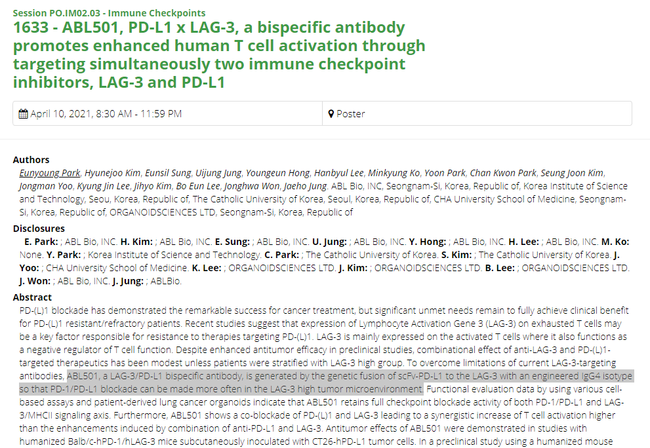
ABL Bio presented the preclinical trial results of its bispecific antibody dual immune checkpoint blockade that includes the target LAG-3, an emerging next-generation immuno-oncology drug.
ABL501 is a bispecific antibody that simultaneously targets both PD-L1 and LAG-3.
Recently, BMS announced successful results of a Phase II/III trial using its anti-LAG-3 antibody(elatlimab) in combination with its PD-1 inhibitor (nivolumab) in patients with melanoma, bringing the candidate substance one step closer to commercialization.
In-vitro and in-vivo assessments of the drug demonstrated that ABL501 showed better anti-tumor effect than the PD-L1and LAG-3 combination therapy.
With such positive results, the drug was evaluated to have potential as a new alternative to patients who did not see an effect with existing PD-1 or PD-L1-based therapies.
ABL Bio plans to submit a Phase 1 Investigational New Drug Application (IND) based on the data.
MedPacto presented the potential to use its immune-oncology drug Vactosertib as a combination therapy.
The combination of Vactosertib and Onivyde was found to significantly reduce metastasis of cancer cells and greatly improved survival rates compared to Onivyde alone.
In the 50-day study of the combination using animal models, the survival rate of the group that was not administered Vactosertib and the group that used the current established treatment was 23% and 53% respectively.
However, the Vactosertib combination group’s survival rate improved to reach 84%.
This suggests the potential of the combination as a new treatment option.
Also, Qurient announced the results for its CDK-7 inhibitor ‘Q901’ and received attention for its potential as an alternative for patients developing resistance.
Although the study is yet in its in-vivo stages, Q901 showed tumor growth inhibition effect in mice that developed resistance to the CDK4·6 inhibitor (Ibrance), suggesting its potential in patients who developed resistance to existing breast cancer treatments that may found in clinical studies in the future.
-

- 0
댓글 운영방식은
댓글은 실명게재와 익명게재 방식이 있으며, 실명은 이름과 아이디가 노출됩니다. 익명은 필명으로 등록 가능하며, 대댓글은 익명으로 등록 가능합니다.
댓글 노출방식은
댓글 명예자문위원(팜-코니언-필기모양 아이콘)으로 위촉된 데일리팜 회원의 댓글은 ‘게시판형 보기’와 ’펼쳐보기형’ 리스트에서 항상 최상단에 노출됩니다. 새로운 댓글을 올리는 일반회원은 ‘게시판형’과 ‘펼쳐보기형’ 모두 팜코니언 회원이 쓴 댓글의 하단에 실시간 노출됩니다.
댓글의 삭제 기준은
다음의 경우 사전 통보없이 삭제하고 아이디 이용정지 또는 영구 가입제한이 될 수도 있습니다.
-
저작권·인격권 등 타인의 권리를 침해하는 경우
상용 프로그램의 등록과 게재, 배포를 안내하는 게시물
타인 또는 제3자의 저작권 및 기타 권리를 침해한 내용을 담은 게시물
-
근거 없는 비방·명예를 훼손하는 게시물
특정 이용자 및 개인에 대한 인신 공격적인 내용의 글 및 직접적인 욕설이 사용된 경우
특정 지역 및 종교간의 감정대립을 조장하는 내용
사실 확인이 안된 소문을 유포 시키는 경우
욕설과 비어, 속어를 담은 내용
정당법 및 공직선거법, 관계 법령에 저촉되는 경우(선관위 요청 시 즉시 삭제)
특정 지역이나 단체를 비하하는 경우
특정인의 명예를 훼손하여 해당인이 삭제를 요청하는 경우
특정인의 개인정보(주민등록번호, 전화, 상세주소 등)를 무단으로 게시하는 경우
타인의 ID 혹은 닉네임을 도용하는 경우
-
게시판 특성상 제한되는 내용
서비스 주제와 맞지 않는 내용의 글을 게재한 경우
동일 내용의 연속 게재 및 여러 기사에 중복 게재한 경우
부분적으로 변경하여 반복 게재하는 경우도 포함
제목과 관련 없는 내용의 게시물, 제목과 본문이 무관한 경우
돈벌기 및 직·간접 상업적 목적의 내용이 포함된 게시물
게시물 읽기 유도 등을 위해 내용과 무관한 제목을 사용한 경우
-
수사기관 등의 공식적인 요청이 있는 경우
-
기타사항
각 서비스의 필요성에 따라 미리 공지한 경우
기타 법률에 저촉되는 정보 게재를 목적으로 할 경우
기타 원만한 운영을 위해 운영자가 필요하다고 판단되는 내용
-
사실 관계 확인 후 삭제
저작권자로부터 허락받지 않은 내용을 무단 게재, 복제, 배포하는 경우
타인의 초상권을 침해하거나 개인정보를 유출하는 경우
당사에 제공한 이용자의 정보가 허위인 경우 (타인의 ID, 비밀번호 도용 등)
※이상의 내용중 일부 사항에 적용될 경우 이용약관 및 관련 법률에 의해 제재를 받으실 수도 있으며, 민·형사상 처벌을 받을 수도 있습니다.
※위에 명시되지 않은 내용이더라도 불법적인 내용으로 판단되거나 데일리팜 서비스에 바람직하지 않다고 판단되는 경우는 선 조치 이후 본 관리 기준을 수정 공시하겠습니다.
※기타 문의 사항은 데일리팜 운영자에게 연락주십시오. 메일 주소는 dailypharm@dailypharm.com입니다.