- LOGIN
- MemberShip
- 2026-09-16 15:19:49
- Unsure efficacy of Alzheimer's drug aducanumab
- by Choi-sun | translator Alice Kang | 2022-05-10 06:07:04
The Korean Dementia Association has reviewed the clinical potential of aducanumab (Aduhelm), the first new drug for Alzheimer's disease to be introduced to the field in 18 years.
With the efficacy of the drug under constant debate, and being barely approved for its effect in reducing surrogate biomarkers such as amyloid reduction in Korea and turned down in Europe, KDA’s position is that verification over time is required to confirm the drug’s actual effect.
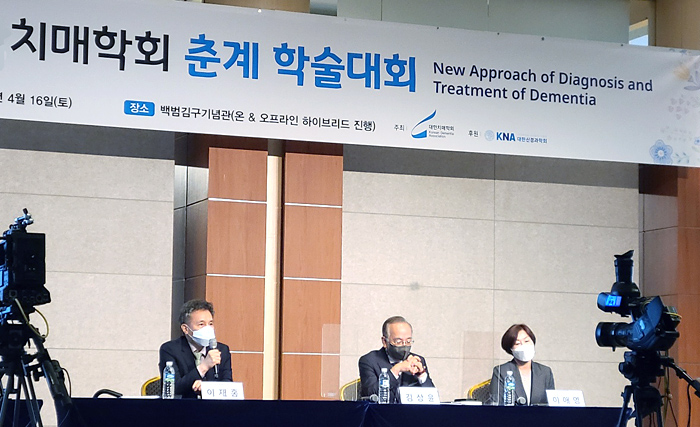
At the event, held a panel discussion session with 4 members including KDA Chair Dong-Won Yang and KDA President Ae Young Lee.
In June 2021, the US FDA granted conditional approval for aducanumab as a treatment for Alzheimer’s.
Aducanumab, which is a monoclonal antibody developed to target the mechanism of Alzheimer’s Disease, had become the first new drug to be approved for Alzheimer’s since 2003.
As abnormal accumulation and aggregation of beta-amyloid plaques are reported in the brains of patients with Alzheimer’s, the widely-accepted theory in the field was that these protein buildups (plaques) generate neurotoxins and gradually deteriorate the cognitive function of the brain.
Aducanumab was developed to remove this plaque, and although it is not a cure, its effect in was in slowing down cognitive decline in patients was recognized.
But still, there is an ongoing debate on whether the drug is ‘clinically effective’ in academia, including among FDA’s internal advisors.
As the drug failed to demonstrate efficacy in the clinical trial that used the change from baseline on the Clinical Dementia Rating Scale Sum of Boxes (CDR-SB) as the scale, experts judged that it is difficult to definitively acknowledge the drug’s effect only with the surrogate endpoint that demonstrated reduced amyloid accumulation.
Fully aware of such controversy during its review, the FDA had set a condition upon approval that Biogen will have to conduct post-approval studies to verify the treatment’s anticipated clinical benefit in addition to the amyloid PET results.
However, the EMA refused to grant marketing authorization for the drug.
Through a statement, KDA had announced, “Despite much controversy, approval of aducanumab is in itself encouraging news for patients, clinical doctors and researchers in the field,” and stressed that the association will make efforts to rigorously verify the drug’s effect with science in the future to members while sharing relevant information.
The panel discussion also focused on whether the amyloid plaque removal mechanism translates to real clinical efficacy.
Jae Hong Lee, Professor of Neurology at Seoul Asan Medical Center, said, “As the drug wasn’t able to reach the primary efficacy endpoint of the trial, it is difficult to readily embrace the FDA's approval result.
However, I believe the FDA approved the new drug despite headwinds as the promise of a cure with new drugs in development is a long way off.
Lee added, “Considering the strict standards that have been applied to new drugs for Alzheimer's disease so far, the drug was difficult to be approved.
To some, the CDR-SB improvement in patients who were administered the 10mg high-dose over 14 times in the post-analysis may seem far-fetched.” “Results show only 0.1% of the patients passed the final clinical review.
This is an unconventional and proactive attitude on the FDA’s part when considering FDA’s traditional approval standards.
In the ENGAGE trial, the drug failed to demonstrate its clinical efficacy but demonstrated a reduction in biomarkers, therefore, whether the improvement in biomarkers will bring clinical effect needs to be seen,” said Lee, warning caution over overinterpretation of the trial results.
In other words, although clinical improvement can be expected due to the reduced biomarker effects demonstrated by amyloid and tau protein, Lee believes the time is needed to verify the efficacy of the drug.
KDA Chair Dong-Won Yang said, “It is quite interesting that the drug continued to reduce amyloid plaques and tau in up to 1 and 2 years after high-dose administration.
We need to recognize its effect in removing amyloid plaques.” Sang-Yoon Kim, Professor of Neurology at Seoul National University Bundang Hospital said, “The drug does have an amyloid reduction effect, but its clinical effect may differ by months.
Also, the tau protein reduction was observed, but due to the small number of patients, we would need to wait longer to observe its actual effect," he said.
KDA President Ae Young Lee limited the drug’s utility in terms of its side effects.
ARIA (amyloid-related imaging abnormalities) more commonly occurred in the aducanumab administered group (43%).
In addition, ARIA-E occurred in about 50% of the 7th dose and 90% of the 12th dose of aducanumab.
President Lee said, “With over 40% of patients administered the high-dose experiencing ARIA, observation according to administration period and the number of doses will be needed.
As the occurrence rate differs by up to 7 times in ApoE E4 carriers, we need to play caution in using the drug for treatment.” Professor Kim said, “ Patients were recruited under very strict standards for the clinical trial, to the extent that patients with other diseases were excluded from the trial.
This is very different from the characteristics of patients in the actual clinical environment.
As there is a possibility of side effects in case patients have heart conditions or other diseases, a guideline for its administration needs to be set.” Kim added, “Since the effect has been confirmed in a specific patient group in the trial if the drug is introduced in Korea, we would also need to strictly select a patient group in consideration of the side effects and effects in line with the clinical trial.
We need to leave the decision on whether to administer the drug at the discretion of each clinician,” However, considering the current treatment environment in which there is no suitable new drug, most HCPs have shown a positive response to ‘making an attempt’ with aducanumab.
The larger issue is its price, which costs tens of millions of won.
Professor Lee said, “Price of aducanumab fell from the ₩65 million early on to ₩25-30 million currently.
If the price becomes more reasonable, I plan to attempt administering the drug to patients who are less likely to develop ARIA and see an effect.
Chair Yang said, “I believe the drug may be of help as I've seen many patients whose condition deteriorates with amyloid accumulation.
It would be great if we can use the drug in the early stages of the disease, but we need to gradually increase the dose with continuous MRI monitoring due to the possibility of ARIA."
-

- 0
댓글 운영방식은
댓글은 실명게재와 익명게재 방식이 있으며, 실명은 이름과 아이디가 노출됩니다. 익명은 필명으로 등록 가능하며, 대댓글은 익명으로 등록 가능합니다.
댓글 노출방식은
댓글 명예자문위원(팜-코니언-필기모양 아이콘)으로 위촉된 데일리팜 회원의 댓글은 ‘게시판형 보기’와 ’펼쳐보기형’ 리스트에서 항상 최상단에 노출됩니다. 새로운 댓글을 올리는 일반회원은 ‘게시판형’과 ‘펼쳐보기형’ 모두 팜코니언 회원이 쓴 댓글의 하단에 실시간 노출됩니다.
댓글의 삭제 기준은
다음의 경우 사전 통보없이 삭제하고 아이디 이용정지 또는 영구 가입제한이 될 수도 있습니다.
-
저작권·인격권 등 타인의 권리를 침해하는 경우
상용 프로그램의 등록과 게재, 배포를 안내하는 게시물
타인 또는 제3자의 저작권 및 기타 권리를 침해한 내용을 담은 게시물
-
근거 없는 비방·명예를 훼손하는 게시물
특정 이용자 및 개인에 대한 인신 공격적인 내용의 글 및 직접적인 욕설이 사용된 경우
특정 지역 및 종교간의 감정대립을 조장하는 내용
사실 확인이 안된 소문을 유포 시키는 경우
욕설과 비어, 속어를 담은 내용
정당법 및 공직선거법, 관계 법령에 저촉되는 경우(선관위 요청 시 즉시 삭제)
특정 지역이나 단체를 비하하는 경우
특정인의 명예를 훼손하여 해당인이 삭제를 요청하는 경우
특정인의 개인정보(주민등록번호, 전화, 상세주소 등)를 무단으로 게시하는 경우
타인의 ID 혹은 닉네임을 도용하는 경우
-
게시판 특성상 제한되는 내용
서비스 주제와 맞지 않는 내용의 글을 게재한 경우
동일 내용의 연속 게재 및 여러 기사에 중복 게재한 경우
부분적으로 변경하여 반복 게재하는 경우도 포함
제목과 관련 없는 내용의 게시물, 제목과 본문이 무관한 경우
돈벌기 및 직·간접 상업적 목적의 내용이 포함된 게시물
게시물 읽기 유도 등을 위해 내용과 무관한 제목을 사용한 경우
-
수사기관 등의 공식적인 요청이 있는 경우
-
기타사항
각 서비스의 필요성에 따라 미리 공지한 경우
기타 법률에 저촉되는 정보 게재를 목적으로 할 경우
기타 원만한 운영을 위해 운영자가 필요하다고 판단되는 내용
-
사실 관계 확인 후 삭제
저작권자로부터 허락받지 않은 내용을 무단 게재, 복제, 배포하는 경우
타인의 초상권을 침해하거나 개인정보를 유출하는 경우
당사에 제공한 이용자의 정보가 허위인 경우 (타인의 ID, 비밀번호 도용 등)
※이상의 내용중 일부 사항에 적용될 경우 이용약관 및 관련 법률에 의해 제재를 받으실 수도 있으며, 민·형사상 처벌을 받을 수도 있습니다.
※위에 명시되지 않은 내용이더라도 불법적인 내용으로 판단되거나 데일리팜 서비스에 바람직하지 않다고 판단되는 경우는 선 조치 이후 본 관리 기준을 수정 공시하겠습니다.
※기타 문의 사항은 데일리팜 운영자에게 연락주십시오. 메일 주소는 dailypharm@dailypharm.com입니다.