
- LOGIN
- MemberShip
- 2026-04-28 14:33:06
- Policy
- Prior approval not required for reimb of Strensiq in KOR
- by Lee, Tak-Sun Apr 01, 2024 05:29am
- Strensiq Inj (asfotase alfa, AstraZeneca), which was subject to prior review by the Health Insurance Review and Assessment Service since it was listed for reimbursement in June 2020, will be converted and be subject to post-review from next month. The drug is a long-term enzyme replacement therapy used to treat bone symptoms in patients with perinatal- and infantile-onset hypophosphatasia and was a drug that previously required prior review from HIRA before administration for coverage. However, starting this month, its reimbursed use will no longer require prior review, expanding access to treatment. HIRA has announced the revisions to the “Detailed Matters on the Procedures for Prior Review, etc” that contained the changes above. The revised standards will take effect as of April 1. According to the revisions, Strensiq Inj will be removed from the list of drugs that require prior review after 4 years upon revision of the reimbursement criteria. Until now, the drug was only approved reimbursement for cases that were pre-applied for and approved – for continued treatment, applications had to be submitted 3 months, 6 months after the start of treatment, then every 6 months thereafter. However, HIRA decided to improve the prior approval system at the end of last year, and HIRA’s Strensiq Inj Subcommittee decided to remove the prior review requirement for Strensiq earlier this year, in accordance with expert opinions. The prior authorization rate for Strensiq Inj has been high until now. Last year, Crysvita, a pediatric hypophosphatemia treatment, was also added to the prior review list. Meanwhile, Samsung Bioepis' Soliris biosimilar ‘Epysqli Inj’ was added to the reimbursement list, adding the Soliris biosimilar Epysqli to the prior authorization list. The indications that require prior authorization are paroxysmal nocturnal hemoglobinuria (PNH) and atypical hemolytic uremic syndrome (aHUS). The new indication Soliris acquired indication for – neuromyelitis optica spectrum disorder (NMOSD) – will not require prior authorization for reimbursement.
- Policy
- The NHI Trade Union says, 'NHIS should join the DREC'...
- by Lee, Tak-Sun Mar 29, 2024 05:53am
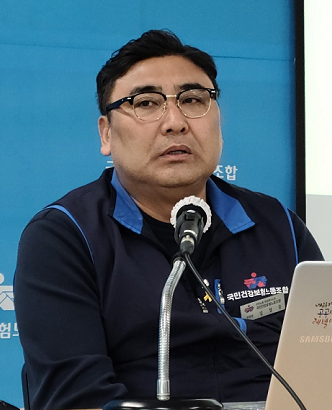
- Kim Cheoljung, the chairman of the National Health Insurance Trade Union. The National Health Insurance Trade Union has criticized the government’s ‘The Second Comprehensive Plan of National Health Insurance’ regarding measures to strengthen patients’ access to new drugs. The union argued that the government formulated the policy referencing the corporate civil complaint. And added, it would be more effective to include the National Health Insurance Service (NHIS) as part of the Drug Reimbursement Evaluation Committee (DREC). During a press conference at the NHIS headquarters on the 26th, Kim Cheoljung, the chairman of the National Health Insurance Trade Union, stated this. Kim maintained a critical standpoint when asked about the union’s stance on the details of the second comprehensive plan of National Health Insurance, which includes strengthening patients’ access to new drugs, reducing listing duration, and expediting the market entry of innovative medical instruments. “The union regards ‘expediting the market entry of innovative medical instruments’ and ‘expanding the scope of the waiver system for new medical technology’ as merely corporate civil complaints and not the interests of the health insurance,” Kim explained. According to the union, the government is pushing measures such as shortening the time it takes to list new drugs for health insurance from 330 days to 150 days via parallel processing of ‘approval-evaluation-negotiation,’ which is the process for drug reimbursement. Additional measures include a comprehensive review and evaluation system to expedite the market entry of innovative medical instruments and an expansion of the waiver system for new medical technology. “Terms like new drug accessibility, innovation, and new technology may sound nice, but the government must base its reimbursement decision on clinical effectiveness and cost-effectiveness, and not on implementing what corporates wish for their quick benefit,” Kim said. The alternative would be to include the NHIS in the DREC of the Health Insurance Review and Assessment Service (HIRA). “Recently, new high-priced drugs were primarily considered for health insurance reimbursement. However, allowing reimbursement of those drugs that have not been evaluated for safety and cost-effectiveness may lead to a waste of finances, along with putting citizens as subjects of clinical experiment,” Kim said. “The government has suggested processing reimbursement evaluation and drug pricing negotiations in parallel. But, our opinion is that including the NHIS in the HIRA's DREC can shorten the duration and reflect on the NHIS’ stance regarding the cost-effectiveness of finances.” The union has strongly criticized the Yoon Suk Yeol government’s retrogressive policy. The government did not release the National Health Insurance's annual insurance coverage cost to the public in 2022. The government is limiting itself as an enforcement agency. Rather than focusing on patient co-payment policy, such as strengthening cost coverage per income level, to aid citizens who cannot receive medical treatments because of the patient co-payment, The government is emphasizing the need for businesses to assist with catastrophic medical expenses, which can be perceived as a charity-like approach by the government. “As an insurer, the government must enforce a policy to strengthen cost coverage or a separate business focusing on public function,” Kim said. “Policies aimed at expanding health insurance big data sharing and legalizing non-face-to-face treatment can be characterized as privatization. In response to the policy of expanding health insurance big data sharing, the union will collaborate with civil society for an action. The union, along with the civil society, will boycott the NHIS’ meeting scheduled for the April 2,” Kim stressed. The union said it will pursue ‘non-reimbursed treatments and reimbursed treatments should not be administered during a single visit’ to prevent national insurance loss. "Every year, the burden of health insurance costs, personal insurance costs, and patient co-payments directly impact the citizens," Kim added. "To address common practices in the medical field, such as recommending non-reimbursed treatments to patients seeking reimbursed treatment or providing unnecessary reimbursed treatments and billing them, as well as treating non-reimbursed instead of reimbursed practices, The union believes that 'mixed medical practices should be prohibited' now to eliminate these issues," Kim explained. Regarding the recent conflicts between the medical community and the government over expanding medical school quotas, Kim expressed deep regret and emphasized the importance of having concrete plans for utilizing medical personnel stationed in regional areas. "I feel really bad about the recent conflict regarding the 'expansion of the medical school enrollment quota,' Kim added. "The biggest problem with this situation is that the government's policy of 'expanding the medical school enrollment quota' and the' doctors' strike' claim focus solely on 'money,' including medical insurance fees. It is concerning that the government is not considering the well-being of citizens," Kim said. “Of course, expanding the medical school enrollment quota is essential. However, concrete plans should be made for the 'station and utilization of medical personnel' who will be responsible for the lives of citizens across the nation,” Kim emphasized. The National Health Insurance Trade Union is affiliated with the Korean Public Service and Transport Workers’ Union (KPTU) under the Korean Confederation of Trade Unions (KCTU). The union has a total of 13,842 members, with a membership rate of approximately 93%. It consists of 13 headquarters, 267 branches, and 345 representatives. The union expresses its opinion regarding the national health insurance policy as an insurer. The union emphasizes the importance of expanding health insurance coverage and reducing citizens’ medical expenses.
- Policy
- "Seek social consensus, shift away from 2,000 quota"
- by Lee, Jeong-Hwan Mar 29, 2024 05:53am
- Lee Jae-myung, the leader of the Democratic Party of Korea (chairman of the standing joint election committee). "How can we persuade and negotiate with the medical community after President Yoon Suk Yeol forced university assignments by pushing through with an excessive fixation on increasing the quota to 2,000? It's time to shift away from this fixation and instead establish a committee proposed by the Democratic Party to facilitate social discussion and reach agreements." On the 27th, Lee Jae-myung, the leader of the Democratic Party of Korea (chairman of the standing joint election committee), proposed operating a consultative body to seek social consensus by questioning President Yoon Suk Yeol and the ruling party about increasing the medical school quota by 2,000 students. Lee pointed out that the fixation of the president and the ruling party with increasing the medical school quota to 2,000 has led to a medical crisis, resulting in hospital doctors overworking and actual harm to patients. During a field press conference at Changwon-gu in Cheongju, Lee said, "There was a similar rumor a month or two ago." He added, "During the Moon Jae-in administration, the Democratic Party government planned to increase the number of doctors by 400 annually for ten years. It was not completely satisfactory, but it was believed to be able to resolve a significant portion of the problem. But, it was postponed due to COVID-19." "However, the Yoon Suk Yeol government's decision to increase the medical school admission quota by five times, to a total of 2000, appears to be an attempt to provoke and forcefully suppress the opposition from the medical community. There was speculation that someone might emerge suddenly and try to create an illusion of resolution, similar to the June 29 Declaration," Lee stated. "During the Democratic Party's highest committee meeting, I raised concerns multiple times and pointed out that we shouldn't approach this strategically," Lee said. Adding, "However, it feels like the situation is becoming similar to gossip. Such critical policy matters should be handled by ministers, vice ministers, prime ministers, and the president. However, the chairman of the ruling party's central committee suddenly meets with former President Park Geun-hye to discuss these matters. This approach raises questions about whether this is part of normal governance," Lee questioned. Regarding the extended conflict between the medical community and the government, Lee stated, "President Yoon's fixation on 2,000 medical school quota and university assignments has made it difficult to persuade the medical community and reach agreements." He highlighted the "fixation on the 2,000 increase" as the cause and said, "Even ruling party candidates agreed." "We must focus on improving public health, which is essential. We need to shift our focus from the fixed number of 2,000 additional admission quotas and instead work on a comprehensive expansion plan that includes establishing public medical schools and regional doctor programs. These programs are essential for maintaining medical services in public and regional areas," Lee said. "As proposed by the Democratic Party, we request the establishment and operation of a consultative body to resolve the issue swiftly," Lee suggested.
- Policy
- NHIS expands info disclosure about drug pricing negotiations
- by Lee, Tak-Sun Mar 29, 2024 05:53am
- The National Health Insurance Service (NHIS) has decided to expand the scope of information disclosure on its website. Starting in April, the public will have expanded access to information regarding drug pricing negotiations. Information on the types of negotiations of drugs under review and the outcomes of agreements will be made open to the public. According to industry sources on the 28th, the National Health Insurance Service (NHIS), in agreement with the pharmaceutical industry, is expected to expand the disclosure of information related to drug pricing negotiations. Starting from May 2019, people will be able to access information related to drug pricing negotiations by going to ‘NHIS Website-Pre-release Information-Laws/Business Standards-Standards for long-term care reimbursement-Drug pricing negotiations menu.’ The website provides information related to product and pharmaceutical company names of new drugs under drug pricing negotiations, the date of registration, and a list of medicines that concluded drug pricing negotiations. Previously, the NHIS disclosed the information on the website after notifying the pharmaceutical company and following the legal process. Negotiation details and submission documents related to the pharmaceutical company's trade secrets were excluded. However, many have pointed out that such information alone is insufficient to fulfill the rights of citizens and patients to access information. For example, the website currently discloses information on ‘new drugs’ among medicines under drug pricing negotiations. Moreover, the outcomes of the concluded negotiations are not available. Considering the criticism, the NHIS has decided to expand the scope of information disclosure. Starting in April, new drugs, 'medicines exempt from price negotiations,' and 'medicines with expanded indications' that are under negotiation will be disclosed. Additionally, after April, the scope of disclosure will be extended to include medicines subject to negotiation orders from the Ministry of Health and Welfare (MOHW). Furthermore, the NHIS plans to post the agreement outcomes of the drugs that concluded negotiations. Currently, the NHIS does not disclose information on agreement details and only posts medicines that concluded negotiations. There were instances where drugs renewing risk-sharing agreements (RSA) made it onto the list despite failed renegotiations, as initial negotiations were completed. It is anticipated that people can easily find accurate information on medicines under negotiation and agreements reached. “During the meeting, we have notified pharmaceutical companies about the measures to expand information,” an official of the NHIS said. “If pharmaceutical companies with drugs subject to negotiation orders do not raise objections upon receiving notification of disclosure, their details will be posted on the website.”
- Policy
- JW Pharmaceutical agrees on RSA renewal terms for Hemlibra
- by Lee, Tak-Sun Mar 29, 2024 05:53am
- JW Pharmaceutical has reportedly agreed to renew its risk-sharing agreement (RSA) for its hemophilia treatment ‘Hemlibra SC injection’ with the National Health Insurance Service. The company for the leukemia drug ‘Venclexta Tab,’ which was also in the process of negotiating the terms of RSA renewal, is expected to push for a temporary extension of the contract as it failed to reach an agreement by the RSA negotiation deadline. JW Pharmaceutical signed an RSA contract for Hemlibra from May 1, 2020, to April 30 this year. The expenditure cap type of RSA was applied. Hemlibra was unable to reach an agreement in the first round of renewal negotiations but succeeded in reaching an agreement in subsequent negotiations. In May 2020, Hemlibra was first reimbursed for severe hemophilia A antibody patients, and the coverage was extended to patients without antibodies last year. As there are more patients without antibodies than those with antibodies among the 1,700 hemophilia A patients in Korea, the number of insurance claims is expected to increase. Last year, the company's annual sales exceeded KRW 10 billion. With the successful renewal, the RSA contract will continue to be applied for 5 years from May 1 this year to April 30, 2029. On the other hand, discussions on the leukemia drug Venclexta (AbbVie, venetoclax) are having difficulty reaching an agreement within the RSA contract deadline. Venclexta is currently reimbursed as a third-line or greater monotherapy in patients with chronic lymphocytic leukemia (CLL) who have relapsed or are refractory to chemotherapy and B-cell receptor inhibitors, or as a combination therapy in the second-line in patients with chronic lymphocytic leukemia (CLL) who have received at least one prior chemotherapy. The drug’s RSA contract term is from April 1, 2020, through March 31 this year, and was applied the expenditure cap type RSA. In February last year, the drug’s insurance ceiling price was reduced by 12.2% due to the expanded scope of its use. The NHIS and its pharmaceutical company are expected to push for a temporary RSA extension as it would be difficult for the parties to reach an agreement by the end of the RSA term. Sanofi had also signed a temporary term extension agreement for its Dupixent after its contract expired in December last year, and the company successfully renewed its RSA last month.
- Policy
- LG Chem expands its Zemimet SR Tab lineup
- by Lee, Tak-Sun Mar 28, 2024 05:52am
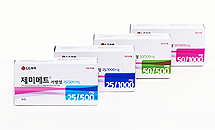
- A new dosage form of LG Chem's diabetes combination drug ‘Zemimet SR Tab (gemigliptin /metformin) will be added to the reimbursement list next month. This is expected to increase prescription options in the field and allow fully personalized prescriptions for the patients. According to industry sources on the 27th, Zemimet SR Tab 25/750 mg will be added to the reimbursement list from April 1. Zemimet SR Tab 25/750 mg is a combination of 25 mg of gemigliptin and 750 mg of metformin. The addition of the 25/750mg dose will bring the total lineup of Zemimet SR Tab to five. This is the most diverse array of options provided among all DPP-4 inhibitor class products. Currently, Zemimet SR 25/500mg, 50/1000mg, 50/500mg, and 25/1000mg are listed in Korea’s reimbursement list. Zemimet SR Tab 25/750 mg will be the first option that provides 750 mg of sustained-release metformin among the combinations. The new product will allow patients to be prescribed various combinations of metformin in different doses depending on their symptoms. For example, patients will be able to receive fully personalized prescriptions that contain low to high-dose metformin- 500, 1000, 1250, 1500, 1750, and 2000 mg – suited to each patient’s specific condition. The product has been designated as an incrementally modified drug combination by the Ministry of Food and Drug Safety in recognition of its improved efficacy and utility. As a result, its drug price has also been incentivized. Since it is an incrementally modified drug combination and LG Chem is an innovative pharmaceutical company, a 68% pricing premium is added to the amount calculated using a set standard (calculating the upper limit of each single drug (or combination drug) by applying a content formula and then summing them). Accordingly, the company received a ceiling price of KRW 428. Last year, LG Chem’s Zemimet SR Tab lineup generated KRW 100.3 billion in outpatient prescriptions (UBIST), surpassing the KRW 100 billion mark for 2 consecutive years. LG Chem and Daewoong Pharmaceutical's joint sales of the drug are analyzed to be creating synergistic effects. LG Chem said, "The new dosage form has significance in that it provides a more targeted, step-by-step drug escalation option for diabetes patients. We will continue to make R&D investments in our Zemiglo product lineup to provide effective diabetes treatment options."
- Policy
- Ruling party will focus on fostering Korea's pharma industry
- by Lee, Jeong-Hwan Mar 27, 2024 06:04am
- The ruling party has adopted a number of policies proposed by domestic pharmaceutical companies and the Korea Pharmaceutical and Bio-Pharma Manufacturers Association as pledges for the 22nd general election, foretelling its plan to concentrate on fostering the domestic pharmaceutical industry. The ruling party's main pledge, which is to create an environment for Korea to make the leap and become a central player in the global pharmaceutical market by expanding government investment in pharmaceutical and bio R&D, supporting the development of blockbuster new drugs, expanding pharmaceutical exports, and expanding incentives for finished pharmaceuticals that use domestic ingredients, largely coincides with the policy proposals that were made by KPBMA. The ruling party’s pledge also met the needs of the pharma-bio sector by adding a policy that strengthens incentives such as expedited review and drug price premiums for developing or manufacturing essential drugs for children or the elderly while establishing a supply management committee to respond to drug supply and demand instability, expanding the items and quantity of drugs in the national stockpile, and supporting manufacturing facilities for essential medicines. This observation was made while comparing between the People Power Party’s 22nd general election policy pledges and the KRPBMA’s policy proposals on the 25th. Specifically, the association requested the government to strengthen the R&D environment to become a global center, expand government R&D investment, support blockbuster drug development, and continue to expand the megafund for blockbuster drugs, and the ruling party responded to the request with such pledges. The plan also included creating a pharma-bio digital innovation ecosystem that incorporates advanced technologies such as AI and big data, expanding drug exports and supporting the development of global big pharmaceutical companies, improving the stability of essential drug supply, and establishing nation-wide measures to realize self-sufficiency of drug substances. The People Power Party will continue to promote and expand a Korean ARPA-H to create blockbuster new drugs and expand tax credits for investments in biotech companies by pharma and bio companies. Also, to improve the success rate of new drug development and commercialization, the government will strengthen support for late phase II-III trials and global expansion and improve the drug price compensation system for domestically developed new drugs. To expand drug exports and support the development of global big pharmaceutical companies, the ruling party also pledged to provide clinical and licensing consulting, distribution network construction and marketing, expand the pool of overseas pharmaceutical experts, and support the establishment of customized export strategies, and establishment of a global medical supply base (contract manufacturing organizations). To stabilize the supply of essential medicines, the government has announced amendments to the Pharmaceutical Affairs Act, including establishing a system to detect drug supply instability and establishing a supply management committee to respond to drug supply instabilities. In addition, the party decided to expand the items and quantity of drugs in the national stockpile, secure adequate inventory for pharmaceutical companies, realize services for the automation of essential drug production and manufacturing facilities, and expand government stockpiles. The drug shortage prevention system and the national essential medicine system will also be linked to support cost preservation. In particular, incentives for the development and manufacturing of essential drugs, especially for pediatric and elderly patients, will be strengthened. Development of essential medicines for pediatric and elderly patients will receive expedited review and separate drug pricing premiums. The government will also support the companies’ development of self-sufficient technologies for essential vaccine ingredients and drugs. Furthermore, a compensation system to reward the innovative value of new drugs will be established. The government will establish an incentive system for the development of new drugs for domestic and foreign pharmaceutical companies, and fully reflect the value of domestic and foreign innovative new drugs in their drug prices. The ruling party's pharma and biotech policy pledges will be implemented in the legislation and government administration depending on the outcome of the 22nd general election.
- Policy
- 'Trajenta-duo' generics as SR tablets…55 approved items
- by Lee, Hye-Kyung Mar 27, 2024 06:04am
- As the patent expiration of 'Trajenta-duo (linagliptin and metformin),' a DPP-4 inhibitor combination therapy for the treatment of diabetes, approaches, approvals of sustained-release formulations are increasing. According to the Ministry of Food and Drug Safety (MFDS), as of March 26th, 55 tablets containing the active ingredients linagliptin and metformin from 27 companies received approvals last year, starting with Daewon Pharmaceutical’s 'Tralitincombi Tab' Out of 55 items approved, 53 items received approvals this year, including 43 items approved in March. Trajenta-duo’s subsequent entry drugs in sustained-release formulation that received approvals in March. Boehringer Ingelheim Korea’s Trajenta-duo, the original drug, received approval on November 15, 2012. Trajenta-duo holds a patent for ‘xanthine and its manufacturing method’ until June 2024. As the patent expiration approaches, domestic pharmaceutical companies have received approvals for generics starting in 2018. The first Trajenta-duo generic was Hanmi Pharm’s 'Linaglo Duo Tab,' a film-coated tablet for rapid action, which is similar to the original. Domestic pharmaceutical companies have received approvals for film-coated tablets of Trajenta-duo after Hanmi Pharm. Until Daewon Pharmaceutical released a sustained-release tablet, 138 products received generic approvals in the form of film-coated tablets. After 'Tralitincombi Tab,' a sustained-release formulation, received approval on October 13, 2023, domestic pharmaceutical companies are releasing Trajenta-duo subsequent entry drugs as sustained-release formulation. Sustained-release tablets regulate the release or discharge mechanism of drugs, allowing them to be released into the body for an extended period after ingestion. This enables the drug to be slowly absorbed in the body for extended efficacy. Therefore, subsequent entry drugs of Trajenta-duo as sustained-release formulations have the advantage of once-daily evening dosing. Boehringer Ingelheim Korea is expanding its product line-up with combination therapies, such as Trajenta-duo and 'Esgliteo (Empagliflozin·linagliptin),' after Trajenta-duo. According to the pharmaceutical market research agency UBIST, Trajenta's outpatient prescription sales amounted to KRW 64.2 billion, and Trajenta-duo's amounted to KRW 68.3 billion, for a total of KRW 130 billion.
- Policy
- MFDS reviews enacting a separate and special law for drugs
- by Lee, Hye-Kyung Mar 26, 2024 06:30am
- The Ministry of Food and Drug Safety (MFDS) is considering enacting a 'special law' to separately manage drug safety management. For this, the MFDS recently launched a call for researchers for the ‘Study for the Analysis of the Legal System of the Pharmaceutical Affairs Act and Review of the Special Act on Drug Safety Management'. The research will be conducted for 7 months from the date the research service is outsourced, and a budget of KRW 50 million will be invested to review reorganizing the legal structure of the ‘Pharmaceutical Affairs Act' in line with the newly changing regulatory environment and to lay the foundation for the enactment of a special law. The 'Pharmaceutical Affairs Act' was enacted in 1953, and has evolved with the development of the pharmaceutical industry, covering a wide range of pharmacist functions and drug licensing, management, and use. The MFDS raised the need for a comprehensive review of the law, explaining, "The law has been partially revised 48 times over the years, limited to only those necessary to introduce new systems and improve operational problems." Therefore, the study will review the legal system and consistency of the law through analysis of the history of the enactment and amendment of the Pharmaceutical Affairs Act, and identify revisions needed under the jurisdiction of MFDS, based on the results. The special law on drug safety management will analyze the domestic pharmaceutical environment and administrative conditions for drug safety management, and conduct demand surveys through industry-wide surveys, etc. The MFDS will conduct a demand survey on major issues and stakeholders' positions on areas that need to be managed by a separate law, the Special Act. In terms of areas requiring drug safety management, the research team will review clinical and licensing, manufacturing and quality control, licensing patent linkage system and data protection system, post-marketing safety management, and the supply system in place for drugs such as essential medicines. The MFDS explained, "Through the study, we will classify, organize, and systematically review the provisions in the Pharmaceutical Affairs Act regarding the areas where special laws need to be enacted. We will also investigate the statutes of special laws enacted in major countries such as the United States and Europe by field with regards to the areas where special laws need to be enacted." In addition, the study will include research on the effective regulatory operation plans for new drugs that cannot be managed by existing laws, such as converged medical products and new drugs utilizing AI. Meanwhile, the MFDS has been enacting and implementing the 'Special Act on Imported Food Safety Management' since February 4, 2016. The Special Act on Imported Food Safety Management aims to improve the consistency and efficiency of the administrative measures posed by unifying the provisions on imported food safety management that were dispersed into the Food Sanitation Act, the Livestock Hygiene Management Act, the Health Functional Food Act, and the Livestock Epidemic Prevention Act. After discussions, the MFDS decided to improve and complement systems already in place in the Food Sanitation Act while maintaining the current status quo, and the scope of regulation was expanded and strengthened by introducing a new registration system for overseas manufacturing companies and establishing new business types such as imported food declaration agencies and internet purchase agencies.
- Policy
- Daewoong joins in competition in the Forxiga generic market
- by Lee, Tak-Sun Mar 26, 2024 06:30am
- Daewoong Pharmaceutical, which had been in charge of the domestic sales and marketing of the original SGLT-2 diabetes drug ‘Forxiga (propanediol hydrate),’ is belatedly entering the generic market through a transfer and acquisition deal. Daewoong had sold Forxiga until January this year. It is analyzed that Daewoong also entered the generic market after AstraZeneca announced its plan to withdraw the drug from the Korean market in the second half of this year. According to the industry on the 5th, Daewoong Pharmaceutical will be listing its Forxiga generic ‘Forxilo Tablet 5mg' at a ceiling price of KRW 262 from April through a transfer and acquisition. Daewoong reportedly acquired Zalozin Tab 5mg from NBK Pharm. The drug is produced by Dongkoo Bio&Pharma upon consignment. Daewoong also acquired the license for Forxilo 10mg in January through an assignment and transfer deal Daewoong did not enter the generic market when Forxiga’s patent expired in April last year because it was selling the original Forxiga Tab at the time. Daewoong has been in charge of domestic sales and marketing of AstraZeneca's Forxiga since March 2018. The company continued to sell Forxiga even after launching its SGLT-2 class drug Envlo (enavogliflozin) in May last year. However, its ties with AstraZeneca ended at the end of the past year with AstraZeneca’s announcement that it will discontinue sales of Forxiga in Korea. In January, Daewoong stopped the distribution and sales of Forxiga, and HK Inno.N took over. Daewoong's entry into the generic market is expected to change the competitive landscape of the market. In particular, generic companies are expected to compete fiercely for the remaining pie once the original withdraws from the domestic market in the second half of the year. Although Daewoong is focusing on promoting its own new drug Envlo, the pharmaceutical industry believes that the power and experience the company had accumulated selling the original Forxiga for 6 years is a force to be reckoned with. Another factor that will affect the market structure is that from April 8, the generic pricing premium applied to innovative Forxiga generic drugs will end. This is because the reduced drug price is likely to reduce promotion costs. However, the pricing premium will be maintained on April 8, 2026, for salt-modified drugs produced by three or fewer generic companies.
