
- LOGIN
- MemberShip
- 2026-05-06 21:27:43
- Policy
- The gov. begins research on preferential tx
- by Lee, Jeong-Hwan Oct 20, 2021 05:56am
- The MOHW has launched a research service to prepare preferential measures for new drugs developed by innovative pharmaceutical companies in Korea. The policy is to innovate pharmaceutical companies and achieve health insurance fiscal consistency, such as giving incentives when adjusting drug prices and supporting drug prices linked to R&D investment scale. On the 19th, the MOHW completed an order to Korea Online EProcurement System for "Research on Pharmaceutical Price Support Policy of Innovative Pharmaceutical Companies in Conformity with International Trade Order" through the KHIDI. Regarding the background of research on drug preferential treatment for innovative pharmaceutical companies, the KHIDI predicted that the global pharmaceutical market will grow 4.7% annually over the past five years, recording about $1.3 trillion in 2019, and expand up to $1.4 trillion by 2026. As the pharmaceutical and bio markets are expected to be new growth engines in Korea in the future, it is necessary to actively promote support measures. The KHIDI said that although the revision of the Pharmaceutical Industry Promotion and Special Act in December 2018 provided a basis for preferential treatment for innovative pharmaceutical companies, there are no subordinate laws due to trade problems. In fact, Article 17-2 of the Pharmaceutical Industry Promotion Act stipulates that the Minister of Health and Welfare sets drugs manufactured by innovative pharmaceutical companies by Presidential Decree, including the addition of the upper limit on medical care benefits under the National Health Insurance Act. The problem is that the Presidential Decree and enforcement regulations, which are subordinate statutes of the provision, have not been created, making it ineffective. When domestic pharmaceutical companies and the National Assembly's Health and Welfare Committee said they needed improvement in this year's parliamentary audit, the MOHW said it would launch research through the KHIDI to find ways to preferential drug prices for innovative pharmaceutical companies. The KHIDI took follow-up measures through practical research orders. It seeks a policy to support new drug prices for innovative pharmaceutical companies without harming the international trade order, with a research period of six months from the date of the contract and a budget of 50 million won. After the research order in October, the agency plans to select successful candidates for the research in early November and receive a final result report in March next year after an interim report in January next year. The key point of the study is to investigate the current status of drug price policies in the domestic and foreign pharmaceutical industries and to collect opinions on drug support from innovative pharmaceutical companies. It reviews the need to support innovative pharmaceutical companies and prepares practical drug preferential policy measures that meet the international trade order. It will also investigate drug price support policies of major overseas pharmaceutical advanced countries for innovative new drugs, biovectors, IMDs, biosimilars, and generics. After COVID-19, major pharmaceutical industry support policies in major foreign countries in the vaccine and bio sectors will be studied with weight on drug price support policies. It will also investigate international trade disputes and settlement cases related to drug price support policies to prepare for international friction. Innovative pharmaceutical companies will prepare opinions from related organizations such as the HIRA and the Health Insurance Corporation and drug support measures based on the demand survey for drug support. It is also accompanied by external opinions such as academic experts and civic groups. It plans to form an advisory committee to collect related opinions and investigate opinions from various fields related to drug support through surveys and interviews. There is also a procedure to analyze the history or effectiveness of support policies for innovative pharmaceutical companies, and the limitations of the current support policy. In order to favor innovative new drugs that do not harm the international trade order, it will induce innovation of pharmaceutical companies, such as drug price support measures, incentives for drug price follow-up adjustment, and drug price support linked to R&D investment. Above all, research will also be conducted to identify in advance the factors that can actually be raised and resolve solutions to ordinary issues related to policy measures for supporting innovative pharmaceutical companies. It plans to provide international trade advice through trade experts such as academic experts and lawyers. The KHIDI said, "The research goal is to present risk factors and solutions when promoting drug support for innovative pharmaceutical companies." The KHIDI said, "We will also analyze data requested by the organizer related to policies to support innovative pharmaceutical companies." It added, "We will select a research institute in December, sign a contract, and receive a report on the results in March after an interim report next year." The MOHW and the KHIDI are currently certifying 45 innovative pharmaceutical companies to intensively foster the pharmaceutical and bio industries as national growth engines.
- Policy
- It will improve side effects caused by non-face-to-face tx
- by Lee, Jeong-Hwan Oct 20, 2021 05:56am
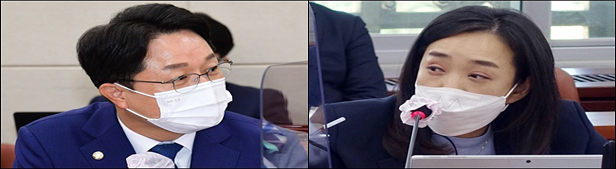
- Rep. Kang Byeongwon of the Democratic Party (left) and Rep. Choi Hye-young proposed amendments to the medical law, which officially introduces temporary non-face-to-face tx, respectively The National Assembly is trying to solve problems arising from the implementation of non-face-to-face treatment temporarily allowed due to COVID-19 for more than a year and reduce social concerns. Instead of allowing non-face-to-face treatment temporarily and extensively, the ruling party-centered National Assembly officially introduces it as a supplement to face-to-face treatment to eliminate side effects. On the 18th, the Democratic Party of Korea previously proposed a revision to the medical law, which focuses on legislation of non-face-to-face treatment, following Rep. Kang. Kang's proposal, which was proposed first, is to officially institutionalize "remote monitoring," which is part of non-face-to-face treatment between doctors and patients. Choi Hye-young's proposal is expected to have a significant impact on the medical community in that it specifies the concept of non-face-to-face treatment itself and clearly specifies the allowable patient group and disease group. For now, both bills limited non-face-to-face medical institutions to primary medical institutions at the clinic level, not at the hospital level. It also aims to comply with the principle of face-to-face treatment and prevent unnecessary diseases from allowing non-face-to-face treatment by allowing non-face-to-face treatment, focusing on patients suffering from chronic diseases such as high blood pressure and diabetes. In a detailed sense, Kang focused on the legislation of non-face-to-face treatment for chronically ill patients and remote monitoring of ECGs for hikers, which partially proved their effectiveness in the Gangwon Digital Healthcare Special Zone. Rep. Choi focused on enabling non-face-to-face treatment only for chronic diseases if access to medical institutions such as islands, mountains, remote areas, or military units is significantly low, or if movement is greatly inconvenient, such as disabled or patients after surgery. Given that the scope of non-face-to-face treatment is specified and the concept is clarified, the two lawmakers' views are that if the two bills are promoted, the side effects of non-face-to-face treatment pointed out so far will be greatly improved. The number of cases of unnecessarily over-prescribing hormone drugs such as psychotropic drugs, erectile dysfunction treatments, hair loss drugs, and acne through non-face-to-face treatment is also expected to decrease significantly if the bill is promoted. In particular, Choi's proposal was designed to address concerns related to non-face-to-face treatment, which the front-line medical community, led by the Korean Medical Association, strongly opposes. An official from Choi Hye-young's office said, "As non-face-to-face treatment is temporarily allowed only in the crisis of infectious diseases such as COVID-19, the need for non-face-to-face treatment in areas or patient groups with low medical access has been confirmed."
- Policy
- One-shot treatment Kymriah passed the cancer committee
- by Lee, Hye-Kyung Oct 20, 2021 05:55am
- Kymriah (Tisagenlecleucel) of Novartis Korea, a "one-shot treatment" with an ultra-high cost of 500 million won per dose, passed the Cancer Drugs Benefit Appraisal Committee. At the Cancer Drugs Benefit Appraisal Committee held last month, the gap between health authorities and pharmaceutical companies was barely narrowed at the second Cancer Drugs Benefit Appraisal Committee. The HIRA released the "7th Cancer Drugs Benefit Appraisal Committee Deliberation Results in 2021" on the afternoon of the 13th. The HIRA, like the Cancer Drugs Benefit Appraisal Committee and the Cancer Drugs Benefit Appraisal Committee this month, decided to disclose the results of the deliberation to the media after the meeting. According to the results of today's meeting, Kymriah's benefit criteria were set for both indications: adult diffuse giant B-cell lymphoma and B-cell acute lymphocytic leukemia (ALL) in children and young adults. After 60 days of drug price negotiations with the NHIS after being recognized by the Drug Reimbursement Evaluation Committee, it must pass the Health Insurance Policy Committee to be listed on the list in earnest. Kymriah used Drug Approval-Linkage Systems in March to register benefits with approval from the MFDS. At the Cancer Drugs Benefit Appraisal Committee with Kymriah, there was a discussion on the expansion of benefit standards, but all of them failed to pass the Cancer Drugs Benefit Appraisal Committee except for the Benetoclax combination therapy of AbbVie Korea. Drugs that have not been set based include FOLFOX (Folinic acid, Fluorouracil, and Oxaliplatin), chronic lymphocytic leukemia treatment Imbruvica(Ibrutinib) by Janssen Korea, and B-cell acute lymphocyte leukemia treatment Blincyto (Blinatumomab).
- Policy
- What's Kymriah's procedure after passing the Committee?
- by Lee, Hye-Kyung Oct 19, 2021 08:54pm
- It seems that it will take time for the ultra-high-priced one-shot treatment Kymriah (Tisagencleucel) to be registered. In particular, it is because the setting of additional financial sharing conditions for pharmaceutical companies, which was not easy in the Cancer Drugs Benefit Appraisal Committee, may pass the Drug Reimbursement Evaluation Committee evaluation. The HIRA (Director Kim Sun-min) conducted the second Kymriah's standard review at the 7th The Cancer Drugs Benefit Appraisal Committee held on the 13th. Kymriah's standard, which were not set at the 6th Cancer Drugs Benefit Appraisal Committee held on September 1, were set at the 7th Cancer Drugs Benefit Appraisal Committee. Kymriah, which entered Korea in March using Drug Approval-Linkage Systems, is a one-shot treatment, but it took about seven months to set the standard as an ultra-high-priced new drug with a single dose cost of 500 million won. Even so, it was said that the period was shortened even a little due to the influence of one-man protests and national petitions as well as the parliamentary audit of the National Assembly's Health and Welfare Committee on the 15th, urging patients to pay Kymriah. The standard set after about seven months of meeting requires additional financial sharing by Novartis Korea. Novartis applied for benefits for both indications, including "adult diffuse giant B-cell lymphoma" and "B-cell acute lymphocytic leukemia in children and young adults," approved by the MFDS. The Cancer Drugs Benefit Appraisal Committee was concerned with indications for adult diffuse giant B-cell lymphoma. This is why the setting of salary standards was put on hold at the 6th Cancer Drugs Benefit Appraisal Committee. Finally, the Cancer Drugs Benefit Appraisal Committee established standards under these provisions like ▲ higher level of risk-sharing by pharmaceutical companies considering overseas drug prices ▲ in the case of diffuse giant B-cell lymphoma with insufficient clinical performance compared to acute lymphocytic leukemia, addition of risk-sharing system according to treatment performance at a patient level ▲ benefit can be applied. After reviewing the risk-sharing plan for cancer screening in detail, making a final draft, putting the agenda on the committee for review and resolution, and then negotiating drug prices with the NHIS. It has also been conducting drug price negotiations with the MOHW and the HIRA for 60 days, and will come up with a plan to share finances between the government and pharmaceutical companies. Therefore, since it is applied after deliberation and notification by the Risk Sharing Subcommittee, the Drug Reimbursement Evaluation Committee, the NHIS negotiations, and the Health Insurance Policy Review Committee of the MOHW, it must be at least next year for actual patients to receive Kymriah benefits.
- Policy
- The benefit of 7 α-GPC products will be suspended
- by Lee, Hye-Kyung Oct 19, 2021 08:53pm
- Benefits for seven items that have been canceled for not participating in the clinical re-evaluation of the brain function improvement drug Choline alfoscerate will be suspended from the 21st. The MOHW announced on the 18th that it has decided to suspend health insurance benefits for drugs that have been canceled for product licenses due to confirmation of violations of the Pharmaceutical Affairs Act. The seven items violating the Pharmaceutical Affairs Act were canceled following the first two-month suspension of sales and the second six-month suspension of sales without complying with Article 33 (Regulations on the Reevaluation of Drugs) under the Choline alfoscerate formulation. The head of the MFDS may reevaluate drugs that need to be reviewed for safety and effectiveness, or that need to prove drug equivalence among drugs that have been approved or reported. In June of last year, the MFDS announced in June last year that it would conduct a clinical re-evaluation of three indications like ▲ secondary symptoms and denaturation or degenerative cerebral matrix mental syndrome caused by cerebrovascular defects, ▲ changes in emotions and behaviors, including ▲ senile pseudophobia. The MFDS ordered 255 items from 134 companies to submit clinical trial plans by December 23 of that year. More than 60 pharmaceutical companies participated in the clinical re-evaluation of Choline alfoscerate, divided into Daewoong Bio-Chong Kun Dang Group and United Group, while the rest of the pharmaceutical companies are receiving administrative measures such as suspension of work and cancellation of item without submitting clinical plans. Samik's Memoode, KMS Pharm's Alfotne Soft Cap, Austin Pharm's 'Newcholine Soft Cap', Intropharm's I-Choline, Saehanpharm's Glatone, and Mirae Pharm's Gliarin will be suspended. Medical institutions such as hospitals, clinics, and pharmacies should note that they cannot prescribe and prepare benefits from the 21st as seven items will be removed from the list due to the cancellation of item licenses.

- Policy
- Korea United Pharm's Galvusmet generic is the first approved
- by Lee, Tak-Sun Oct 19, 2021 06:00am
- Korea United Pharm received approval for the first generic of Novartis’s DPP-4 inhibitor, ‘Galvusmet (vildagliptin/metformin hydrochloride),’ an antidiabetic treatment. With the approval, the company will likely be competing with Hanmi Pharmaceutical next year, which marked the start of Galvusmet latecomers with a salt-modified drug in July. The Ministry of Food and Drug Safety approved Korea United Pharm’s Galvusmet generic on the 18th. The product is a fixed-dose combination of vildagliptin and metformin hydrochloride and is a generic drug that contains the same ingredient as Novartis’s Galvusmet that was approved in 2008. The drug was approved as an adjunct to diet and exercise to improve glycaemic control in type 2 diabetes patients that are eligible to take the vildagliptin+metformin combination. With the substance patent for the single-agent drug Galvus and combo Galvusmet to expire on March 4th of next year, companies of latecomer drugs are accelerating development to preoccupy the patent-expired market. Twelve companies including Ahn-Gook Pharmaceutical, Ahngook New Pharm, Hanmi Pharmaceutical, Genuone Sciences, LitePharmTech, White Life Science, PharmGen Science, Mother’s Pharmaceutical, Daewoong Bio, Dongkoo Bio&Pharma, KyungBo Pharm, GL Pharma have already received approval for latecomer single-agent vildagliptin products. Among the companies, Ahn-Gook Pharmaceutical and Ahngook New Pharm succeeded in avoiding the original's patent by challenging part of the term extended for the substance patent of Galvus and achieved generic exclusivity from January 9th to May 29th. Therefore, other drugs with the same vildagliptin ingredient as those approved by Ahn-Gook Pharmaceutical and Ahngook New Pharm cannot be sold during the term. However, drugs with a different salt ingredient are not considered identical and are not subject to sales restrictions. Also, the vildagliptin/metformin combination agents are also not subject to sales restrictions under Ahn-Gook’s generic exclusivity. Until now, only Hanmi Pharmaceuticals and Korea United Pharm received approval for a latecomer combination drug. However, Hanmi Pharmaceuticals’ product is a salt-modified drug and not a generic of the same ingredient. Hanmi and United succeeded in avoiding the composition patent of Galvusmet through a passive trial to confirm the scope of rights and may start the sale of their products after the original’s product patent expires. In other words, the companies may sell their products without any issue from March 4th. In addition, if the companies receive a ruling confirming the ruling made by the Patent Court of Korea in the trial to invalidate the extended period of substance patent that is pending in the Supreme Court, the companies may be able to sell their drugs from January of the next year. The trial is currently ongoing between Novartis, the patent holder, and the latecomer companies, Ahn-Gook Pharmaceutical and Hanmi Pharmaceutical. As Hanmi and United had received approvals of their respective drugs before October, they may even be able to release their products with insurance benefit in January. Therefore, the two companies are expected to compete fiercely to preoccupy the market. By market size, the Galvusmet has a much larger market than the single-agent Galvus. According to UBIST, outpatient prescription sales of the drugs last year was ₩8.1. billion for Galvus and four times higher - ₩36.4 billion - for Galvusmet. With rapid commercialization being the key to preoccupying this immense Galvusmet latecomer market, Hanmi and Korea United Pharm seem to have taken a lead.
- Policy
- Keytruda·Tagrisso is in the process of expanding benefits
- by Lee, Hye-Kyung Oct 18, 2021 05:54am
- There was an opinion calling for expediting the expansion of the benefit standard for tumor-agnostic therapy. Independent lawmaker Lee Yong-ho said in a parliamentary audit of the National Assembly's Health and Welfare Committee on the 15th, "Benefits of Keytruda & Tagrisso have not expanded and are causing pain to patients," adding, "Keytruda's first lung cancer benefit has not been expanded for four years. I think many patients would have lived during that period." Han Hyun-ho, a clinical assistant professor at Yonsei University's urology department, who attended as a reference at the request of lawmaker Lee, demanded the urology benefit of Keytruda. Professor Han said, "Keytruda is an anticancer drug approved for tumor-agnostic therapy overseas," adding, "It can be used in patients with bladder cancer and prostate cancer in urology." In response to such criticism, Kim Sun-min, director of the HIRA said, "Keytruda is expensive and takes a lot of finance," adding, "We are also considering the cost-effectiveness of clinical sites." Director Kim said, "The HIRA is also being reviewed, and the term-agnostic therapy has set benefit standards and is in the process of follow-up procedures," adding, "We will quickly strengthen the coverage of cancer patients." However, he added that kidney cancer and bladder cancer have not yet received clear evidence based on the HIRA, so review will be conducted after clinical research is conducted.
- Policy
- “Impartiality of reimbursement review system undermined"
- by Lee, Jeong-Hwan Oct 18, 2021 05:54am
- HIRA president Sun-Min Kim (left) is answering to People Power Party member Jung-sook Suh’s inquiry (Pic provided by National Assembly Press Corps)The principal investigator of the clinical trial of lung cancer drug B participated in lung cancer A drug’s reimbursement assessment meeting. Isn’t this a conflict of interest and cause for the member’s exclusion from the committee?” (People Power Party Jung-sook Suh) “There are operational regulations set for the Cancer Disease Deliberation Committee, however, it is difficult to regulate the members’ participation in competitor drug’s clinical trials” (HIRA president Sun-Min Kim) Controversy over the fairness and expertise of the Health Insurance Review and Assessment Service and its Cancer Disease Deliberation Committee has risen in the course of providing health insurance benefits for non-small cell lung cancer treatments. The issue was that a professor of a medical school who is in charge of the clinical trial of lung cancer drug B, a competitor drug, had participated in the reimbursement review of the lung cancer drug A, which is a conflict of interest that undermines the impartiality of HIRA and the expertise of CDDC. On the criticism, HIRA’s president Sun-Min Kim expressed the service’s position that it would be difficult to exclude all professors who participated in clinical trials of competitors' drugs from the reimbursement reviews. NA member Jung-sook Suh of the People Power Party had inquired so to HIRA president Sun-Min Kim at the NHIS·HIRA’s NA audit on the 15th. Suh had pointed out that it is inappropriate for the principal investigator of a competing company to participate in the drug reimbursement review of its competitor drug. Suh's point of view was affected by the appeal made by a lung cancer patient group that visited the National Assembly to ask for the extended reimbursement of the lung cancer drug A. With lung cancer drug A failing to receive reimbursement for several years, some have been criticizing that this was an infringement of the patients’ right to accessibility. Currently, the lung cancer drug A has been approved for reimbursement as a second-line treatment and applied to extend its reimbursement to first-line. The competitor drug B is currently conducting clinical trials to assess its efficacy in the first line. Suh said that professor K, principal investigator of the clinical trial of lung cancer drug B, participating in lung cancer drug A’s reimbursement review raises the issue of fairness. The professor had participated in the Cancer Disease Deliberation Committee meeting in April that reviewed the reimbursement of lung cancer drug A as first line. Suh used the committee’s exclusion, recusal, and avoidance regulations to point out that the situation has greatly undermined the objectivity of the reimbursement review for lung cancer drug A. According to Article 13-2 of the Operating Regulations of the Cancer Disease Deliberation Committee, if a person who attends the committee and makes a statement is deemed not to be fair or objective due to family relations or personal and economic interest under the civil law, the committee shall refuse the participation and statement of the committee member. Seo said, “It is very inappropriate for the principal investigator of the competitor lung cancer drug B’s clinical trial, professor K, to participate and deliberate on lung cancer drug A’s first-line reimbursement. According to the Operating Regulations of the Cancer Disease Deliberation Committee, professor K should have refused to participate or provide an opinion on the matter. A serious and clear flaw in the committee’s operations have been revealed, and HIRA should explain why this has happened and come up with measures to prevent recurrence “ While expressing some agreement to Suh’s argument, HIRA president Sun-min Kim expressed the service’s position that it would be difficult to regulate the member’s participation in other drugs’ clinical trials as exclusion criteria in the operating regulations. Kim said, “Operating Regulations for the Cancer Disease Deliberation Committee does exist, however, it is difficult to regulate the members’ participation in competitor drug’s clinical trials.”
- Policy
- Introduction of CDF for Zolgensma was proposed
- by Lee, Hye-Kyung Oct 18, 2021 05:54am
- When the National Assembly proposed the introduction of the Cancer Drugs Fund (CDF) for Zolgensma, the NHIS accepted the beginning of the discussion. Rep. Kim Sung-joo of the Democratic Party of Korea said in a parliamentary audit of the National Assembly's Health and Welfare Committee on the 15th, "There was a story of a new drug worth 2.5 billion won per time, but patients are losing valuable time because of pharmaceutical companies and the government trying to cut drug prices." "An alternative approach is needed to this issue," he said. Rep. Kim said, "I think a new fund is needed if there is no agreement between the parties." He said, "I want to propose an anticancer drug fund like the UK. I also know that a bill has been proposed for pharmaceutical companies, the government, and private foundations to pay for treatments that have been proven cost-effective in health insurance. "I want to ask what the chairman thinks," he asked. In this regard, Chairman Kim Yong-ik said, "CDF seems to be an important proposal," adding, "As of now, there is no discussion, so there is nothing good or bad about it." "I will say that we should open the beginning of the discussion," he said.

- Policy
- The HIRA also decided to disclose the results of Kymriah
- by Lee, Hye-Kyung Oct 15, 2021 05:58am
- The HIRA has decided to disclose the results of the drug benefit assessment. Although the entire evaluation process required by citizens, patient organizations, and the pharmaceutical industry is not disclosed in detail, it has decided to clearly disclose the establishment of benefit standards and appropriateness of benefits. The HIRA released the "7th Severe Cancer Drugs Benefit Appraisal Committee's deliberation results" at 6:23 p.m. on the 13th, and distributed a press reference to Kymriah deliberated at the Cancer Drugs Benefit Appraisal Committee at 10:46 p.m. The results of the Cancer Drugs Benefit Appraisal Committee deliberation include the items applied for the medical care benefit decision, pharmaceutical companies, efficacy and effect, deliberation results and expanded benefit standards. It is similar to the scope of disclosure of the results of the Drug Reimbursement Evaluation Committee review, which has been released since June 2017. Following the Drug Reimbursement Evaluation Committee, the HIRA decided to distribute the results of the Cancer Drugs Benefit Appraisal Committee deliberation on the media and website in the form of press references after the end of each month's meeting. Kim Ae-ryeon, head of the drug management office, said, "There have been demands for disclosure of the results of the Severe Cancer Drugs Benefit Appraisal Committee, and some unwanted pharmaceutical companies have been curious about expensive drugs and discussed with the Cancer Drugs Benefit Appraisal Committee." Regarding the press reference related to Kymriah, she said, "In addition to setting the benefit standard, Kymriah's reference data were exceptionally released." She said, "It was also dealt with in this parliamentary audit, and there were several issues. It won't come out continuously." The HIRA is considering the timing of distribution of press reference materials. Like the Drug Reimbursement Evaluation Committee, it was also scheduled to distribute press references the morning after the meeting. However, due to the issue drugs such as Kymriah, it announced that it would be distributed after 6 p.m. on the 13th, shortly after the end of the meeting, and distributed to reporters immediately after the monthly meeting. In this regard, Director Kim said, "We will need to consider the timing of distributing the press reference materials of the Drug Reimbursement Evaluation Committee and the Cancer Drugs Benefit Appraisal Committee," and added, "We will review the timing after the parliamentary audit and finalize it."
