- LOGIN
- MemberShip
- 2026-09-16 20:37:01
- Implementation of the drug price reform may be delayed to next year
- by Lee, Jeong-Hwan | translator Alice Kang | 2026-03-05 17:30:50
The Ministry of Health and Welfare plans to finalize its drug pricing reform proposal that focuses on lowering prices of already-listed generics while granting pricing incentives to innovative pharmaceutical companies through a special one-point meeting of the Health Insurance Policy Deliberation Committee (HIPDC) review in early to mid-March.
However, the government is reportedly considering postponing the implementation timeline from the originally planned July this year to January next year.
The significant backlash from the domestic pharmaceutical industry against the drug pricing reform plan appears to be the reason the MOHW decided in February to postpone submitting it to the HIPDC subcommittee and plenary session, and is now reviewing whether to defer the implementation date from July this year to next year.
Nevertheless, the MOHW remains steadfast in its plan to submit the drug pricing system reform proposal, which contains specific generic drug calculation rates, to the HIPDC this month (March) to finalize the drug pricing policy direction.
A ministry official said on the 3rd, “It is true that we are reviewing a plan to postpone the implementation of the drug pricing system reform plan until next year, but we will complete the submission and vote on the reform proposal at the HIPDC this month.”
In effect, even if implementation is delayed, the policy framework itself is expected to be finalized soon. This means the calculation rate for generic drug price reductions and the detailed regulations for preferential pricing for innovative pharmaceutical companies will be determined at this month's meeting.
Currently, the ministry has proposed lowering the price calculation ratio for already-listed generics from the current 53.55% to the 40% range. The reform proposal also includes pricing incentives depending on whether a company is certified as an “innovative pharmaceutical company,” while allowing non-certified firms to receive preferential pricing based on their clinical trial performance and contribution to supplying drugs with unstable supply.
Domestic pharmaceutical companies have criticized the proposal, arguing that it fails to adequately reward firms that invest in facilities for high-quality drug production and in innovative R&D for new drugs. They contend that it instead imposes the same level of price reduction shock on companies that have made no such investments and focused solely on generating revenue through contract generic production.
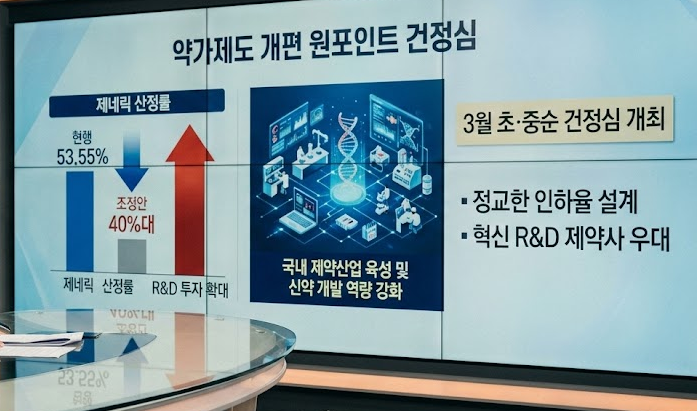
Particularly regarding the MOHW's decision to finalize the drug pricing system reform plan at the March HIPDC meeting and postpone its implementation from July this year to next year, the domestic pharmaceutical industry is criticizing that “the specific policy content matters far more than delaying the implementation date.”
They argue that if the government reduces the generic pricing ratio to the 40% range, companies may abandon the production of low-margin drugs, leading to job losses and reduced capacity for new drug R&D.
Based on the current 53.55% generic drug pricing rate, the position of most domestic pharmaceutical companies is that the MOHW must set the rate at a minimum of 48% to allow them to maintain reasonable operations without changing their current business status.
In particular, mid-sized and top-tier pharmaceutical companies, including those certified as Korean innovative pharmaceutical companies, state that the Korean pharmaceutical and biotech industry can only grow if drug prices for companies that have sustained value-based investments for decades are preserved, while prices for contract-manufactured generic-focused companies that have made no investments are significantly reduced.
In other words, they insist the reform must move away from across-the-board mechanical price cuts and adopt a differentiated system reflecting actual investment and contribution.
This is why attention is rising on whether the reform will include measures that foster innovative R&D environments crucial to the growth of the Korean pharmaceutical industry.
As a result, the pharmaceutical industry is closely watching the detailed direction and revisions of the reform proposal expected to be presented at the one-point HIPDC meeting in early to mid-March.
In the National Assembly, lawmakers like Yoon Kim of the Democratic Party of Korea have pointed out the incompleteness of the MOHW's drug pricing reform plan and called for a revised plan.
While praising the Lee Jae-myung administration for deciding on the first significant overhaul of the domestic drug pricing system since the 2012 blanket generic price cuts, Rep. Kim also raised the need for a ‘more refined reform plan’.
He argued that generic drug prices should be adjusted more carefully by therapeutic class, referencing price levels in 8 countries already being referenced by Korea.
However, the drug pricing system reform plan announced by the MOHW on November 28 last year involves a blanket adjustment of approximately 40% for drugs whose prices have seen little change since the 2012 blanket price cuts.
Rep. Kim has urged the MOHW to submit a revised proposal that sets differentiated reduction rates by therapeutic class instead of applying uniform cuts.
Rep. Kim stated, “To enhance the innovation of the pharmaceutical industry through drug pricing policy, drug price reform should not be a standalone policy but part of a package policy that can foster innovative pharmaceutical companies. The core issue is not simply price cuts but addressing excessive marketing competition through CSOs, curbing the proliferation of generics, and identifying price distortions created by competition centered on selling and administrative expenses.”
The pharmaceutical industry points out that the MOHW's approach of simply assigning different drug price premiums and preferential rates based solely on whether a company is certified as an innovative pharmaceutical company is overly crude and risks creating a distorted pharmaceutical industry landscape.
The point is that promoting innovative R&D should not automatically translate into preferential treatment solely for companies with official certification.
A drug pricing manager at a mid-sized domestic pharmaceutical company expressed, “The MOHW's drug price reform plan concentrates all benefits on certified innovative pharmaceutical companies. Ultimately, these innovative pharmaceutical companies are defined by the proportion of new drug R&D relative to total sales. It's questionable whether the standard for innovation can be determined solely by the R&D ratio.”
This manager added, “It is highly inappropriate to select innovative pharmaceutical companies and grant benefits exclusively to them based on this criterion when the government and the pharmaceutical industry have not mutually agreed on the definition or standards of innovation. The reform plan must adequately reflect that pharmaceutical companies not certified as innovative are also striving for the development of the domestic pharmaceutical industry and overseas exports through high-value-added new drugs or improved new drugs. As it stands, it is unfair.”
Another pricing executive at a large pharmaceutical company commented, “The current proposal effectively cuts prices uniformly without distinguishing between companies that invested in high-quality generic production and those that generated profits through contract generics and aggressive marketing without real investment. If the goal is to reward companies that contribute through new drug R&D, high-quality manufacturing, or stabilizing supply, the reform must introduce a differentiated pricing system that significantly lowers prices for companies that make no such contributions.”
-

- 0
댓글 운영방식은
댓글은 실명게재와 익명게재 방식이 있으며, 실명은 이름과 아이디가 노출됩니다. 익명은 필명으로 등록 가능하며, 대댓글은 익명으로 등록 가능합니다.
댓글 노출방식은
댓글 명예자문위원(팜-코니언-필기모양 아이콘)으로 위촉된 데일리팜 회원의 댓글은 ‘게시판형 보기’와 ’펼쳐보기형’ 리스트에서 항상 최상단에 노출됩니다. 새로운 댓글을 올리는 일반회원은 ‘게시판형’과 ‘펼쳐보기형’ 모두 팜코니언 회원이 쓴 댓글의 하단에 실시간 노출됩니다.
댓글의 삭제 기준은
다음의 경우 사전 통보없이 삭제하고 아이디 이용정지 또는 영구 가입제한이 될 수도 있습니다.
-
저작권·인격권 등 타인의 권리를 침해하는 경우
상용 프로그램의 등록과 게재, 배포를 안내하는 게시물
타인 또는 제3자의 저작권 및 기타 권리를 침해한 내용을 담은 게시물
-
근거 없는 비방·명예를 훼손하는 게시물
특정 이용자 및 개인에 대한 인신 공격적인 내용의 글 및 직접적인 욕설이 사용된 경우
특정 지역 및 종교간의 감정대립을 조장하는 내용
사실 확인이 안된 소문을 유포 시키는 경우
욕설과 비어, 속어를 담은 내용
정당법 및 공직선거법, 관계 법령에 저촉되는 경우(선관위 요청 시 즉시 삭제)
특정 지역이나 단체를 비하하는 경우
특정인의 명예를 훼손하여 해당인이 삭제를 요청하는 경우
특정인의 개인정보(주민등록번호, 전화, 상세주소 등)를 무단으로 게시하는 경우
타인의 ID 혹은 닉네임을 도용하는 경우
-
게시판 특성상 제한되는 내용
서비스 주제와 맞지 않는 내용의 글을 게재한 경우
동일 내용의 연속 게재 및 여러 기사에 중복 게재한 경우
부분적으로 변경하여 반복 게재하는 경우도 포함
제목과 관련 없는 내용의 게시물, 제목과 본문이 무관한 경우
돈벌기 및 직·간접 상업적 목적의 내용이 포함된 게시물
게시물 읽기 유도 등을 위해 내용과 무관한 제목을 사용한 경우
-
수사기관 등의 공식적인 요청이 있는 경우
-
기타사항
각 서비스의 필요성에 따라 미리 공지한 경우
기타 법률에 저촉되는 정보 게재를 목적으로 할 경우
기타 원만한 운영을 위해 운영자가 필요하다고 판단되는 내용
-
사실 관계 확인 후 삭제
저작권자로부터 허락받지 않은 내용을 무단 게재, 복제, 배포하는 경우
타인의 초상권을 침해하거나 개인정보를 유출하는 경우
당사에 제공한 이용자의 정보가 허위인 경우 (타인의 ID, 비밀번호 도용 등)
※이상의 내용중 일부 사항에 적용될 경우 이용약관 및 관련 법률에 의해 제재를 받으실 수도 있으며, 민·형사상 처벌을 받을 수도 있습니다.
※위에 명시되지 않은 내용이더라도 불법적인 내용으로 판단되거나 데일리팜 서비스에 바람직하지 않다고 판단되는 경우는 선 조치 이후 본 관리 기준을 수정 공시하겠습니다.
※기타 문의 사항은 데일리팜 운영자에게 연락주십시오. 메일 주소는 dailypharm@dailypharm.com입니다.