- LOGIN
- MemberShip
- 2026-09-18 23:25:12
- BD experts in demand due to increasing global partnerships
- by Whang, byung-woo | translator Alice Kang | 2025-04-15 05:54:54
Due to increasing technology transfer and partnership opportunities in the pharmaceutical and biotech industries, the role of business development (BD) is becoming increasingly important.
Also, demand is growing for the ability to move beyond R&D that advances science-based technologies to securing actual deals.
This means that it is a key department that brings in new products or drives partnerships that will drive company growth, and it is directly tied to the export (licensing out) of new technologies.
Domestic pharmaceutical and bio companies are achieving success and making licensing out deals overseas, thanks to increased investment in new drug development.
In fact, in 2019, there were 14 licensing-out deals (worth about KRW 8.5 trillion) in Korea, and in 2021, the number of contracts reached 31, a threefold increase from the previous year, setting a new record.
In particular, large-scale licensing deals are emerging, whose upfront payments exceed KRW 1 trillion per technology, although their milestone achievement progress remains to be seen.
As pharmaceutical companies, which used to focus on the domestic market, are entering the global stage, the BD department is becoming at the forefront of business development, transferring technology to overseas partners and leading joint development, which is adding strength to the growing view that BD capabilities directly affect corporate competitiveness.
In fact, domestic bio companies are strengthening their strategy of developing their own products from the non-clinical to early clinical stages and then licensing them out.
Specifically, they are actively pursuing entry into the global market by establishing overseas subsidiaries and hiring local BD personnel.
" “Lack of experience is the biggest challenge” ...
Systematic training is essential.
The problem is that domestic companies are still facing difficulties in the global BD process, due to the lack of negotiating power, lack of experience in evaluating technology value, and lack of global communication experience.
A representative of Pharma Ventures, who the reporter met at the 2025 Young BD Workshop hosted by the Korea Drug Development Fund (KDDF), expressed disappointment in the “storytelling” poser of Korean companies.
“Korean companies have very good scientific capabilities and technology, but they often fail to develop their assets to the level required by global big pharma,” said a Pharmaventures official.
”Companies often concentrate on a single pipeline, so when if they license out their technology, the company's is virtually just giving out their whole value.” It is also important to reduce the gap between investors and Korean companies when it comes to technology transfer and deal-making, but it is often assessed that Korean companies cannot translate science into 'value and business opportunities'.
Ultimately, for Korean companies to find opportunities overseas, in addition to R&D, there is a growing need to develop specialized personnel who can turn these into commercial opportunities.
In the pharmaceutical and biopharmaceutical industry, there is a common view that, as the saying goes, “it's all about people,” and that talent investment is important for new drug development.
However, there is also a realistic point of view that there are still not enough educational opportunities to systematically train BD talents.
In particular, young BD managers with 1-5 years of experience are in very high demand for training to strengthen their expertise, as they work in an environment where it is difficult to gain practical experience.
In this situation, the 2025 Young BD Workshop held by KDDF in early April sought to foster the next generation of BD talent.
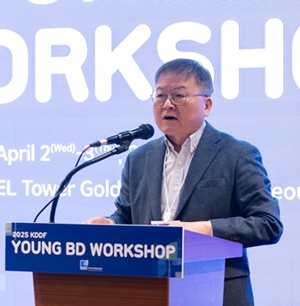
Young-min Park, head of the National New Drug Development Project Team, said, “A sophisticated commercialization strategy is needed from the early stages for successful new drug development.
I hope this workshop will serve as a stepping stone for fostering young BD talents with expertise and practical capabilities that meet global standards.” With KDDF at the forefront, BD is responsible for the company's future growth engines, such as closing new product licensing agreements and building partnerships in the long term.
As such, the company is showing a consensus on securing and cultivating talent.
An industry official added, “I think the cultivation of BD talent is an important factor that can turn Korea's quality technology into commercial success.
I think that the education and efforts related to BD, along with the cultivation of various talents in the pharmaceutical and bio sector, will play a major role in creating a Korean bio ecosystem in the future.”
-

- 0
댓글 운영방식은
댓글은 실명게재와 익명게재 방식이 있으며, 실명은 이름과 아이디가 노출됩니다. 익명은 필명으로 등록 가능하며, 대댓글은 익명으로 등록 가능합니다.
댓글 노출방식은
댓글 명예자문위원(팜-코니언-필기모양 아이콘)으로 위촉된 데일리팜 회원의 댓글은 ‘게시판형 보기’와 ’펼쳐보기형’ 리스트에서 항상 최상단에 노출됩니다. 새로운 댓글을 올리는 일반회원은 ‘게시판형’과 ‘펼쳐보기형’ 모두 팜코니언 회원이 쓴 댓글의 하단에 실시간 노출됩니다.
댓글의 삭제 기준은
다음의 경우 사전 통보없이 삭제하고 아이디 이용정지 또는 영구 가입제한이 될 수도 있습니다.
-
저작권·인격권 등 타인의 권리를 침해하는 경우
상용 프로그램의 등록과 게재, 배포를 안내하는 게시물
타인 또는 제3자의 저작권 및 기타 권리를 침해한 내용을 담은 게시물
-
근거 없는 비방·명예를 훼손하는 게시물
특정 이용자 및 개인에 대한 인신 공격적인 내용의 글 및 직접적인 욕설이 사용된 경우
특정 지역 및 종교간의 감정대립을 조장하는 내용
사실 확인이 안된 소문을 유포 시키는 경우
욕설과 비어, 속어를 담은 내용
정당법 및 공직선거법, 관계 법령에 저촉되는 경우(선관위 요청 시 즉시 삭제)
특정 지역이나 단체를 비하하는 경우
특정인의 명예를 훼손하여 해당인이 삭제를 요청하는 경우
특정인의 개인정보(주민등록번호, 전화, 상세주소 등)를 무단으로 게시하는 경우
타인의 ID 혹은 닉네임을 도용하는 경우
-
게시판 특성상 제한되는 내용
서비스 주제와 맞지 않는 내용의 글을 게재한 경우
동일 내용의 연속 게재 및 여러 기사에 중복 게재한 경우
부분적으로 변경하여 반복 게재하는 경우도 포함
제목과 관련 없는 내용의 게시물, 제목과 본문이 무관한 경우
돈벌기 및 직·간접 상업적 목적의 내용이 포함된 게시물
게시물 읽기 유도 등을 위해 내용과 무관한 제목을 사용한 경우
-
수사기관 등의 공식적인 요청이 있는 경우
-
기타사항
각 서비스의 필요성에 따라 미리 공지한 경우
기타 법률에 저촉되는 정보 게재를 목적으로 할 경우
기타 원만한 운영을 위해 운영자가 필요하다고 판단되는 내용
-
사실 관계 확인 후 삭제
저작권자로부터 허락받지 않은 내용을 무단 게재, 복제, 배포하는 경우
타인의 초상권을 침해하거나 개인정보를 유출하는 경우
당사에 제공한 이용자의 정보가 허위인 경우 (타인의 ID, 비밀번호 도용 등)
※이상의 내용중 일부 사항에 적용될 경우 이용약관 및 관련 법률에 의해 제재를 받으실 수도 있으며, 민·형사상 처벌을 받을 수도 있습니다.
※위에 명시되지 않은 내용이더라도 불법적인 내용으로 판단되거나 데일리팜 서비스에 바람직하지 않다고 판단되는 경우는 선 조치 이후 본 관리 기준을 수정 공시하겠습니다.
※기타 문의 사항은 데일리팜 운영자에게 연락주십시오. 메일 주소는 dailypharm@dailypharm.com입니다.