- LOGIN
- MemberShip
- 2026-05-15 07:55:43
- MFDS to tighten up regulations on appetite suppressant
- by jung, sae-im | translator Byun Kyung A | 2020-07-27 06:31:48

The draft contains high-level of regulations like adopting active substance designation system used in narcotics control, which can heavily impact the relevant industry.
According to pharmaceutical industry sources on July 24, Korea’s Ministry of Food and Drug Safety (MFDS) is planning to manage psychoactive appetite suppressants.
Some of the approaches unveiled were introducing quarterly active substance designation system like the narcotics control, notifying amfepramone and mazindol as restricted substance, and designating psychoactive appetite suppressants as subjects to submit a risk management plan (RMP).
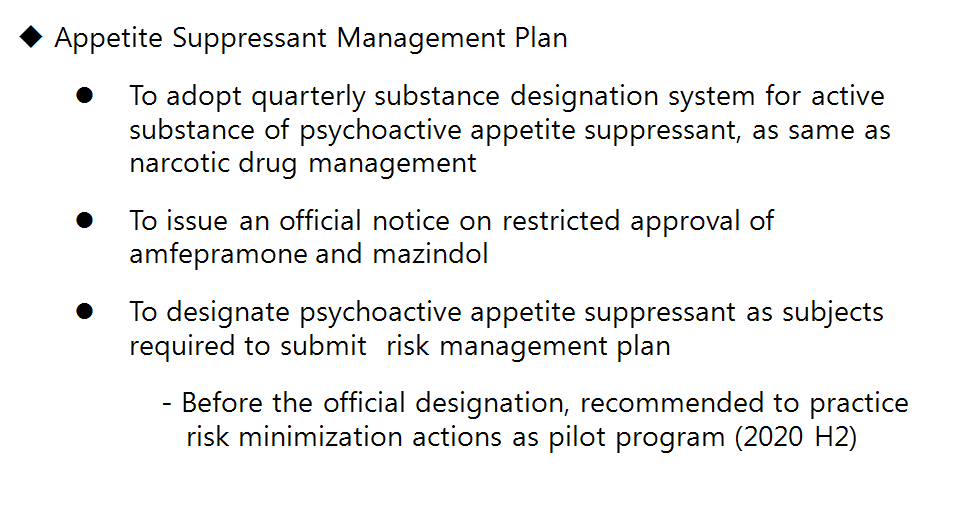
The government intends to enforce the system to handle the appetite suppressant on the equivalent level to narcotic drugs.
The current system designates each company on which narcotic substance to supply after reviewing the projected yearly use volume of narcotic substance and quarterly plan of active psychoactive drug use submitted by each supplier company from the previous year.
When the result is notified to each company, the narcotic drug manufacturers are allowed to purchase the active substance strictly following the designation conditions.
MFDS sketched out a plan to survey each company’s inventory this year, and enforce the new regulation from 2021 after finalizing and notifying the appetite suppressant manufacturing approval plan in November.
When the new regulation comes in effect, the drug manufacturers can only manufacture the suppressant drugs as much as the government allows.
Basically, the government would be invested with the power to set down the manufacturing volume of psychoactive appetite suppressant.
Moreover, the government aims to newly restrict approval on amfepramone and mazindol.
The official notification would be issued around August.
In the past, the approval on phentermine and phendimetrazine has been restricted due to frequent reports of abuse.
The ministry now plans to expand the restricted scope of substances and include amfepramone and mazindol.
The designated substance drugs may be restricted when seeking for narcotic drug handling approval, manufacturing or importation approval.
Lastly, the ministry plans to designate psychoactive appetite suppressants as drugs required to submit a RMP.
The system usually targets new drug or orphan drug, but a drug the Minister of Food and Drug Safety acknowledges the need for RMP submission due to severe adverse reaction reported may also be designated.
MFDS is shooting for early next year to enforce the designation.
Pharmaceutical companies with drugs required to submit RMP have to comply with the plan and regularly submit evaluation result.
Until the final designation is announced, the ministry is to recommend the companies to voluntarily practice risk minimization actions as a pilot program.
Also the government body would soon survey demands on the pilot program from the participating companies.
On July 21, MFDS convened a conference with the affected industry and shared the said details.
The ministry would make final decisions after reviewing the industry’s opinion.
Regardless of the abuse prevention and safe use policies enforced on appetite suppressants so far, MFDS has decided to take the stricter action as the drugs were still excessively prescribed.
In 12 months time from July 2018 through June 2019, 24,000 healthcare institutes prescribed the appetite suppressants to 1.29 million patients, which adds up to 6.11 million cases of dispensing and use of the drugs.
According to 2018-2019 technical reports published by International Narcotics Control Board (INCB), Korea’s phentermine and phendimetrazine substance importation volume is one of the highest in the world.
Analyzing appetite suppressant prescription and administration data, the report confirmed frequent cases of abnormal use suspected of abuse.
And apparently, these drugs have been globally criticized for the wide discrepancies between the submitted projection psychoactive drug substance use volume and the actual manufactured volume.
However, the relevant industry points out the blueprint of the regulation do not match with the goal of preventing drug abuse.
An industry insider who requested anonymity noted, “The government should rather actively promote drug administration instruction or safe use, if the drug abuse is the issue.
Many of the industry associates say regulating and controlling the actual manufacturing and production of the drugs is inadequate.” Meanwhile, the obesity treatment market in Korea, including the psychoactive appetite suppressant market, is valued at approximately 150 billion won.
-

- 0
댓글 운영방식은
댓글은 실명게재와 익명게재 방식이 있으며, 실명은 이름과 아이디가 노출됩니다. 익명은 필명으로 등록 가능하며, 대댓글은 익명으로 등록 가능합니다.
댓글 노출방식은
댓글 명예자문위원(팜-코니언-필기모양 아이콘)으로 위촉된 데일리팜 회원의 댓글은 ‘게시판형 보기’와 ’펼쳐보기형’ 리스트에서 항상 최상단에 노출됩니다. 새로운 댓글을 올리는 일반회원은 ‘게시판형’과 ‘펼쳐보기형’ 모두 팜코니언 회원이 쓴 댓글의 하단에 실시간 노출됩니다.
댓글의 삭제 기준은
다음의 경우 사전 통보없이 삭제하고 아이디 이용정지 또는 영구 가입제한이 될 수도 있습니다.
-
저작권·인격권 등 타인의 권리를 침해하는 경우
상용 프로그램의 등록과 게재, 배포를 안내하는 게시물
타인 또는 제3자의 저작권 및 기타 권리를 침해한 내용을 담은 게시물
-
근거 없는 비방·명예를 훼손하는 게시물
특정 이용자 및 개인에 대한 인신 공격적인 내용의 글 및 직접적인 욕설이 사용된 경우
특정 지역 및 종교간의 감정대립을 조장하는 내용
사실 확인이 안된 소문을 유포 시키는 경우
욕설과 비어, 속어를 담은 내용
정당법 및 공직선거법, 관계 법령에 저촉되는 경우(선관위 요청 시 즉시 삭제)
특정 지역이나 단체를 비하하는 경우
특정인의 명예를 훼손하여 해당인이 삭제를 요청하는 경우
특정인의 개인정보(주민등록번호, 전화, 상세주소 등)를 무단으로 게시하는 경우
타인의 ID 혹은 닉네임을 도용하는 경우
-
게시판 특성상 제한되는 내용
서비스 주제와 맞지 않는 내용의 글을 게재한 경우
동일 내용의 연속 게재 및 여러 기사에 중복 게재한 경우
부분적으로 변경하여 반복 게재하는 경우도 포함
제목과 관련 없는 내용의 게시물, 제목과 본문이 무관한 경우
돈벌기 및 직·간접 상업적 목적의 내용이 포함된 게시물
게시물 읽기 유도 등을 위해 내용과 무관한 제목을 사용한 경우
-
수사기관 등의 공식적인 요청이 있는 경우
-
기타사항
각 서비스의 필요성에 따라 미리 공지한 경우
기타 법률에 저촉되는 정보 게재를 목적으로 할 경우
기타 원만한 운영을 위해 운영자가 필요하다고 판단되는 내용
-
사실 관계 확인 후 삭제
저작권자로부터 허락받지 않은 내용을 무단 게재, 복제, 배포하는 경우
타인의 초상권을 침해하거나 개인정보를 유출하는 경우
당사에 제공한 이용자의 정보가 허위인 경우 (타인의 ID, 비밀번호 도용 등)
※이상의 내용중 일부 사항에 적용될 경우 이용약관 및 관련 법률에 의해 제재를 받으실 수도 있으며, 민·형사상 처벌을 받을 수도 있습니다.
※위에 명시되지 않은 내용이더라도 불법적인 내용으로 판단되거나 데일리팜 서비스에 바람직하지 않다고 판단되는 경우는 선 조치 이후 본 관리 기준을 수정 공시하겠습니다.
※기타 문의 사항은 데일리팜 운영자에게 연락주십시오. 메일 주소는 dailypharm@dailypharm.com입니다.
- [Reporter's View] The dark side of improved diabetes med convenience
- Reporter's view | Son, Hyung Min

- [Reporter's View] Contradiction of "K-passing" and a new drug powerhouse
- Reporter's view | Lee, Jeong-Hwan