- LOGIN
- MemberShip
- 2026-09-25 15:08:34
- Only 2 out of 10 are prescribed monotherapy for diabetes
- by Kim, Jin-Gu | translator Alice Kang | 2022-10-07 06:04:29
The use of combination therapies in diabetes has been increasing further.
Already, 8 of 10 patients are prescribed two or more drugs at once.
In particular, the triple therapy combination regimen seems to be rapidly establishing its presence in the field.
By ingredient, DPP-4 inhibitor class drugs are still showing strength, but their growth is gradually slowing down.
On the other hand, SGLT-2 inhibitor class drugs are gaining influence, while sulfonylurea class drugs are on a steady decline.
◆From dual to triple therapies…the diabetes treatment paradigm is shifting The Korean Diabetes Association published a ‘2022 Diabetes Fact Sheet’ that contained the information above.
Based on the national health insurance claims data, the Fact Sheet contains the prevalence, treatment rate, and drug prescription rate of diabetes in Korea from the year 2002 to 2019.

2 in 10 diabetes patients have been prescribed a single drug for their condition.
The other 77.8% are receiving two or more drugs at once.
The rate of combination therapy prescriptions had risen 5.4%p in 5 years from the 73.4% in 2014.
In particular, the prescription rate of three-or-more drug combinations is on the rise.
The three-or-more drug combination therapies that had been prescribed in only 31.9% of all cases until 2014, had risen 6.1%p in 5 years to 38.0%.
In the same period, prescription of dual combination therapies had decreased by 1.7%p from 41.5% to 39.8%.
Prescription of monotherapies had fallen 4.4%p in 5 years from the 26.6%.
The gap between prescription of dual and triple combination therapies had been 9.6%p in 2014, which had been reduced to 1.8% in 5 years.
The industry has been interpreting this as a shift in the diabetes treatment paradigm, of how the diabetes treatment paradigm is moving from dual combination therapies to triple combination therapies.
This phenomenon is also reflected in the number of drugs that are initially prescribed after being diagnosed with diabetes.
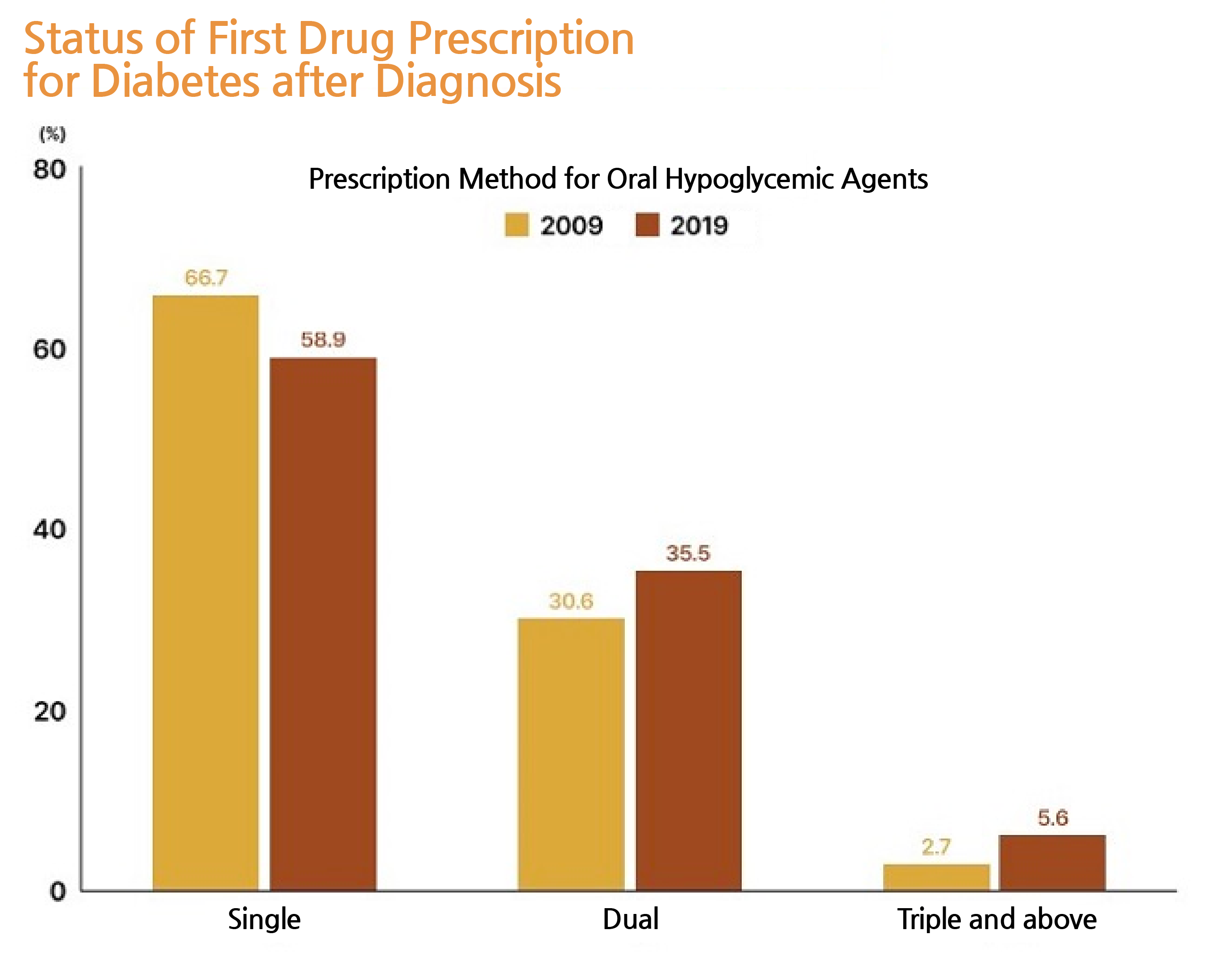
The prescription rate of dual combination therapies had been 30.6%, and triple combination therapies 2.7%.
In 2019, the prescription rate of monotherapies in those first diagnosed with diabetes had become 58.9%, a 7.8%p decrease in 10 years.
On the other hand, the prescription rate of dual combination therapies had increased 4.9%p to 35.5%, and triple combination therapies 2.9%p to 5.6%.
◆Sales of metformin and DPP-4i surge...
sulfonylurea sales fall, SGLT-2i rise By ingredient, metformin and DPP-4 inhibitor class drugs are still the most popular.
As of 2019, 87.5% of all diabetes patients were prescribed metformin, followed by 63.9% receiving DPP-4 inhibitor class drugs, 41.7% sulfonylurea (SU), 11.6% TZD class, 10.8% SGLT-2 inhibitor class, 8.4% insulin (duplicate prescriptions reflected in the statistics).
Compared to 5 years ago in 2014, the prescription rate of metformin increased by 2.1%p from 85.4% to 87.5%.
In the case of DPP-4 inhibitors, prescriptions increased by 18.5%p from 45.4% to 63.9% in the same period.
After it was first introduced in 2008, the prescription of DPP-4 inhibitors increased rapidly to reach 59.1% in 2016.
However, since then, its growth slowed to 61.8% in 2017, 63.4% in 2018, and 63.9% in 2019.
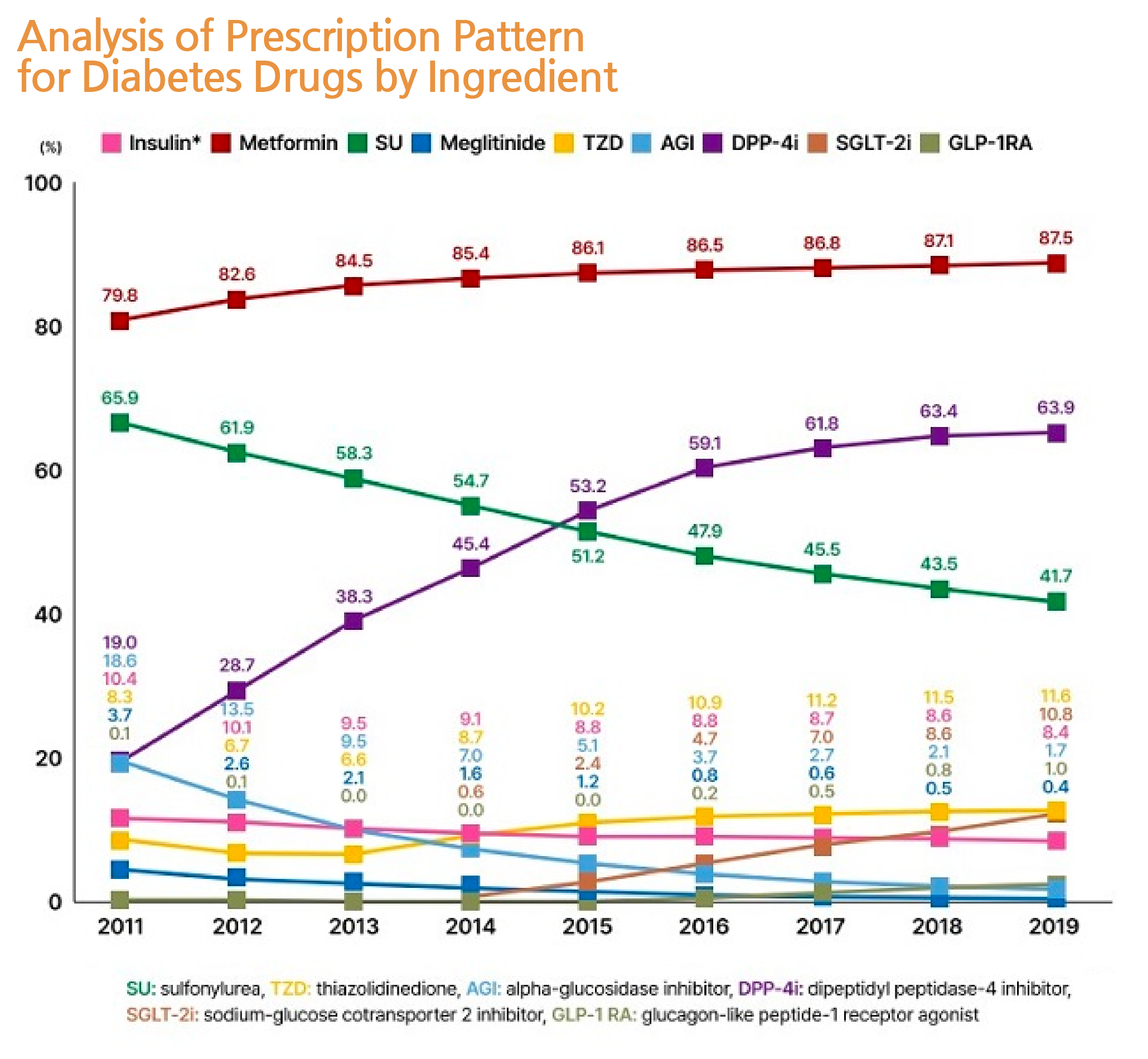
Although it had been the most-prescribed drug until 2009, the prescription rate of sulfonylurea started to slow down with the introduction of DPP-4 inhibitors.
Due to this the prescription rate of sulfonylurea class drugs, which had reached 75.8% in 2009, fell to 51.2% in 2015, and then was overtaken by sales of DPP-4 inhibitors.
Sales continued to decrease further to 41.7% in 2019.
On the other hand, SGLT-2 inhibitor class drugs have been rapidly increasing their influence since their introduction in 2014.
Their prescription rate, which had been only 2.4% in 2015, rose to 10.8% in 2019.
-

- 0
댓글 운영방식은
댓글은 실명게재와 익명게재 방식이 있으며, 실명은 이름과 아이디가 노출됩니다. 익명은 필명으로 등록 가능하며, 대댓글은 익명으로 등록 가능합니다.
댓글 노출방식은
댓글 명예자문위원(팜-코니언-필기모양 아이콘)으로 위촉된 데일리팜 회원의 댓글은 ‘게시판형 보기’와 ’펼쳐보기형’ 리스트에서 항상 최상단에 노출됩니다. 새로운 댓글을 올리는 일반회원은 ‘게시판형’과 ‘펼쳐보기형’ 모두 팜코니언 회원이 쓴 댓글의 하단에 실시간 노출됩니다.
댓글의 삭제 기준은
다음의 경우 사전 통보없이 삭제하고 아이디 이용정지 또는 영구 가입제한이 될 수도 있습니다.
-
저작권·인격권 등 타인의 권리를 침해하는 경우
상용 프로그램의 등록과 게재, 배포를 안내하는 게시물
타인 또는 제3자의 저작권 및 기타 권리를 침해한 내용을 담은 게시물
-
근거 없는 비방·명예를 훼손하는 게시물
특정 이용자 및 개인에 대한 인신 공격적인 내용의 글 및 직접적인 욕설이 사용된 경우
특정 지역 및 종교간의 감정대립을 조장하는 내용
사실 확인이 안된 소문을 유포 시키는 경우
욕설과 비어, 속어를 담은 내용
정당법 및 공직선거법, 관계 법령에 저촉되는 경우(선관위 요청 시 즉시 삭제)
특정 지역이나 단체를 비하하는 경우
특정인의 명예를 훼손하여 해당인이 삭제를 요청하는 경우
특정인의 개인정보(주민등록번호, 전화, 상세주소 등)를 무단으로 게시하는 경우
타인의 ID 혹은 닉네임을 도용하는 경우
-
게시판 특성상 제한되는 내용
서비스 주제와 맞지 않는 내용의 글을 게재한 경우
동일 내용의 연속 게재 및 여러 기사에 중복 게재한 경우
부분적으로 변경하여 반복 게재하는 경우도 포함
제목과 관련 없는 내용의 게시물, 제목과 본문이 무관한 경우
돈벌기 및 직·간접 상업적 목적의 내용이 포함된 게시물
게시물 읽기 유도 등을 위해 내용과 무관한 제목을 사용한 경우
-
수사기관 등의 공식적인 요청이 있는 경우
-
기타사항
각 서비스의 필요성에 따라 미리 공지한 경우
기타 법률에 저촉되는 정보 게재를 목적으로 할 경우
기타 원만한 운영을 위해 운영자가 필요하다고 판단되는 내용
-
사실 관계 확인 후 삭제
저작권자로부터 허락받지 않은 내용을 무단 게재, 복제, 배포하는 경우
타인의 초상권을 침해하거나 개인정보를 유출하는 경우
당사에 제공한 이용자의 정보가 허위인 경우 (타인의 ID, 비밀번호 도용 등)
※이상의 내용중 일부 사항에 적용될 경우 이용약관 및 관련 법률에 의해 제재를 받으실 수도 있으며, 민·형사상 처벌을 받을 수도 있습니다.
※위에 명시되지 않은 내용이더라도 불법적인 내용으로 판단되거나 데일리팜 서비스에 바람직하지 않다고 판단되는 경우는 선 조치 이후 본 관리 기준을 수정 공시하겠습니다.
※기타 문의 사항은 데일리팜 운영자에게 연락주십시오. 메일 주소는 dailypharm@dailypharm.com입니다.