- LOGIN
- MemberShip
- 2026-09-26 03:55:54
- Rare diseases still left neglected in Korea’s healthcare
- by Eo, Yun-Ho | translator Kim, Jung-Ju | 2023-05-04 05:49:58
Patients with rare diseases suffer due to the rarity of their disease.
Even when treatments are available, the drugs have difficulty receiving reimbursement as it is difficult to prove cost-effectiveness and predict financial expenditures for the drugs due to the small number of patients.
The government is well aware of such difficulties.
This is why it has attempted to improve access to rare disease treatments through various systemic improvements.
However, the situation has not improved much.
Among the 6,000 to 7,000 rare diseases known worldwide, only about 6% have available treatments developed.
This is because it is difficult to secure statistical significance of the data due to the small number of patients and limited clinical data.
This is why even the small number of rare diseases for which treatments have been developed is a pie in the sky in terms of reimbursement.
In this sense, the ‘Study on the current status of access to rare disease treatments in Korea and measures to strengthen their coverage' that was recently announced by Professor Jong-Hyeok Lee of Chung-Ang University College of Pharmacy is attracting attention.
Results of the study suggest that there are still many blind spots that remain unattended for rare disease treatments.
Reimbursement rate remains at 33% for orphan drugs ineligible for special calculation exemptions
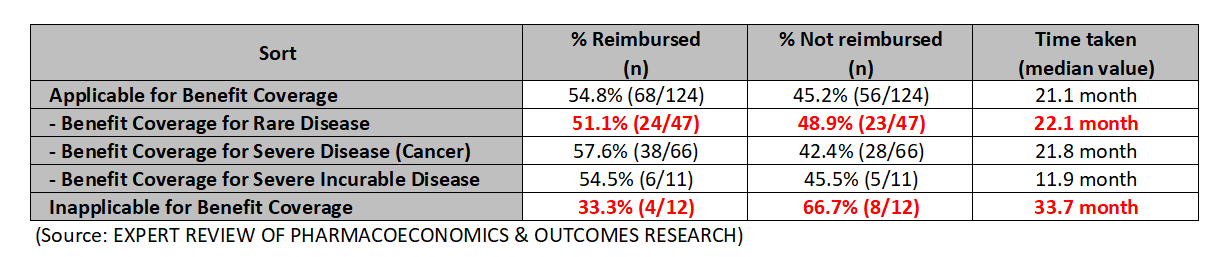
In the case of rare disease treatments, the rate is only 51%.
In particular, the rate for orphan drugs that are not subject to special calculation exemptions is only 33.3%, indicating the existence of the neglected areas, or blind spots that remain, in the area of rare diseases.
In addition, the period required for reimbursement was about 22 months for drugs subject to special calculation exemptions, while it was 34 months for those ineligible for special calculation exemptions, showing the significant difference.
Such results show that Korean patients' access to rare disease drugs is still limited, and the process is time-consuming.
◆Lacks application of RSA and PE exemptions

Reimbursement evaluation results of the drugs analyzed in the study showed that the special systems were mainly applied to anticancer drugs.
The RSA and PE exemptions were only applied to 30% and 22% of the rare disease drugs, respectively.
All in all, the limited scope of application of the special systems was affecting access to treatments for patients with rare diseases.
Supported by such study results, the industry has been requesting that the government allow individual deliberations to be made for drugs that are not subject to the special calculation exemption but are chronically debilitating diseases as orphan drugs not subject to the special calculation exemption system cannot receive the systemic benefits for reimbursement (only 2 products have received benefits from the system).
Meanwhile, the Ministry of Health and Welfare held public-private consultative body meetings to improve the drug pricing system with the National Health Insurance Service, Health Insurance Review and Assessment Service, and three pharmaceutical organizations.
After 5 meetings, the MOHW is known to be preparing to announce the final measure to improve the drug pricing system.
The ultimate purpose of preparing the 'Innovative New Drug Compensation Plan' by the 2nd Vice Minister Min-soo Park of the MOHW for the implementation of ‘Yoon Administration’s National Policy Tasts’ is not on increasing the value of drugs that are already reimbursed, but to fulfilling the fundamental purpose of allowing drugs that have not yet entered the system (received reimbursement benefits) to enter the system.
Therefore, to expand access to rare disease treatment as listed as a national task by the Yoon administration, it is hoped that a practical and effective systemic improvement will be made rather than superficial attempts.
-

- 0
댓글 운영방식은
댓글은 실명게재와 익명게재 방식이 있으며, 실명은 이름과 아이디가 노출됩니다. 익명은 필명으로 등록 가능하며, 대댓글은 익명으로 등록 가능합니다.
댓글 노출방식은
댓글 명예자문위원(팜-코니언-필기모양 아이콘)으로 위촉된 데일리팜 회원의 댓글은 ‘게시판형 보기’와 ’펼쳐보기형’ 리스트에서 항상 최상단에 노출됩니다. 새로운 댓글을 올리는 일반회원은 ‘게시판형’과 ‘펼쳐보기형’ 모두 팜코니언 회원이 쓴 댓글의 하단에 실시간 노출됩니다.
댓글의 삭제 기준은
다음의 경우 사전 통보없이 삭제하고 아이디 이용정지 또는 영구 가입제한이 될 수도 있습니다.
-
저작권·인격권 등 타인의 권리를 침해하는 경우
상용 프로그램의 등록과 게재, 배포를 안내하는 게시물
타인 또는 제3자의 저작권 및 기타 권리를 침해한 내용을 담은 게시물
-
근거 없는 비방·명예를 훼손하는 게시물
특정 이용자 및 개인에 대한 인신 공격적인 내용의 글 및 직접적인 욕설이 사용된 경우
특정 지역 및 종교간의 감정대립을 조장하는 내용
사실 확인이 안된 소문을 유포 시키는 경우
욕설과 비어, 속어를 담은 내용
정당법 및 공직선거법, 관계 법령에 저촉되는 경우(선관위 요청 시 즉시 삭제)
특정 지역이나 단체를 비하하는 경우
특정인의 명예를 훼손하여 해당인이 삭제를 요청하는 경우
특정인의 개인정보(주민등록번호, 전화, 상세주소 등)를 무단으로 게시하는 경우
타인의 ID 혹은 닉네임을 도용하는 경우
-
게시판 특성상 제한되는 내용
서비스 주제와 맞지 않는 내용의 글을 게재한 경우
동일 내용의 연속 게재 및 여러 기사에 중복 게재한 경우
부분적으로 변경하여 반복 게재하는 경우도 포함
제목과 관련 없는 내용의 게시물, 제목과 본문이 무관한 경우
돈벌기 및 직·간접 상업적 목적의 내용이 포함된 게시물
게시물 읽기 유도 등을 위해 내용과 무관한 제목을 사용한 경우
-
수사기관 등의 공식적인 요청이 있는 경우
-
기타사항
각 서비스의 필요성에 따라 미리 공지한 경우
기타 법률에 저촉되는 정보 게재를 목적으로 할 경우
기타 원만한 운영을 위해 운영자가 필요하다고 판단되는 내용
-
사실 관계 확인 후 삭제
저작권자로부터 허락받지 않은 내용을 무단 게재, 복제, 배포하는 경우
타인의 초상권을 침해하거나 개인정보를 유출하는 경우
당사에 제공한 이용자의 정보가 허위인 경우 (타인의 ID, 비밀번호 도용 등)
※이상의 내용중 일부 사항에 적용될 경우 이용약관 및 관련 법률에 의해 제재를 받으실 수도 있으며, 민·형사상 처벌을 받을 수도 있습니다.
※위에 명시되지 않은 내용이더라도 불법적인 내용으로 판단되거나 데일리팜 서비스에 바람직하지 않다고 판단되는 경우는 선 조치 이후 본 관리 기준을 수정 공시하겠습니다.
※기타 문의 사항은 데일리팜 운영자에게 연락주십시오. 메일 주소는 dailypharm@dailypharm.com입니다.