- LOGIN
- MemberShip
- 2026-09-25 06:34:50
- Industry anxiously awaits reimb of SGLT-2 inhibitors
- by Jung, Sae-Im | translator Kim, Jung-Ju | 2023-07-06 05:39:17
The largest barrier to their reimbursement is the concern over the enormous amount of fiscal spending the drugs will bring due to the broad target patient group.
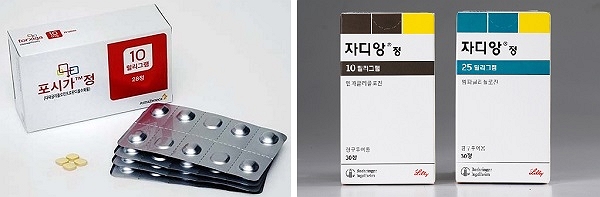
According to industry sources on the 4th, the representative SGLT-2 inhibitors ‘Forxiga (dapagliflozin)’ and ‘Jardiance (empagliflozin)’ are working to extend their reimbursement from diabetes to heart failure.
Forxiga has applied for the reimbursement of its heart failure reduced ejection fraction treatment indication and plans to apply for reimbursement of its heart failure with preserved ejection fraction indication that it has recently received approval for within the month.
Jardiance filed an application for the reimbursement of all types of heart failure regardless of ejection fraction.
In addition to diabetes, SLGT-2 inhibitors have already risen as the ‘backbone’ drug in heart failure as well.
Not only has the drugs demonstrated excellent effect in heart failure with reduced ejection fraction, but they also reduced the risk of cardiovascular death or exacerbation of heart failure in heart failure with preserved ejection fraction, an area for which no treatment option existed.
The rise of the two drugs has also changed the treatment guidelines for chronic heart failure.
In the 2022 AHA/ACC/HFSA Guideline for the Management of Heart Failure that the 3 major heart societies in the U.S.
– American College of Cardiology, American Health Association, and the Heart Failure Society of America – that was released last year, the societies gave a Class 2A recommendation for SGLT-2 inhibitors to treat heart failure with mild, reduced, preserved ejections.
The Korean Society of Heart Failure also recommended SGLT-2 inhibitors to reduce hospitalization or cardiovascular death due to heart failure in patients with preserved ejection fraction, regardless of diabetes mellitus (recommendation grade 1).
This is why experts have been emphasizing the need for the reimbursement of SGLR-2 inhibitors for heart failure.
At the Forxiga press conference hosted by AstraZeneca Korea on the 3rd, Professor Jong-Chan Youn of the Catholic University of Korea’s Seoul St.
Mary’s Hospital, said, “One out of four patients diagnosed with severe heart failure die within a year of hospitalization.
This is why these patients need to use a drug that shows a clear improvement in prognosis from the beginning, which is what SGLT-2 inhibitors do.
However, most outpatients do not use SGLT-2 inhibitors for their heart condition due to reluctance in using non-reimbursed treatment options.
These patients then experience gradually worsening symptoms and are in dire need of improvement in their prognosis, which is why the SGLT-2 inhibitors need to be reimbursed.” The concern is NHI finances.
A sizable amount of NHI finances need to be invested for their reimbursement extension to heart failure.
According to the Health Insurance Review and Assessment Service, the number of patients that received treatment for heart failure exceeded 150,000 in 2021.
This is a 35,000 increase from 5 years ago.
The number of patients with heart failure is expected to increase further due to the rapid population aging in Korea.
Seok-min Kang, President of KSHF (Professor of Cardiology at Yonsei Severance Hospital), said, “As the president of KSHF, I have actively expressed my opinion on extending reimbursement to new drugs for heart failure.
However, the government’s main concern is that too much finances will be spent due to the indiscriminate use of the drugs after reimbursement.
Academically, these are most definitely effective drugs, but the government is reluctant to grant reimbursement due to financial concerns.” The reimbursement of SGLT-2 inhibitors went through the same sluggish progress in diabetes as well.
SGLT-2 inhibitors are only allowed reimbursement in combination with some drugs such as metformin, and even these are limited to two-drug combinations.
It took 8 years of discussion and persuasion to extend reimbursement for SGLT-2 inhibitors in diabetes.
The health authorities had recently discussed reimbursement of heart failure treatment, but Entresto was the only drug that was granted reimbursement extensions.
The discussion ended with only a partial extension of the reimbursement standard for Entresto, a drug that is already receiving reimbursement for heart failure with reduced ejection fraction.
The authorities were unable to make a decision on the reimbursement extension for Forxiga and Jardiance.
Pharmaceutical companies claim that granting reimbursement of SGLT-2 inhibitors will result in the saving of health insurance finances as they will be provided at cheaper prices than existing treatments.
They are referring to the price of Entresto, which is priced at KRW 1,774 per tablet.
Taken twice a day, Entresto costs KRW 3548 a day.
On the other hand, Jardiance (KRW 660) and Forxiga (KRW 734), which are taken once a day, are 1/5 the price of Entresto.
However, unlike Entresto, which is only reimbursed for heart failure with reduced ejection fraction, SGLT-2 inhibitors treat all heart failures, therefore, their cheaper price cannot directly translate to financial savings.
Also, the recent ‘4 pillars’ strategy that has been presented for heart failure combines the use of 'ARNI/ACEI', 'beta blockers', ''mineralocorticoid receptor antagonists', and 'SGLT-2 inhibitors,’ therefore, the SGLT-2 inhibitors cannot act as a direct substitute for Entresto.
Adding on to the injury, Forxiga is embroiled in a drug price reduction lawsuit with the health authorities.
Therefore, there also is an opinion that it would be realistically difficult to extend its reimbursement until the lawsuit is completed.
Nevertheless, the societies emphasized the need for the government to actively establish comprehensive management measures for chronic diseases, including heart failure.
Kang said, “As much as it is important for pharmaceutical companies and the government to reach a consensus, the government also needs to pay more attention and enable the use of good treatments for chronic conditions to be used with reimbursement.”
-

- 0
댓글 운영방식은
댓글은 실명게재와 익명게재 방식이 있으며, 실명은 이름과 아이디가 노출됩니다. 익명은 필명으로 등록 가능하며, 대댓글은 익명으로 등록 가능합니다.
댓글 노출방식은
댓글 명예자문위원(팜-코니언-필기모양 아이콘)으로 위촉된 데일리팜 회원의 댓글은 ‘게시판형 보기’와 ’펼쳐보기형’ 리스트에서 항상 최상단에 노출됩니다. 새로운 댓글을 올리는 일반회원은 ‘게시판형’과 ‘펼쳐보기형’ 모두 팜코니언 회원이 쓴 댓글의 하단에 실시간 노출됩니다.
댓글의 삭제 기준은
다음의 경우 사전 통보없이 삭제하고 아이디 이용정지 또는 영구 가입제한이 될 수도 있습니다.
-
저작권·인격권 등 타인의 권리를 침해하는 경우
상용 프로그램의 등록과 게재, 배포를 안내하는 게시물
타인 또는 제3자의 저작권 및 기타 권리를 침해한 내용을 담은 게시물
-
근거 없는 비방·명예를 훼손하는 게시물
특정 이용자 및 개인에 대한 인신 공격적인 내용의 글 및 직접적인 욕설이 사용된 경우
특정 지역 및 종교간의 감정대립을 조장하는 내용
사실 확인이 안된 소문을 유포 시키는 경우
욕설과 비어, 속어를 담은 내용
정당법 및 공직선거법, 관계 법령에 저촉되는 경우(선관위 요청 시 즉시 삭제)
특정 지역이나 단체를 비하하는 경우
특정인의 명예를 훼손하여 해당인이 삭제를 요청하는 경우
특정인의 개인정보(주민등록번호, 전화, 상세주소 등)를 무단으로 게시하는 경우
타인의 ID 혹은 닉네임을 도용하는 경우
-
게시판 특성상 제한되는 내용
서비스 주제와 맞지 않는 내용의 글을 게재한 경우
동일 내용의 연속 게재 및 여러 기사에 중복 게재한 경우
부분적으로 변경하여 반복 게재하는 경우도 포함
제목과 관련 없는 내용의 게시물, 제목과 본문이 무관한 경우
돈벌기 및 직·간접 상업적 목적의 내용이 포함된 게시물
게시물 읽기 유도 등을 위해 내용과 무관한 제목을 사용한 경우
-
수사기관 등의 공식적인 요청이 있는 경우
-
기타사항
각 서비스의 필요성에 따라 미리 공지한 경우
기타 법률에 저촉되는 정보 게재를 목적으로 할 경우
기타 원만한 운영을 위해 운영자가 필요하다고 판단되는 내용
-
사실 관계 확인 후 삭제
저작권자로부터 허락받지 않은 내용을 무단 게재, 복제, 배포하는 경우
타인의 초상권을 침해하거나 개인정보를 유출하는 경우
당사에 제공한 이용자의 정보가 허위인 경우 (타인의 ID, 비밀번호 도용 등)
※이상의 내용중 일부 사항에 적용될 경우 이용약관 및 관련 법률에 의해 제재를 받으실 수도 있으며, 민·형사상 처벌을 받을 수도 있습니다.
※위에 명시되지 않은 내용이더라도 불법적인 내용으로 판단되거나 데일리팜 서비스에 바람직하지 않다고 판단되는 경우는 선 조치 이후 본 관리 기준을 수정 공시하겠습니다.
※기타 문의 사항은 데일리팜 운영자에게 연락주십시오. 메일 주소는 dailypharm@dailypharm.com입니다.