- LOGIN
- MemberShip
- 2026-09-23 09:16:38
- ‘Concerned about Korea’s stroke treatment system’
- by Son, Hyung-Min | translator Kim, Jung-Ju | 2024-02-15 05:58:55
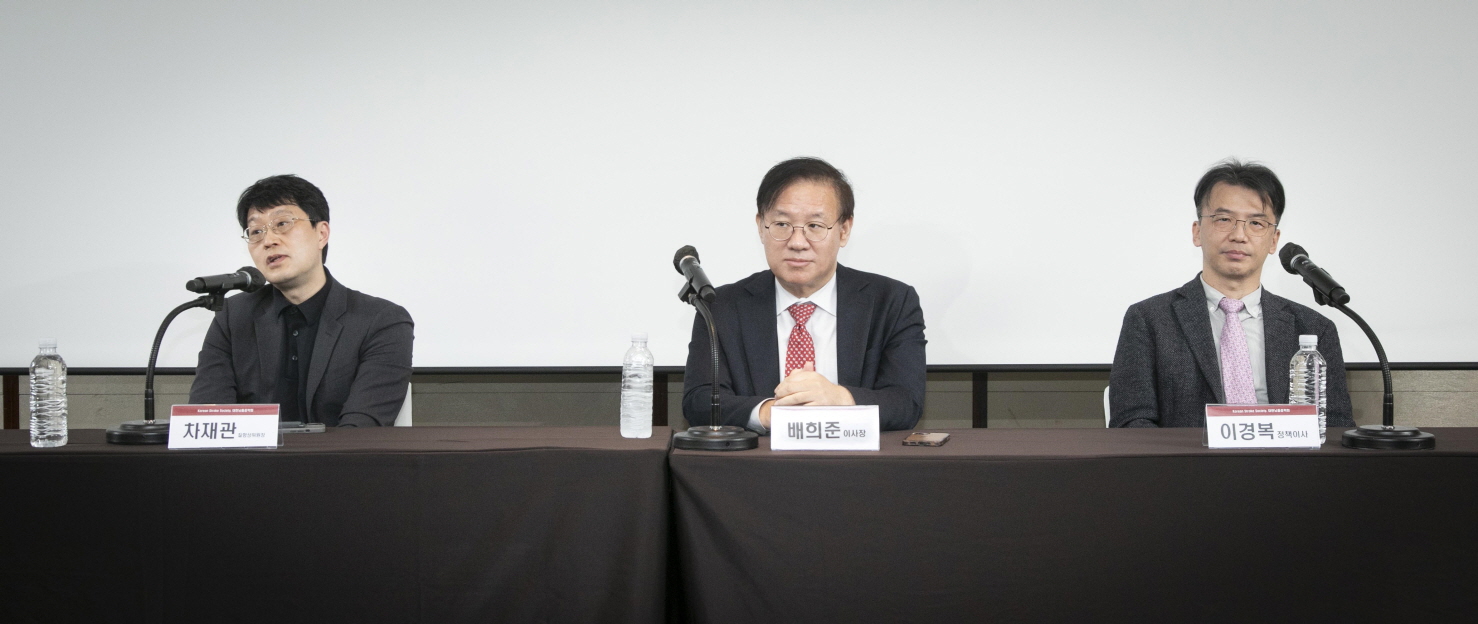
Jae-Kwan Cha (Director, Quality Improvement Committee, KSS), Hee-Joon Bae (President, KSS), Kyung Bok Lee (Director, Policy Making Committee, KSS), The government announced the initiation of a pilot project to lay the foundation for a stroke care system, but its lack of content is being criticized by the academic society.
Academics have suggested that securing human resources, establishing a compensation system, and revising the stroke disease group classification system should be made first for the establishment of any system.
The Korean Stroke Society held a press conference at the Westing Chosun Hotel in Seoul on the 14th to explain its views.
At the conference, Dr.
Tae-jung Kim, Director of the Public Relations Committee (Department of Neurology, Seoul National University Bundang Hospital), pointed out that the number of stroke cases will continue to increase in Korea as the nation has become a super-aged society, but the lack of personnel for its care has not been addressed still.
Kim said, “There are still many weak spots in stroke care in Korea.
In one area where half of all stroke patients live, final stroke treatments such as intravenous thrombolysis and intra-arterial thrombectomy are not available.” According to Statistics Korea, Korea will enter the super-aged society later this year.
By 2050, the country is expected to have about 20 million people aged 65 and older.
Last year, 180,000 people had strokes, and the number is expected to soar to 340,000 by 2050 with population aging.
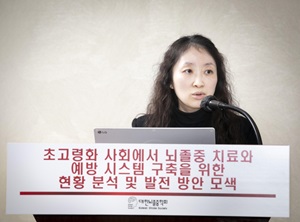
In some regional cardiocerebrovascular disease centers, one specialist treats 400 to 500 stroke patients.” The government has announced that it will promote the "Cardiocerebrovascular Disease Problem-Solving Treatment Cooperation Network Health Insurance Pilot Project," a network-building and support project to encourage active communication and decision-making among medical institutions and specialists for stroke patients, and the "Essential Medical Care Package" to solve local essential medical care issues.
More specifically, the government proposed policies to improve the training environment and expand essential medical care and personnel.
However, the KSS stressed that before such measures, the number of on-call doctors and policy fee categories should be increased, and regional centers be expanded.
Dr.
Jae-Kwan Cha, Director of the Quality Improvement Committee at KSS (Department of Neurology, Dong-a Univ.
Hospital), said, “The current number of stroke specialists falls short of the minimum number of people required to operate a stable medical system.
The treatment system will collapse when we enter a super-aged society with the current level of specialists." "There are about 86 specialists in 74 university hospitals, but the number of specialists needs to be increased to 160 to ensure a stable personnel pool.
If the government wants to build a specialist-centered medical care system, increasing the number of neurology specialists related to essential medical care should be a priority." Dr.Kyung Bok Lee, Director of the Policy Making Committee at KSS criticized how Korea currently classifies stroke as a general medical condition category and emphasized the need to revise it and move it to a specialized medical condition category.
Lee said, “It's no secret that stroke is an essential critical emergency disease.
Stroke is a severe condition.
Nearly 80% of patients suffer from sequelae and need to be treated promptly.
Currently, only a small proportion of stroke patients who undergo surgery or procedures are categorized as specialty care patients.” "This is why we need to classify stroke as a specialty disease to ensure that it is not neglected at tertiary hospitals that treat most of the acute stroke patients are often treated."
-

- 0
댓글 운영방식은
댓글은 실명게재와 익명게재 방식이 있으며, 실명은 이름과 아이디가 노출됩니다. 익명은 필명으로 등록 가능하며, 대댓글은 익명으로 등록 가능합니다.
댓글 노출방식은
댓글 명예자문위원(팜-코니언-필기모양 아이콘)으로 위촉된 데일리팜 회원의 댓글은 ‘게시판형 보기’와 ’펼쳐보기형’ 리스트에서 항상 최상단에 노출됩니다. 새로운 댓글을 올리는 일반회원은 ‘게시판형’과 ‘펼쳐보기형’ 모두 팜코니언 회원이 쓴 댓글의 하단에 실시간 노출됩니다.
댓글의 삭제 기준은
다음의 경우 사전 통보없이 삭제하고 아이디 이용정지 또는 영구 가입제한이 될 수도 있습니다.
-
저작권·인격권 등 타인의 권리를 침해하는 경우
상용 프로그램의 등록과 게재, 배포를 안내하는 게시물
타인 또는 제3자의 저작권 및 기타 권리를 침해한 내용을 담은 게시물
-
근거 없는 비방·명예를 훼손하는 게시물
특정 이용자 및 개인에 대한 인신 공격적인 내용의 글 및 직접적인 욕설이 사용된 경우
특정 지역 및 종교간의 감정대립을 조장하는 내용
사실 확인이 안된 소문을 유포 시키는 경우
욕설과 비어, 속어를 담은 내용
정당법 및 공직선거법, 관계 법령에 저촉되는 경우(선관위 요청 시 즉시 삭제)
특정 지역이나 단체를 비하하는 경우
특정인의 명예를 훼손하여 해당인이 삭제를 요청하는 경우
특정인의 개인정보(주민등록번호, 전화, 상세주소 등)를 무단으로 게시하는 경우
타인의 ID 혹은 닉네임을 도용하는 경우
-
게시판 특성상 제한되는 내용
서비스 주제와 맞지 않는 내용의 글을 게재한 경우
동일 내용의 연속 게재 및 여러 기사에 중복 게재한 경우
부분적으로 변경하여 반복 게재하는 경우도 포함
제목과 관련 없는 내용의 게시물, 제목과 본문이 무관한 경우
돈벌기 및 직·간접 상업적 목적의 내용이 포함된 게시물
게시물 읽기 유도 등을 위해 내용과 무관한 제목을 사용한 경우
-
수사기관 등의 공식적인 요청이 있는 경우
-
기타사항
각 서비스의 필요성에 따라 미리 공지한 경우
기타 법률에 저촉되는 정보 게재를 목적으로 할 경우
기타 원만한 운영을 위해 운영자가 필요하다고 판단되는 내용
-
사실 관계 확인 후 삭제
저작권자로부터 허락받지 않은 내용을 무단 게재, 복제, 배포하는 경우
타인의 초상권을 침해하거나 개인정보를 유출하는 경우
당사에 제공한 이용자의 정보가 허위인 경우 (타인의 ID, 비밀번호 도용 등)
※이상의 내용중 일부 사항에 적용될 경우 이용약관 및 관련 법률에 의해 제재를 받으실 수도 있으며, 민·형사상 처벌을 받을 수도 있습니다.
※위에 명시되지 않은 내용이더라도 불법적인 내용으로 판단되거나 데일리팜 서비스에 바람직하지 않다고 판단되는 경우는 선 조치 이후 본 관리 기준을 수정 공시하겠습니다.
※기타 문의 사항은 데일리팜 운영자에게 연락주십시오. 메일 주소는 dailypharm@dailypharm.com입니다.